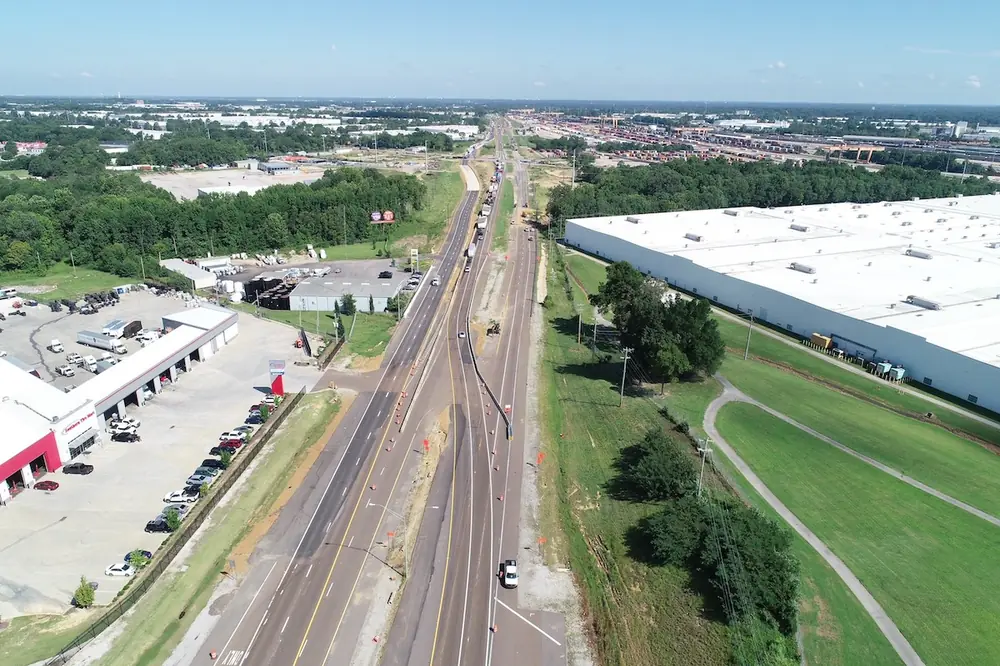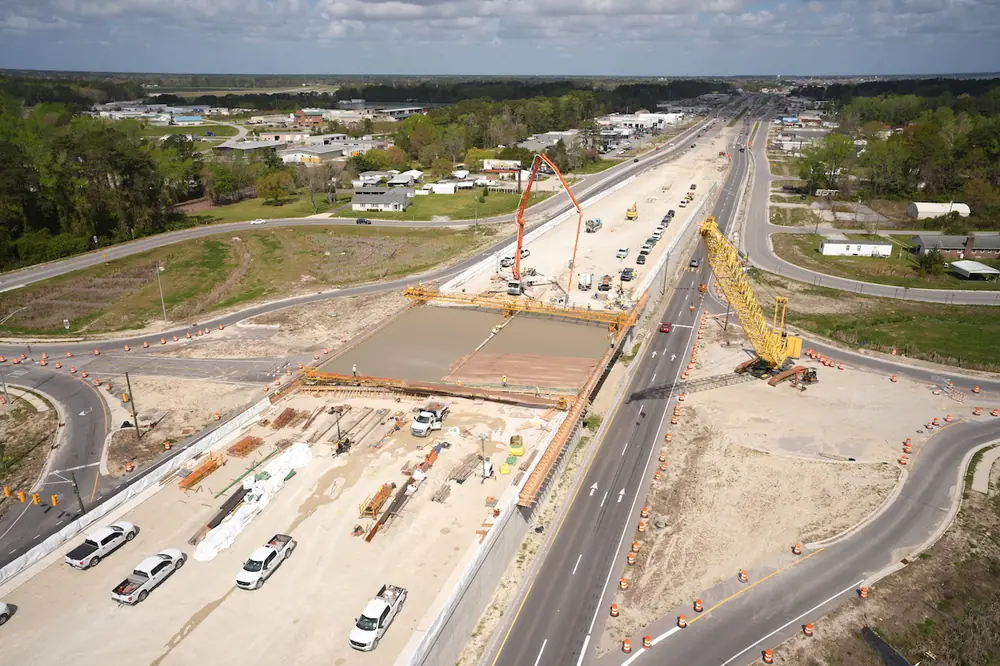
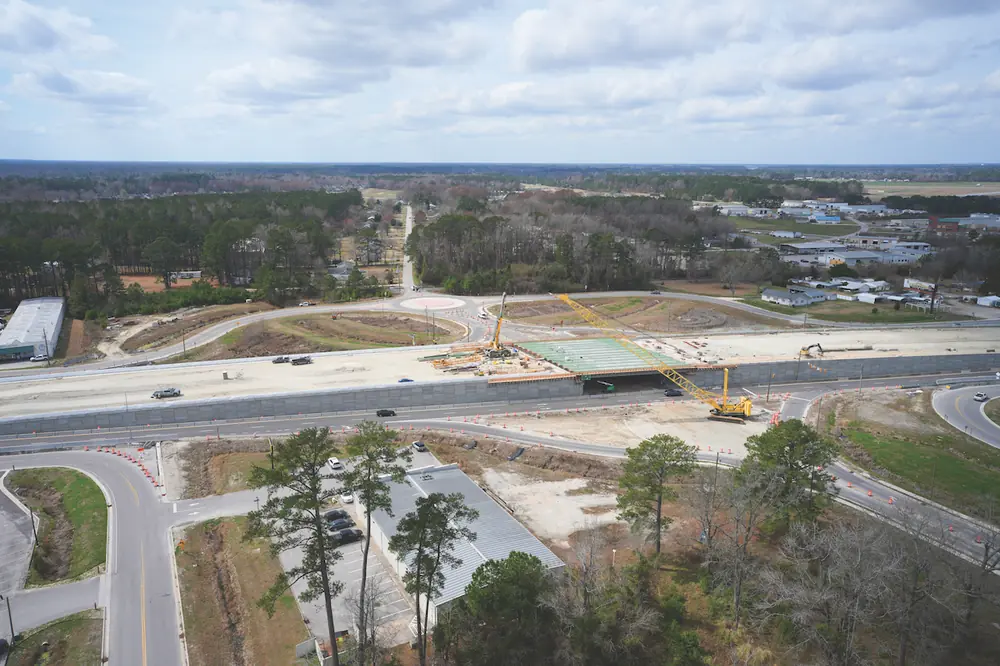
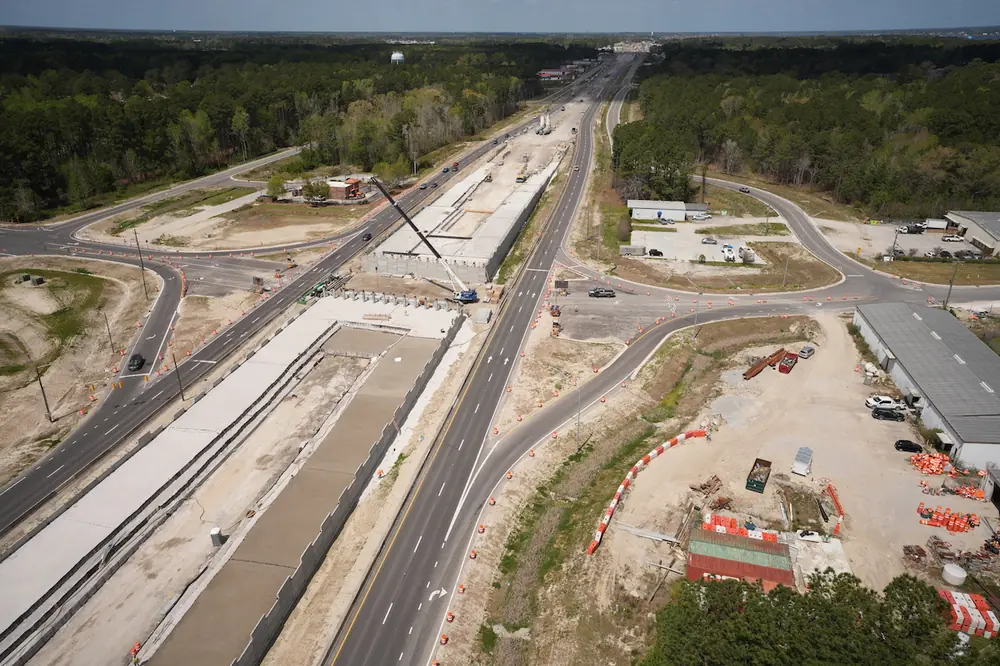
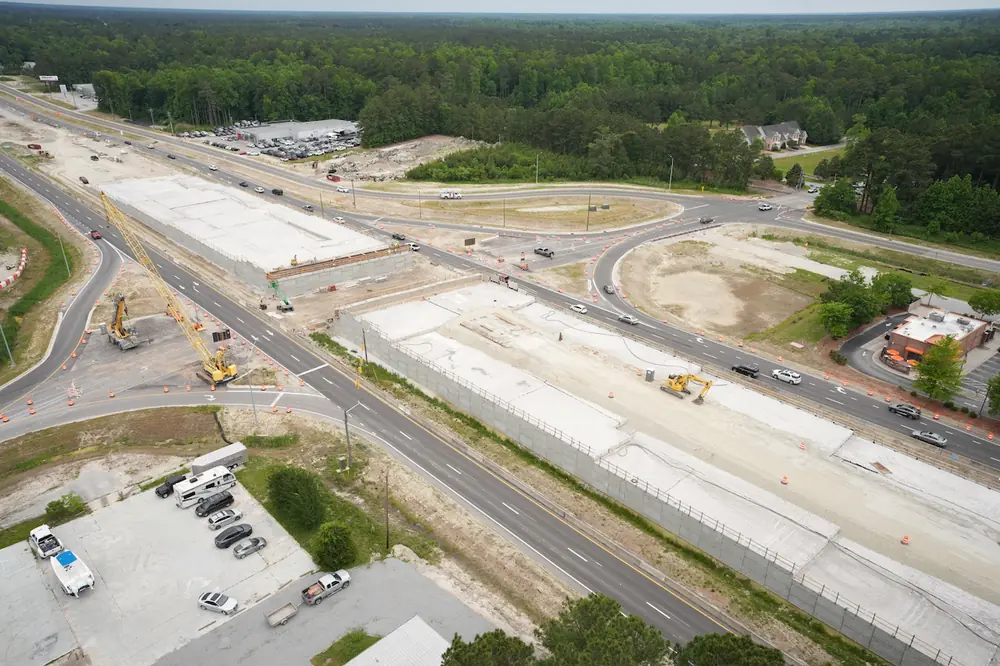
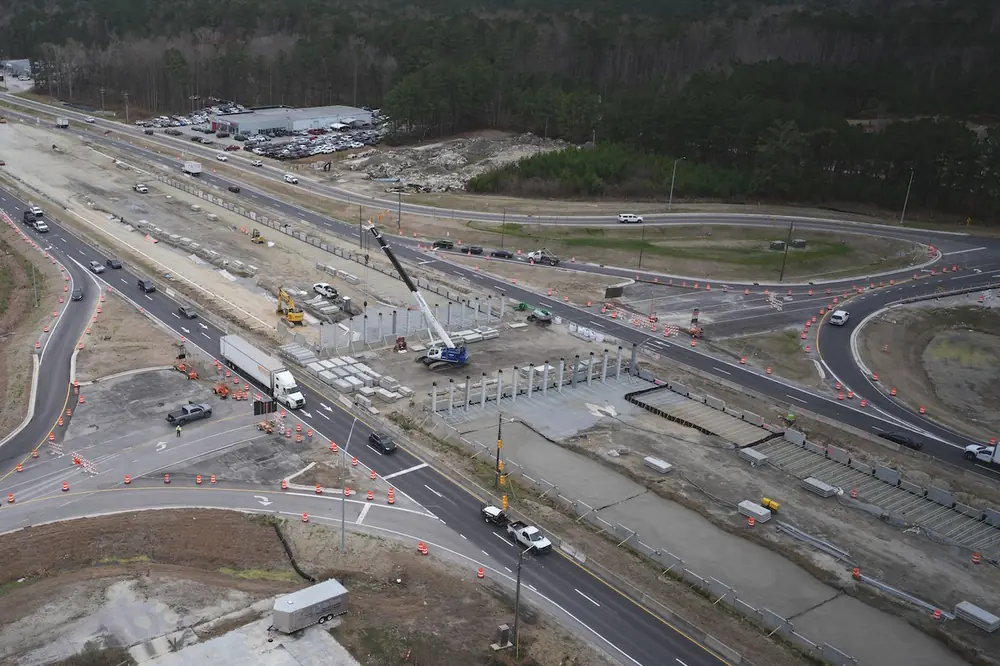
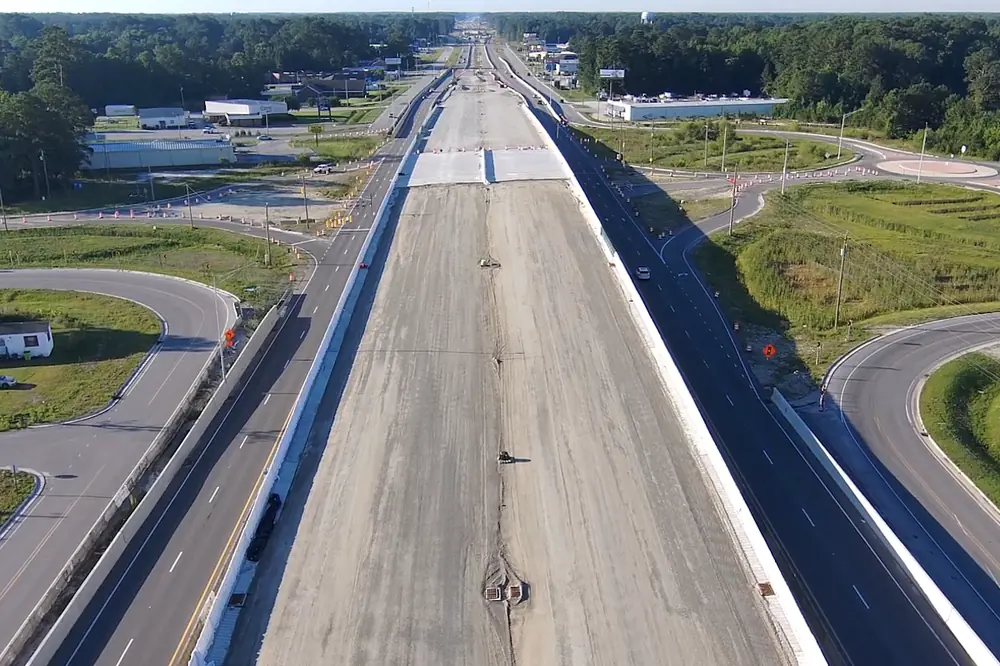
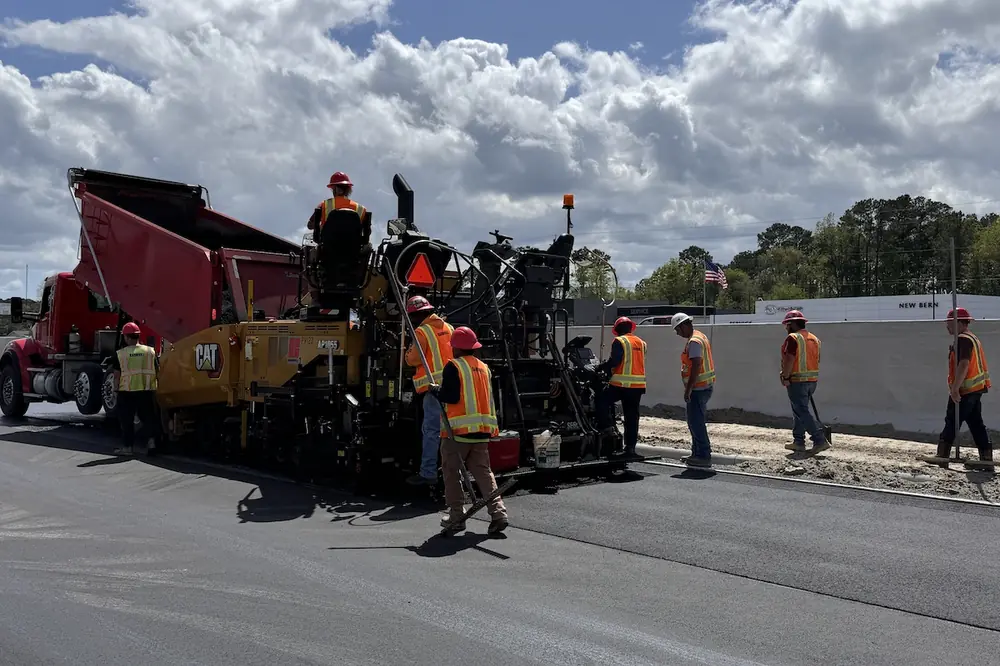

The North Carolina Department of Transportation (NCDOT) is eliminating five traffic signals along 5.1 miles of U.S. 70 through James City, converting the heavily traveled route to interstate standards to improve safety, traffic flow, and capacity while advancing future Interstate 42.
Balfour Beatty is delivering the design-build project with lead designer STV.
“U.S. 70 provides an important connection between the Port of Morehead City, military bases in Havelock and Goldsboro, and the Global TransPark in Kinston,” said Veronica Scott, Public Information Officer for NCDOT Divisions 2 and 3. “The interstate designation will benefit military interconnectivity, aid in economic development, create jobs, and stimulate growth in travel and tourism.”
The team is replacing five at-grade intersections with interchanges and rebuilding or realigning service roads on a corridor carrying about 53,000 vehicles per day, 7 percent of them trucks.
Squeezed between the Neuse River, an active railroad, and Coastal Carolina Regional Airport, crews must elevate U.S. 70 over five crossroads without taking a principal eastern North Carolina route out of service.

| Your local Volvo Construction Equipment dealer |
|---|
| Tyler Equipment |
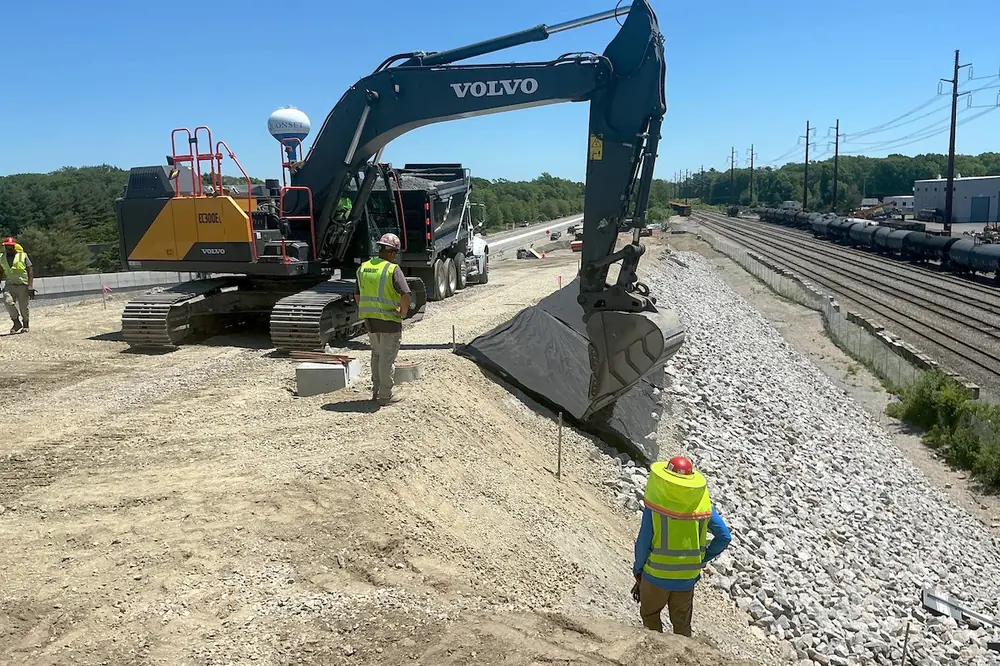
Beneath the highway, weak coastal soils prompted the project’s defining operation — approximately 250,000 cubic yards of lightweight cellular concrete, the largest deployment in NCDOT history.
Construction began in spring 2022 under a $203 million design-build award that included construction, design, and right of way services. NCDOT reported the work approximately 68 percent complete as of this writing. Added work has brought the current construction cost to approximately $233.8 million. The department’s $322.2 million total also includes property acquisition and utility relocation. The anticipated completion is in summer 2028.
When completed, the roadway will have four divided lanes and a 46-foot grass median from east of Thurman Road to Garner Road. Between Garner Road and the Neuse River Bridge, six lanes will flank a 22-foot paved median and concrete barrier.
“Projected traffic volume dictates the number of lanes,” Scott said. “Roundabouts were used in combination with compressed diamond interchanges to minimize the roadway footprint and the need for signals.”

| Your local Case Construction Equipment Inc dealer |
|---|
| Beauregard Equipment |
| Monroe Tractor |
The river, railroad, airport, flood-prone ground, utilities, and roadside development leave little room for conventional widening.
“These issues result in a very narrow footprint for the project, requiring the team to use the existing U.S. 70 footprint where possible,” Scott said. “The project plan included a critical sequence of operations built around an outside-in construction approach.”
Balfour Beatty and lead designer STV begin that sequence by building or relocating service roads and ramps. The team then activates new utilities, retires old utilities, installs drainage, performs earthwork, shifts traffic outward, and enters the existing U.S. 70 footprint.
Balfour Beatty initially expected to begin at the Grantham Road interchange and advance toward Airport and Williams roads.

| Your local Hyundai dealer |
|---|
| Equipment East |
“The design-build nature of the U.S. 70 James City project has allowed Balfour Beatty to be proactive and collaborative with STV and its subconsultants to explore alternative staging scenarios,” said Josh Sommer, Senior Project Manager for Balfour Beatty. “When utility challenges arose on Williams and Airport, we revised the project staging immediately to proceed with delivery operations at the Taberna and Thurman interchanges instead.”
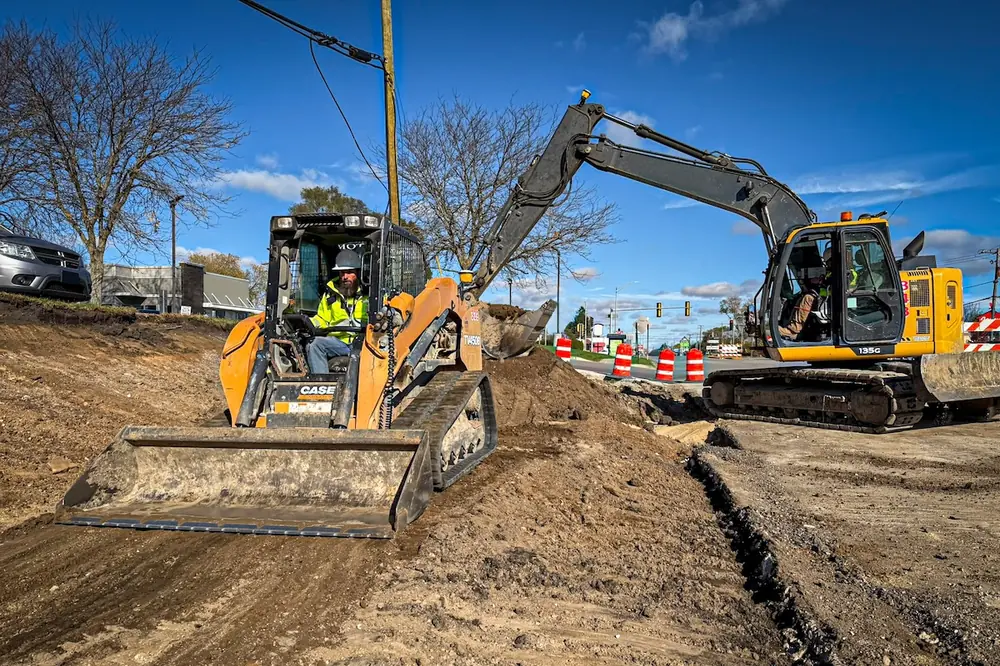
Balfour Beatty is self-performing roadway, structural, and intelligent transportation system work, including approximately 76,000 linear feet of storm drainage. The narrow work area requires staged pipe installation so crews can preserve positive drainage and traffic flow as the highway rises.
Compressible coastal soils created the project’s central geotechnical problem. NCDOT estimated that conventional embankment could produce nearly 20 inches of settlement in some locations.
Alternatives included excavation and granular replacement; wick drains, surcharge, and waiting periods; lightweight aggregate; geofoam; column-supported embankments; and foamed lightweight concrete.

| Your local Trimble Construction Division dealer |
|---|
| SITECH Northeast |
The team selected lightweight cellular concrete, a mixture of cement, water, and foaming agent that provides fill strength at a fraction of the weight of conventional material. Crews place it in lifts about 2.5 to 3 feet deep.
“MixOnSite has provided a full-service batch plant that produces and pumps the lightweight cellular concrete into position at each of the interchanges,” Sommer said. “The material sets up overnight but doesn’t gain full strength for 28 days.”
The lighter fill cuts the load imposed on the weak subgrade and reduces the settlement period from about 280 days with traditional fill to approximately 90 days. Onsite production also avoids an estimated 20,000 truck trips carrying conventional material, limiting construction traffic on a route already handling heavy commuter and seasonal demand.
“The department is monitoring settlement at the fill sites and ensuring that strength requirements are met,” Scott said. “No long-term structural performance issues are expected at these sites.”

| Your local Wirtgen America dealer |
|---|
| United Construction & Forestry |
| WI Clark |
Piezometers, inclinometers, and settlement gauges report continuously. The design limits settlement to less than 2 inches over 15 years. Crews monitor unit weight during production, while quality-control and quality-assurance cylinder breaks verify compressive strength.
Keeping U.S. 70 open required temporary reduced conflict intersections. Balfour Beatty constructed retaining walls between the highway and service roads and used conventional and lightweight fill to create temporary alignments. Portions will become the final ramps.
Each major switch combined roadway, signal, and traffic-control work within a tightly controlled window. Existing asphalt was wedged into the new alignment, while old signals were deactivated as new signals came online. The first major traffic switch of 2025 had to be completed in one weekend before Memorial Day restrictions took effect.
“The traffic switches involved years of careful planning around the use of a reduced conflict intersection concept, which improves traffic flow while the project is under construction,” Sommer said. “Progress was carefully monitored throughout the process at critical junctions to ensure the work came off without a hitch.”

| Your local Esco Corporation dealer |
|---|
| Genalco |
The pattern directs side-street motorists to turn right and use a downstream U-turn rather than cross U.S. 70.
“The temporary reduced conflict intersections have allowed better traffic progression along U.S. 70 than the previous eight-phase signals,” Scott said. “Video detection for these signals has proven challenging, with frequent recalibration required.”
Public comments have been mixed, with generally positive responses to communication about access and traffic impacts. NCDOT and the contractor maintain customer access and deliveries while announcing closures and configuration changes through project updates, email, social media, and roadside information.
Balfour Beatty classifies live traffic alongside construction’s traditional Fatal Four hazards, making it the company’s fifth fatal risk. At James City, that designation influences staging, temporary geometry, and motorist communication.
| Your local Volvo Construction Equipment dealer |
|---|
| Tyler Equipment |
HAAS Safety Cloud technology sends real-time, location-specific alerts through compatible navigation systems and mobile devices. The warnings supplement signs, email, social media, and NCDOT’s public information program. Across three active North Carolina projects, including James City, the system delivered 334,000 digital alerts along 22 miles of roadway in 2025.
“I firmly believe the live traffic-related best practices implemented by Balfour Beatty have drastically improved the safety of our workers by reducing their exposure to vehicle traffic,” Sommer said. “Although we will never know the full scope of the incidents prevented, we can point to reduced vehicle accident frequency and improved traffic flow as meaningful indicators of the initiative’s success.”
Temporary barriers separate routine construction from motorists where the constrained right of way allows. Using the future ramps as temporary U.S. 70 lanes creates protected space for elevated mainline work.
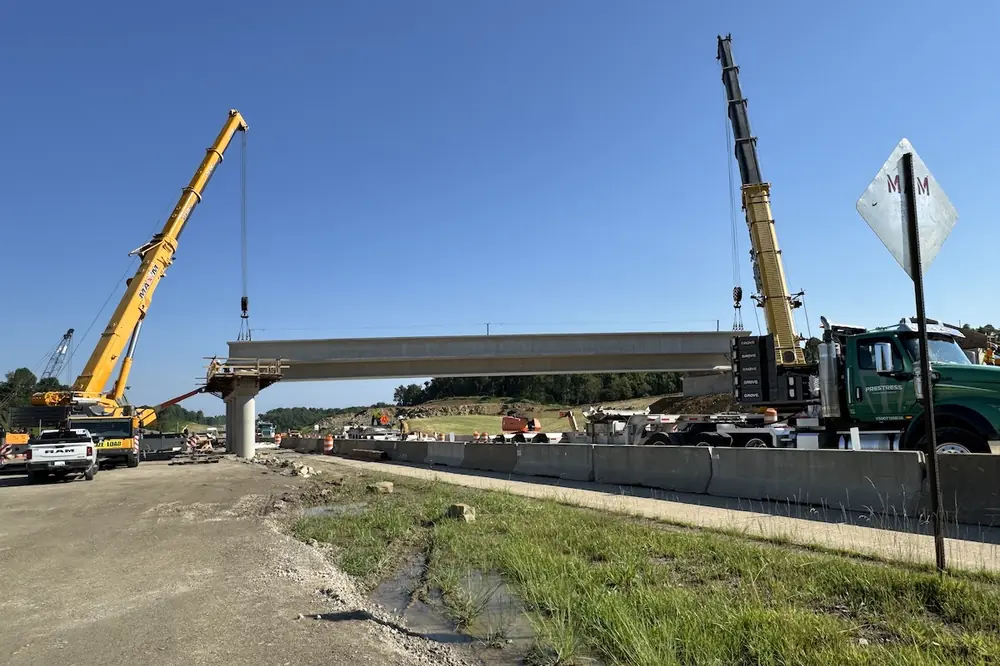
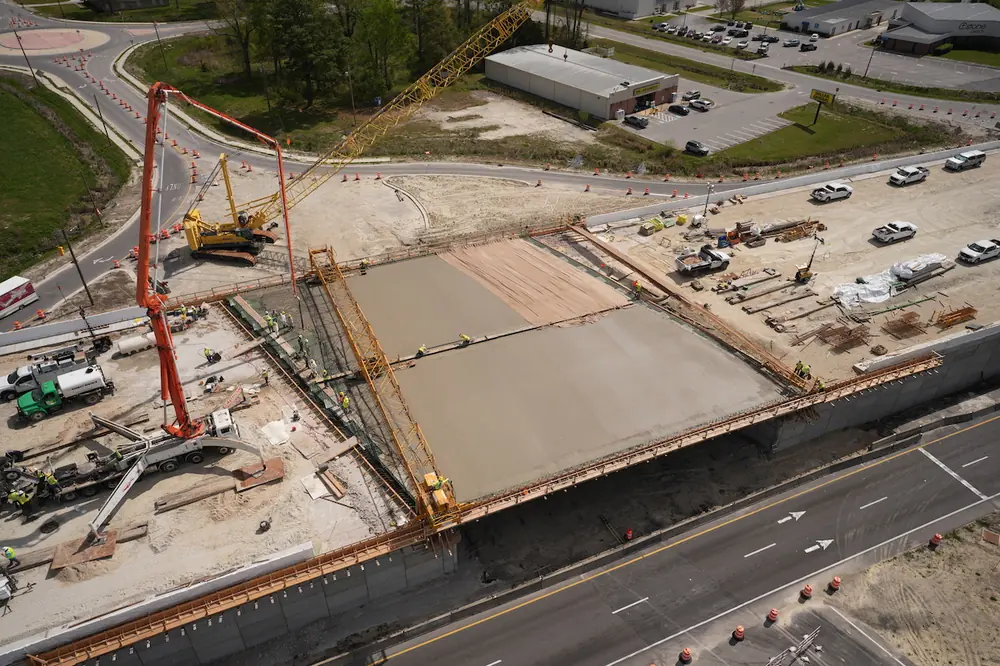
Five single-span bridges will carry U.S. 70 over Taberna Way, Thurman Road, Grantham Road, Airport Road, and Williams Road. Each structure uses driven steel H-pile foundations, precast girders, and precast deck panels supplied by Coastal Precast Systems.
| Your local Volvo Construction Equipment dealer |
|---|
| Tyler Equipment |
“Although the bridges are single span, the decks are skewed and exceptionally wide, with dual crown points that required dual finishing heads and a high rate of concrete placement,” Sommer said. “The Airport [Road] interchange incorporates staged loop ramps that require additional temporary and permanent retaining walls and careful coordination of traffic movements.”
S&W Ready Mix Concrete supplies the cast-in-place deck concrete. Airport Road’s traffic pattern changes as each portion of the interchange becomes available.
NCDOT Division 2 manages design review. Balfour Beatty handles construction quality control, while GFT, the department’s onsite engineering representative, performs quality assurance. The arrangement leaves day-to-day production with the design-builder while preserving an independent check on materials and completed work.
The project is part of NCDOT’s effort to bring U.S. 70 between Interstate 40 in Garner and the Port of Morehead City to interstate standards. Congress designated the route a high-priority future interstate in 2015.
| Your local Volvo Construction Equipment dealer |
|---|
| Tyler Equipment |
Balfour Beatty has submitted information supporting a contract-time extension, which NCDOT was still reviewing. Remaining work includes completing the elevated roadway and bridges, moving traffic into final interchange configurations, and finishing ramps and roundabouts.
The methods developed in James City could extend beyond this 5-mile job, particularly as owners seek to reduce work zone exposure before construction begins.
“Balfour Beatty will continue to focus on incorporating ‘Safety by Design’ into future design-build pursuits,” Sommer said. “Public and workforce safety must be prioritized during the design phase, when it can make the greatest impact with the least cost or time investment before putting boots on the ground.”
- Owner: North Carolina Department of Transportation
- Design-Builder: Balfour Beatty Infrastructure Inc., Wilmington, North Carolina
- Lead Designer: STV, Raleigh, North Carolina
- Construction Quality Assurance: GFT, Raleigh, North Carolina
- Lightweight Cellular Concrete: MixOnSite USA Inc., Buffalo Grove, Illinois
- Precast Bridge Components: Coastal Precast Systems LLC, Chesapeake, Virginia
- Ready-Mix Concrete: S&W Ready Mix Concrete Co. LLC, Clinton, North Carolina
- Subcontractors: Barnhill Contracting Company, Rocky Mount, North Carolina; Blount-Sanford Contracting Co. Inc., Lilburn, Georgia; Bullington Construction Inc., Oakboro, North Carolina; Crawler Pipeline Services LLC, Maysville, North Carolina; Curtin Co. LLC, Charlotte, North Carolina; Delta Contracting Inc., Haw River, North Carolina; Evergreen Seed Co. LLC, Fuquay-Varina, North Carolina; Hendrix-Barnhill Co. Inc., Greenville, North Carolina; Mountain Creek Contractors Inc., Catawba, North Carolina; National Erectors Rebar Inc., Lumberton, North Carolina; Newcon Inc., Rocky Mount, North Carolina; Razorback Boring Inc., Morrisville, North Carolina; RoadSafe Traffic Systems Inc., Apex, North Carolina; Sadler Landscaping LLC, Plymouth, North Carolina; Stay Alert Safety Services, Kernersville, North Carolina; T&H Electrical Corporation, Wilson, North Carolina; Traffic Control Safety Services Inc., Winston-Salem, North Carolina