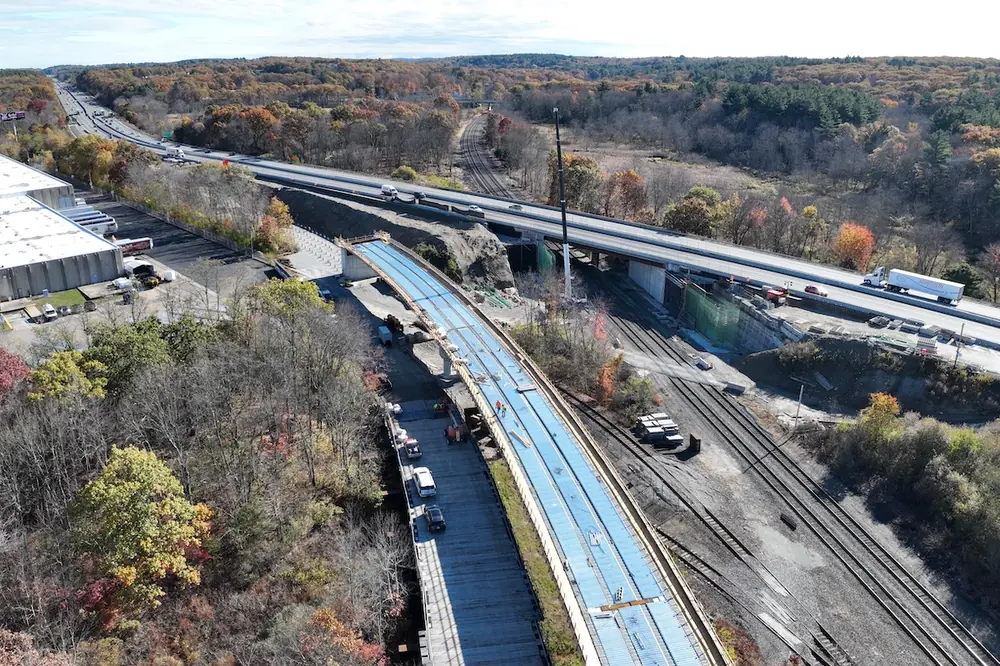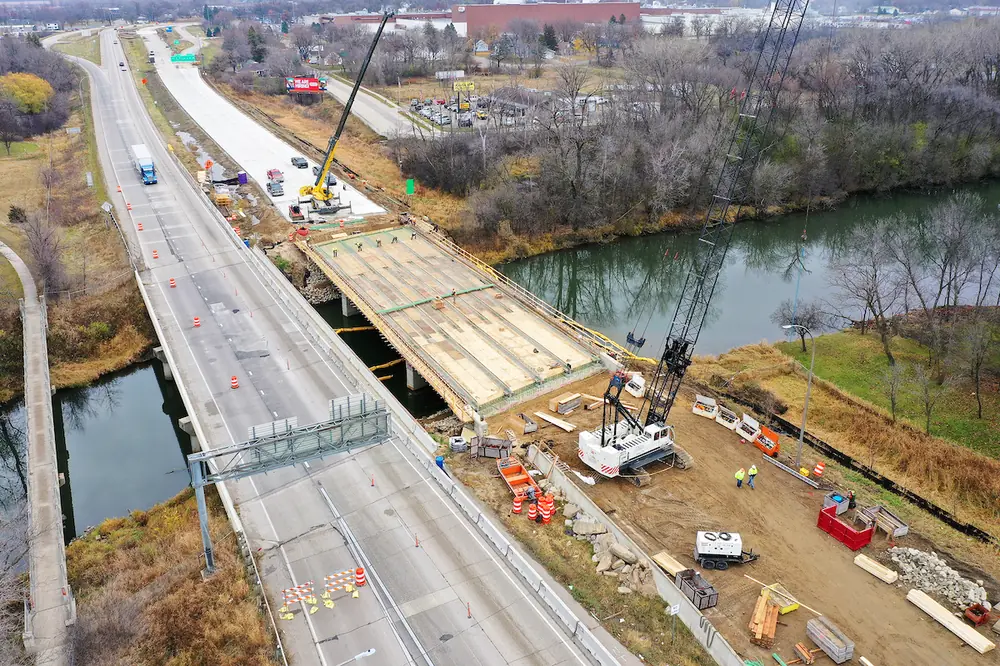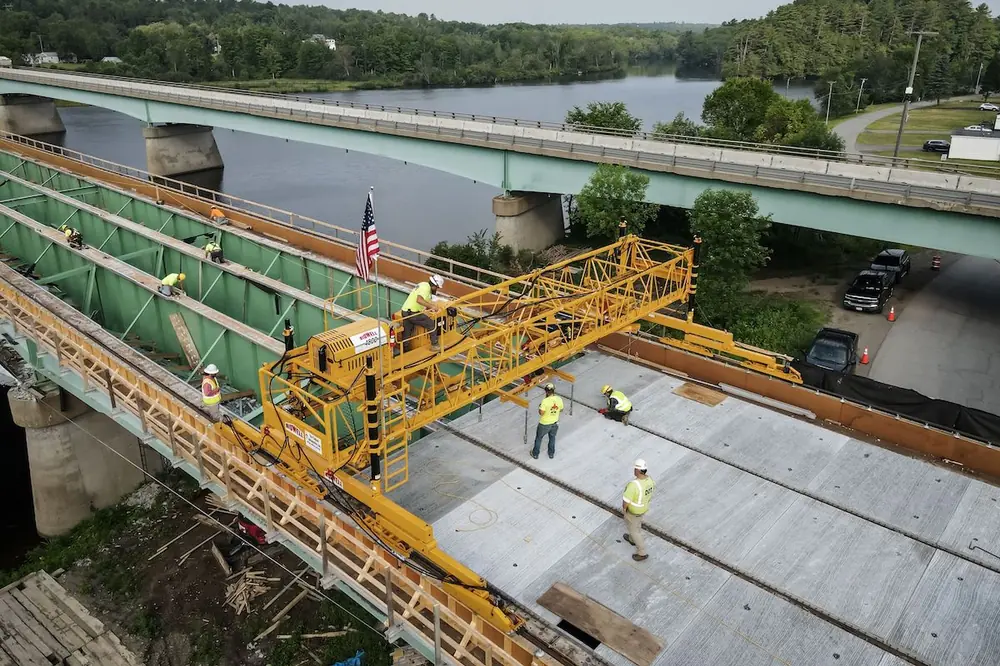

MEDWAY, ME — Necessity is the mother of invention. New England Infrastructure Inc. (NEI) of Hudson, Massachusetts, embodies this saying with bidding replacement of the five bridges for the Medway, Maine, I-95 Bridge Deck Replacement project. The two largest decks measure over 1,000 feet long, and an industry trend that requires the underneath side of the bridge deck to be visible added to the project’s complexity.
This meant stay-in-place deck pans were not an option. Either a cast-in-place method or precast concrete panels were needed for replacement of the nearly 60-year-old northbound and southbound lanes of the I-95 Vaughan Daggett Memorial Bridge over the Penobscot River.
“We had the option of using either method for the two bridges over the Penobscot River, so we planned to use precast panels. We petitioned MaineDOT [Maine Department of Transportation] to use precast panels for the 341-foot-long Route 157 bridge over I-95, and this request was approved,” said Jared Barczak, Executive Project Manager at NEI. Using precast concrete panels increases deck construction efficiency.
Cast-in-place requires forms to be built and then removed after the deck is placed, taking several months to complete.
“We are using cast-in-place for this bridge," said Steve Mullins, NEI Superintendent of the Amoskeag Bridge Rehabilitation project in New Hampshire. "We started deck forms at the beginning of May [2025], and we got our last placement the first week in November."

| Your local Wirtgen America dealer |
|---|
| United Construction & Forestry |
| WI Clark |
| Dobbs Equipment (SC) |
Precast panels can be placed much quicker and require less rebar material.
“Because they are prestressed, this eliminates the majority of the bottom rebar from the decks, so you’re going to see time savings there,” said Ben Rickson, NEI Superintendent on the Medway project.
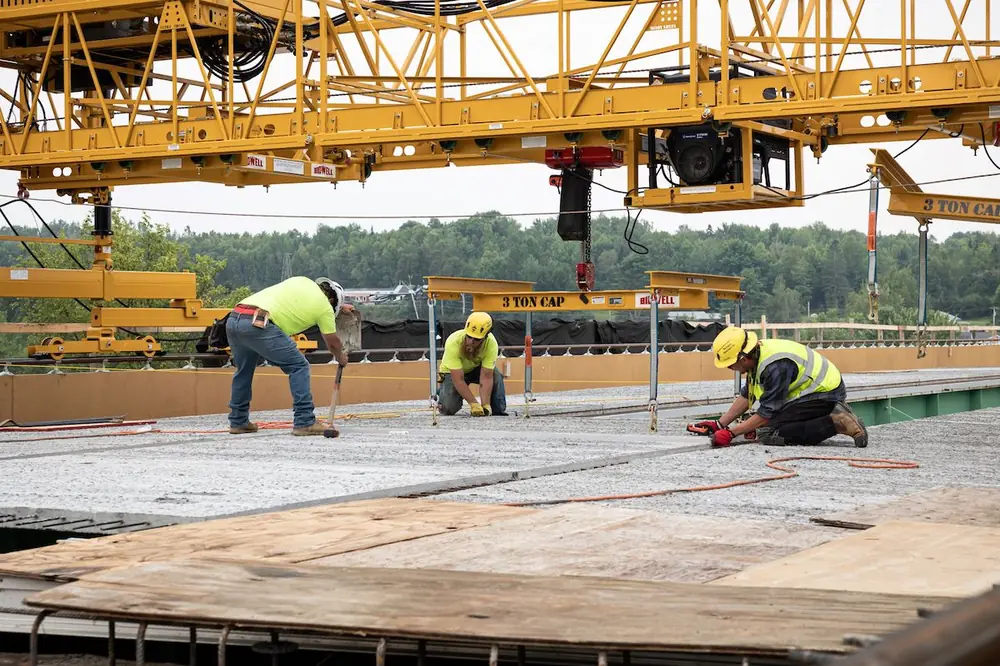
At 5,000 psi and 3.5 inches thick, these precast panels weigh roughly 3,500 pounds each. On previous projects where NEI used the panels, including the Route 157 bridge, they were able to access the bridge deck from both ends and the middle from adjacent bridges.
“Contractors typically use a large crane to set these panels, but panel weight can max out crane capacity at a couple of hundred feet, making it a challenge to get panels to the middle of longer bridges,” said Mark Rhead, Sales Manager for Bid-Well.

| Your local Hyundai dealer |
|---|
| Equipment East |
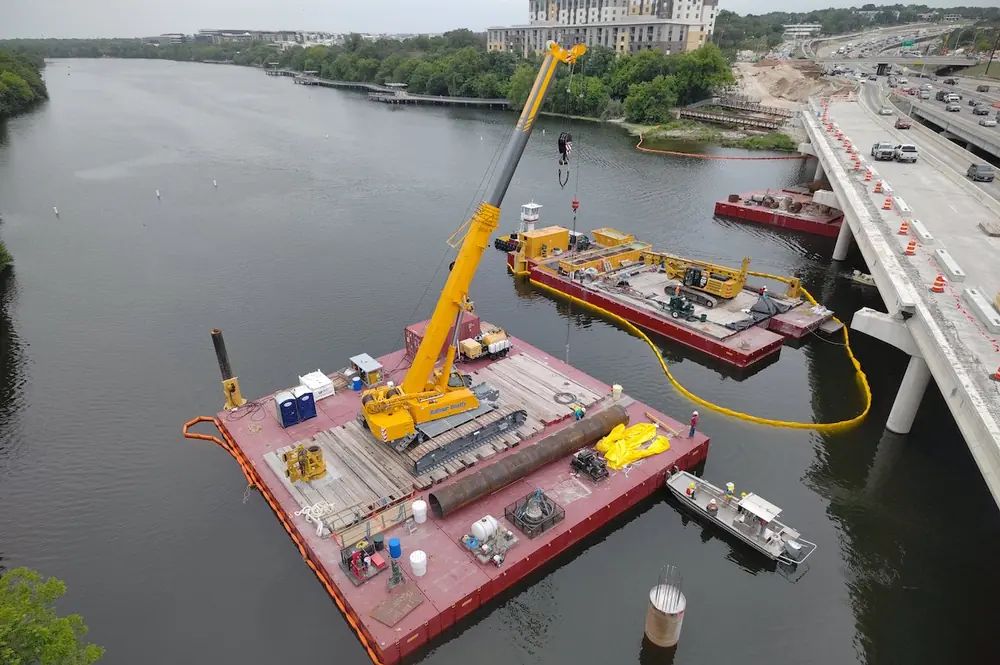
This was the case in 2025, when NEI replaced the northbound lanes. They could not block the southbound lanes for a crane to reach the middle of the bridge. Initial consideration was to place the panels from a barge. However, this posed a logistical challenge fraught with expense.
“You are triple handling every panel, unloading it from the truck, getting out to the barge, and then placing it with a crane,” Barczak said. “We just saw expenses with the barge, crane, and triple handling material, and we said, ‘There’s got to be a better way.’”
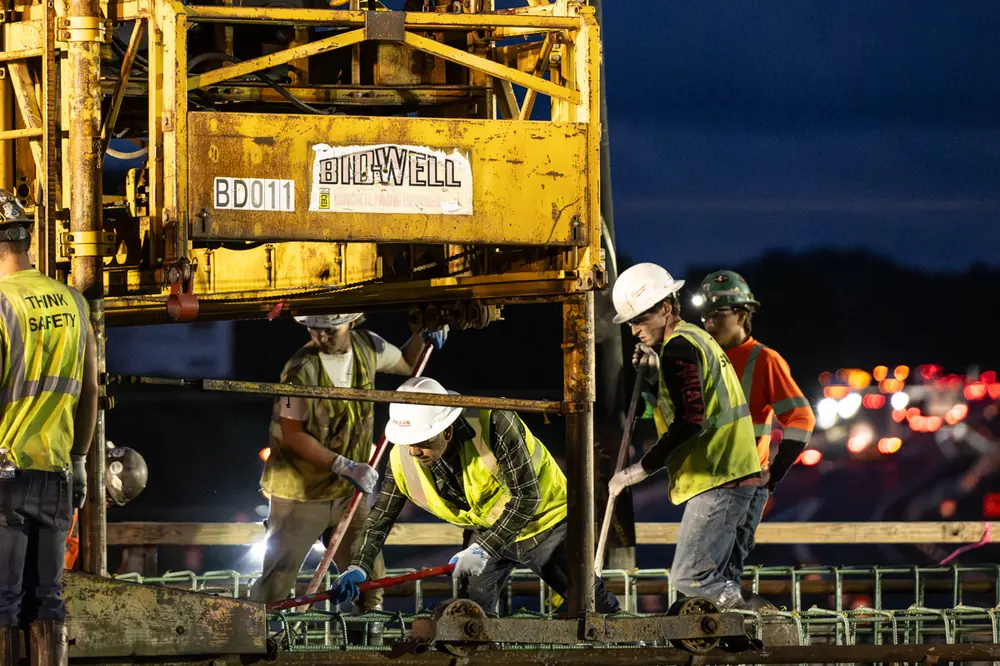
The NEI team had an idea using a Bid-Well paver as a gantry crane to carry and place the deck panels. In early 2024, NEI management met with Bid-Well representatives to discuss their concept.
“It was an interesting idea, as the overhang brackets, rails, and paver are already there,” said Averitt "Drew" Johns, Design Engineer for Bid-Well. “So, it was a matter of replacing the paving carriage with something that could be used to place the panels and making sure the frame and leg system of the paver could handle the weight.”

| Your local Volvo Construction Equipment dealer |
|---|
| Tyler Equipment |
Design concept started with the 4800 paver constructed of lightweight, ultrahigh-strength steel.
“We also looked at an eight-wheel bogie system to match the wheel load of the 3600 paver NEI was using to pave the deck’s surface layer, so that would limit the need to upgrade the overhang brackets,” Johns added.
By the summer of 2024, Bid-Well engineers had finished the design, and NEI gave approval for the build. The Bid-Well MT-1 model was designed to deliver precise panel movement. Its stationary power unit serves as the central energy source and operational control to drive machine travel, trolley movement, elevation adjustments, and any powered accessories.
Instead of a paving carriage, three contiguous material transport trollies and hoists, powered by an auxiliary generator, were placed on the truss frame.

| Your local Trimble Construction Division dealer |
|---|
| SITECH Northeast |
“Each trolley is connected to the machine’s standard chain power transmission system for smooth and consistent movement across the span,” Johns said.
“The MT-1 design allows for up to three panels to be moved at one time, whereas a crane can only place one at a time, so this increases efficiency,” Rhead added.
With machine production finished, NEI management, including Barczak, traveled to South Dakota in February 2025 to see it operate.
“Bid-Well has a good engineering team, but we were impressed by the attention to detail put in this model,” Barczak said. “They not only took the added step of addressing everything we could potentially ask but also how it could be transformed to incorporate moving other materials in the future.”

| Your local Esco Corporation dealer |
|---|
| Genalco |
It wasn’t until after the trip to South Dakota that NEI asked for the ability to move rebar bundles. However, Bid-Well had already anticipated that need and was able to have that design, the MT-2, ready for the I-95 bridge project.
“Bridge construction is more than paving, and Bid-Well is more than a paver. The MT Series is our answer to the evolving material movement needs of contractors,” Rhead said.
NEI took delivery of the MT-1 and deployed it to the Medway site in mid-July 2025. The 36-foot-wide, 1,050-foot-long bridge required 408 precast deck panels. The panels measured 3.5 inches thick and 8 feet long, but panel width varied.
“As the flanges narrow, the panels get wider to maintain a 2-inch overlap,” Rickson said. “We had approximately 23 different panel types on this project.”

| Your local Case Construction Equipment Inc dealer |
|---|
| Beauregard Equipment |
| Monroe Tractor |
NEI’s MT-1 panel carrier was configured with three hoists to place up to three panels at a time. Being the first time using the machine, crews took care to ensure precise placement and crew safety. The machine backed up over the panels, in which a single panel was attached to each hoist. The panels were transported to location at a height of 12 inches.
“The MT-1 is capable of 100-foot lifting heights with speeds reaching 21 feet per minute,” Johns said. “The system supports a maximum load of 15,000 pounds across three trollies and can span up to 120 feet with longer configurations available.”
One operating safety aspect stands out to Rickson.
“It’s hard for the crew to miss the panel carrier when it’s coming down the bridge,” he said. “Plus, you don’t have to look overhead like you do with a crane.”
| Your local Wirtgen America dealer |
|---|
| United Construction & Forestry |
| WI Clark |
| Dobbs Equipment (SC) |
NEI’s team placed all deck panels in about three weeks, even with the first time using the machine. This innovative solution helped to increase efficiency over the potentially more expensive barge-crane option.
“With the expense, we never really did a true comparison of one method to the other. Our consideration focused on the worth of having a second Bid-Well in our fleet,” Barczak said. “Based on the performance of the MT-1, it was worth it to order a paving carriage for the machine to have a complete single unit.”
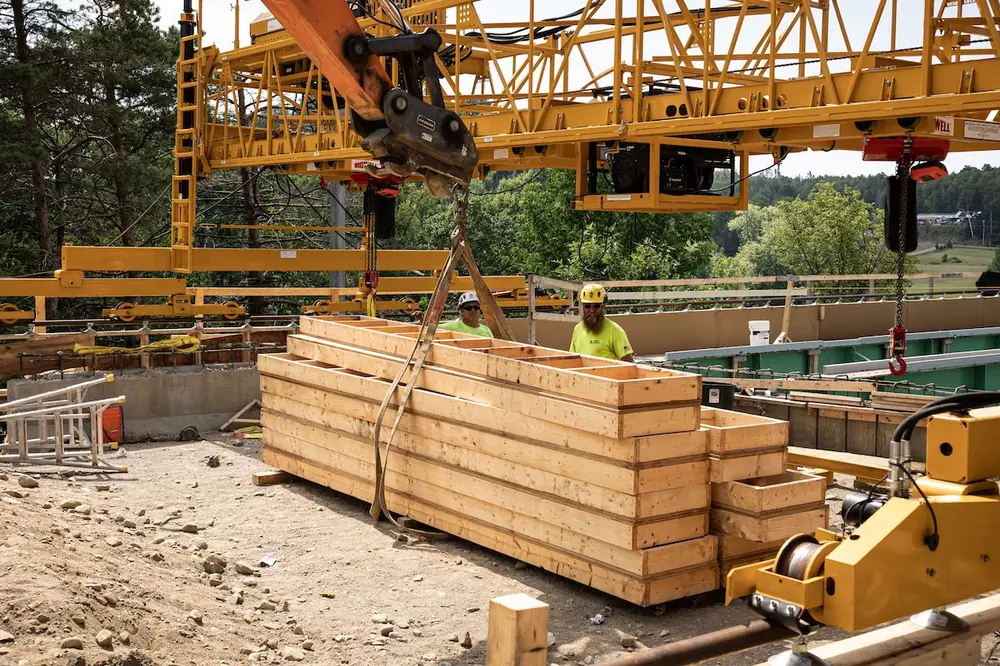
Cast-in-place construction for the Amoskeag Bridge required significantly more rebar than in Medway. NEI moved its Bid-Well MT-1 to Manchester, New Hampshire, and converted it to the MT-2 configuration for rebar placement required for the 645 feet of bridge deck over the river.
“With deck panels, you are only doing one rebar mat, since half the rebar is in the precast panel. Less rebar is brought on the bridge, and there’s less to tie, so you can stage it in advance,” Mullins said. “Here we have two layers and a little over 100 tons of rebar that had to be installed on the deck.”
| Your local Wirtgen America dealer |
|---|
| United Construction & Forestry |
| WI Clark |
| Dobbs Equipment (SC) |
NEI’s contract with its subcontractor, WWR Placement LLC of Lafayette, Louisiana, requires the rebar to be placed within 50 feet of where it is to be installed. Without the MT-2, Mullins estimated five to six workers for roughly four weeks to place the rebar.
“With workers carrying rebar, you have to split up every bundle, as they can only carry four or five pieces at a time,” he said. “This opens up the chance of mislabeling it and putting it in the wrong place.”
Johns said that in its rebar carrier configuration, the machine can "just drop out the trollies and have the hydraulic ram to raise and lower a pivot bar that swivels 360 degrees to place the full bundle."
“You just flip the switch, the hydraulic ram comes down, you strap up the bundle, and hit the switch again to lift the bundle,” Mullins added. The machine can lift and place up to 6,000-pound rebar bundles.
| Your local Wirtgen America dealer |
|---|
| United Construction & Forestry |
| WI Clark |
| Dobbs Equipment (SC) |
The flexibility provided by NEI’s new rebar carrier opened the schedules of the crew that would have been dedicated to rebar placement.
“With the rebar carrier, we spent about an hour a day with two guys moving a handful of bundles that kept the ironworkers going for a few days,” Mullins said. “Everyone was impressed with it. All around, it was a home run.”