
CONCORD, NH — A lack of sufficient transportation funding, further hampered by significant highway construction inflation will make it difficult to address New Hampshire’s top transportation needs and to adequately maintain and improve the state’s roads and bridges. This is according to a new report released by TRIP, a Washington, D.C.-based national transportation research nonprofit.
The TRIP report, titled “Keeping New Hampshire Mobile: Providing a modern, sustainable transportation system in the Granite State,” examines road and bridge conditions, traffic safety, traffic congestion, and funding needs in the state and identifies the 25 most needed transportation projects in New Hampshire, many of which lack sufficient funding to proceed. In addition to statewide data, the report also includes breakdowns for the Merrimack Valley and the Seacoast region.
This report identifies the 25 most needed transportation priorities in the state, many of which lack funding to proceed. A summary of the top 10 projects is below, with a more detailed list of all 25 projects included in the body of the report.
- Ten-Year Transportation Improvement Plan - $4.5 billion: The state’s Ten-Year Transportation Plan (TYP) contains both preservation and maintenance projects and capital projects to address safety, capacity, and improved mobility throughout the state.
- Reconstruction of Exits 6 & 7 on I-293 in Manchester - $280 million: Exit 6 is one of the most hazardous interchanges in the state with many crashes occurring at its southbound on-ramp. Exit 7 is currently a half interchange. Full access is needed to create economic opportunities for the local communities. Current Turnpike revenue does not support construction of this project.
- I-93 widening from south of I-89 to Merrimack River Bridge in Bow-Concord - $780 million: This 6.5-mile corridor has high levels of congestion, high crash rates, short acceleration and deceleration lengths, and Red Listed Bridges. Current Turnpike revenue does not support construction of this project.
- NH 125 capacity and traffic management improvements from Brickyard Plaza to NH 87 in Epping - $22.8 million: NH 125 experiences high congestion levels along this nearly 3-mile, heavily developed corridor. Intersection and driveway safety improvements are also needed. $11 million has been removed from this project due to fiscal constraints.
- Intersection improvements along NH 25 at Sheridan Road and Redding Lane in Moultonborough - $3.4 million: The current intersections pose geometry, crash history, and turning movements issues, affecting overall safety. $1.1 million has been removed from this project due to fiscal constraints.
- Pavement rehabilitation on I-93 from MM 116.1 to 125, including ramps at Exits 38 through 42 - $50 million: This 9-mile section of I-93 was built in the 1960s and needs pavement rehabilitation to allow for future preservation measures. $49 million has been removed from this project due to fiscal constraints. Work has not started.
- Safety and multimodal improvements to King Street (U.S. 3) between High Street and U.S. 3/U.S. 4 intersection in Boscawen - $10.5 million: This heavily developed corridor, which serves a large rural area north of the state capital, is in need of access management, multi-modal improvements, and a major intersection improvement at U.S. 3 and U.S. 4. $9.7 million has been removed from this project due to fiscal constraints.
- Complete streets improvements from Indian Brook Drive to Innovation Drive on NH 108 in Dover, Somersworth, and Rochester - $71 million: This mixed-use developed corridor continues to see growth, with high traffic volumes and moderate pedestrian activity along the 5-mile stretch. Additional capacity at intersections and increased pedestrian elements are needed. $59 million has been removed from this project due to fiscal constraints.
- Safety improvements at U.S. 3A/River Road and U.S. 3A/Grandview Road in Bow - $4 million: Safety improvements are needed along this corridor, which provides access to heavy commercial development and is a link between Concord and Manchester. $2.9 million has been removed from this project due to fiscal constraints.
- Phase III of East Coast Greenway to construct rail trail on abandoned Hampton Branch rail corridor - $7.6 million: This 2.3-mile trail is an important project to improve multimodal movements along the Seacoast. When complete, this four-phase trail project will connect Portsmouth, New Hampshire, to Salisbury, Massachusetts.
Funding constraints and inflation in highway construction costs will make it challenging for the New Hampshire Department of Transportation (NHDOT) to address all needed improvements to the state’s roads and bridges. The Federal Highway Administration’s national highway construction cost index, which measures labor and materials cost, increased by 52 percent from the beginning of 2022 through the third quarter of 2025.

| Your local Esco Corporation dealer |
|---|
| Genalco |
NHDOT estimates that the current Ten-Year Plan is overprogrammed by approximately $400 million due to inflation in project costs, higher costs, and 22 projects being held over from the previous Ten-Year Plan. Due to funding constraints, NHDOT is projected to remove or delay nearly 50 projects from the current Ten-Year Plan. In 2015, NHDOT secured a $200 million low-interest Transportation Infrastructure Finance and Innovation Act (TIFIA) loan from the U.S. Department of Transportation largely for road and bridge repairs in the I-93 corridor. New Hampshire’s repayment of its TIFIA loan increased in 2026 to $23.4 million from $2.2 million in 2025 and will remain at this level through 2034.
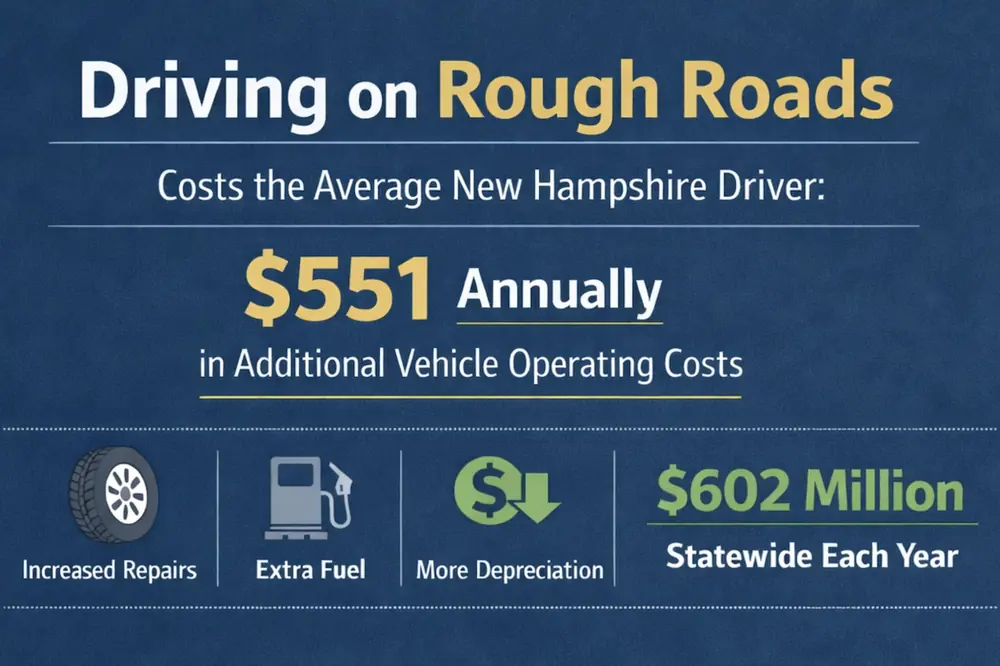
Thirty-four percent of major locally and state-maintained roads in New Hampshire are in poor or mediocre condition. Driving on rough roads costs the average New Hampshire driver nearly $551 annually in additional vehicle operating costs — a total of nearly $602 million statewide. In the Merrimack Valley, 33 percent of major roads are in poor or mediocre condition, costing the average driver there $463 annually in extra vehicle operating costs. Thirty-four percent of major roads in the Seacoast region are rated in poor or mediocre condition. Extra vehicle operating costs as a result of rough roads total $505 per year for the average driver in the Seacoast region.
Eight percent (192 of 2,549) of New Hampshire’s bridges are rated in poor/structurally deficient condition. Bridges that are rated poor/structurally deficient have significant deterioration of the bridge deck, supports, or other major components. Forty-one percent of the state’s bridges are rated in fair condition, and the remaining 51 percent are in good condition. In both the Merrimack Valley and the Seacoast region, 8 percent of bridges are in poor or mediocre condition.
While traffic congestion is largely constrained to the state’s urban areas, increasing congestion on New Hampshire’s major highways and roads hampers the state’s ability to support economic development and quality of life by reducing the reliability and efficiency of personal and commercial travel, including the transport of goods and services. In the Merrimack Valley area, drivers lose an average of 34 hours per year in traffic congestion, costing the average area driver $561 annually in lost time and wasted fuel. In the Seacoast Region, area drivers lose an average of 30 hours per year in traffic congestion, costing the average area driver $604 annually in lost time and wasted fuel.

| Your local Case Construction Equipment Inc dealer |
|---|
| Beauregard Equipment |
| Monroe Tractor |
From 2019 to 2024, 734 people were killed in traffic crashes in New Hampshire, an average of 147 fatalities each year. New Hampshire traffic fatalities increased sharply in 2021 and spiked in 2022, before falling in 2024. While traffic fatalities in the state have fallen modestly in 2023 and 2024, the number of fatalities in 2024 was 42 percent higher than a decade ago in 2014.