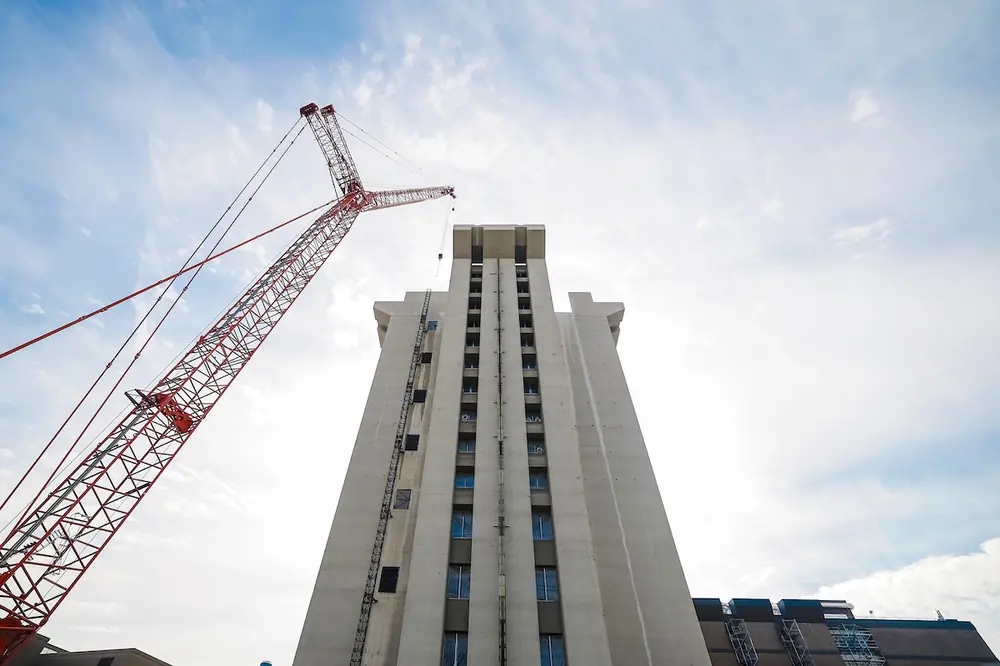
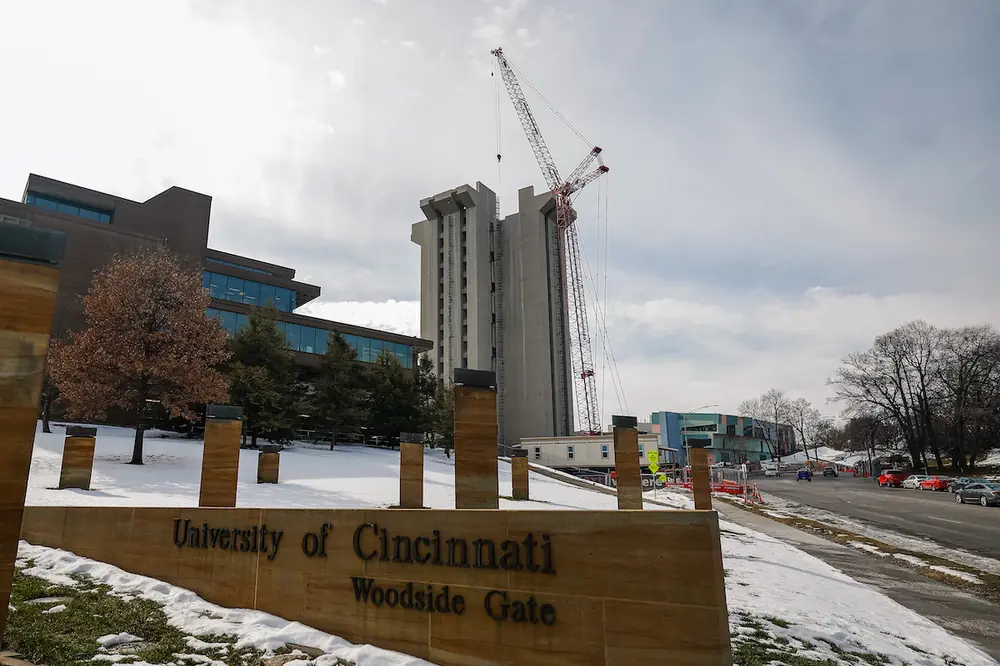
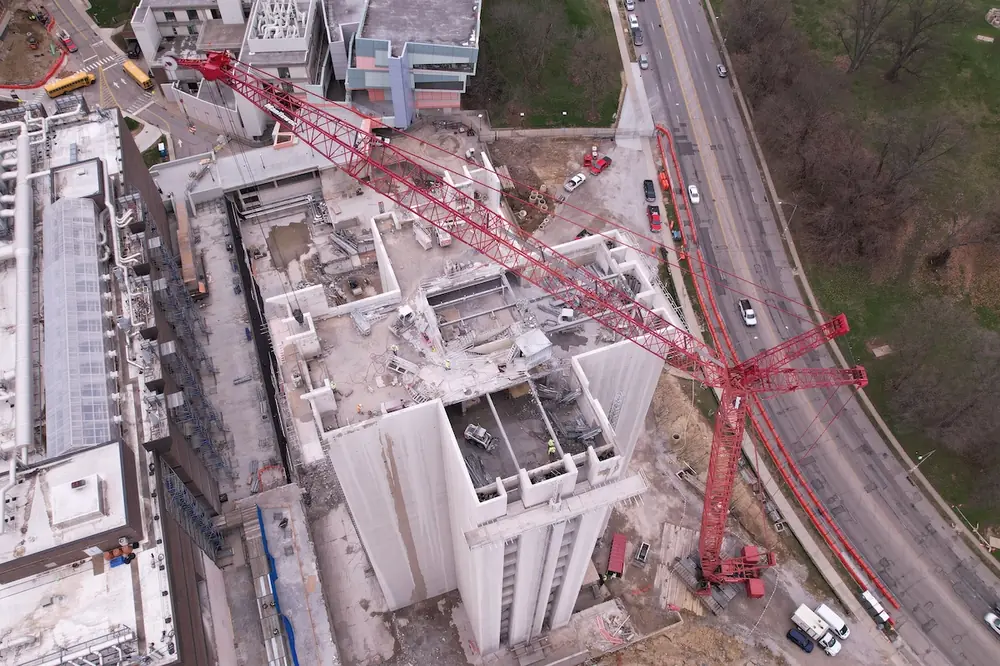
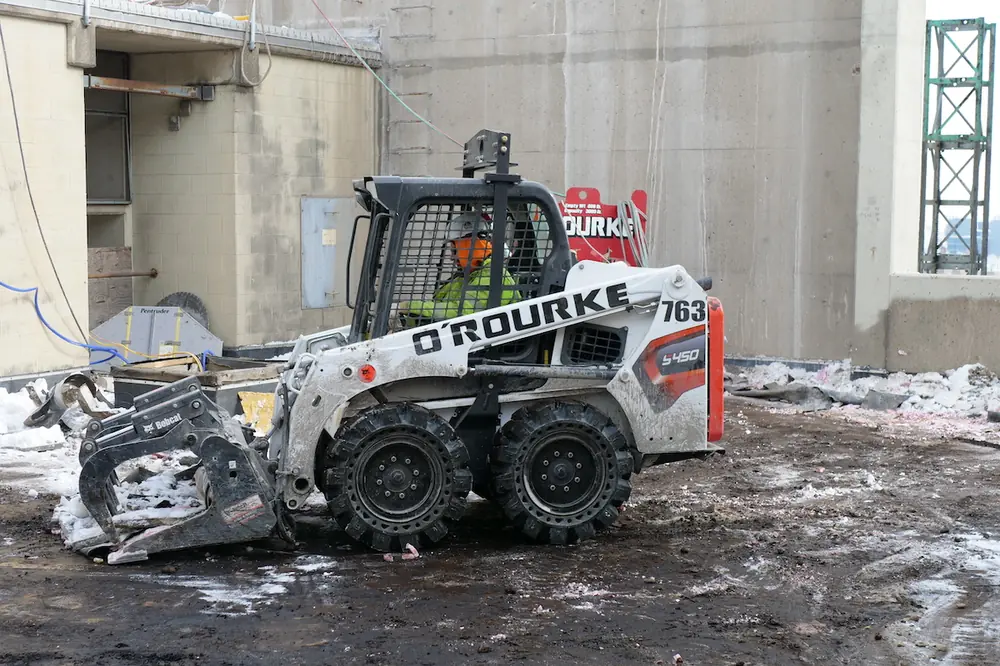

Demolishing the University of Cincinnati’s Crosley Tower involves far more than tearing down a vacant building. The 16-story brutalist landmark is being dismantled piece by piece in the middle of an active urban campus, where students, faculty, research facilities, utilities, and pedestrian traffic continue moving around the site each day.
Skanska is serving as construction manager for the $47.3 million remediation and demolition of Crosley Tower and the adjacent Clifton Court Garage. O’Rourke Wrecking Company (O’ROURKE) is executing the abatement and demolition, while THP Limited — a Cincinnati, Ohio-based structural engineering firm — is providing structural engineering support for demolition sequencing and cut planning. The University of Cincinnati owns the project.
The scope includes hazardous-material abatement, top-down structural deconstruction, debris processing, material recycling, and site remediation in preparation for future development. Demolition officially began in early February 2026 following site preparation and hazardous-material abatement, and the project is expected to conclude in early 2027.
The tower’s removal is tied to a broader campus redevelopment initiative. The University of Cincinnati Board of Trustees approved an initial $30.3 million construction phase for a replacement STEM Academic Facility.
Completed in 1969, Crosley Tower became one of the University of Cincinnati’s most recognizable structures because of both its brutalist appearance and unusual construction method. The building was constructed using an 18-day continuous concrete pour, creating a monolithic reinforced concrete structure without traditional construction joints.

| Your local Wirtgen America dealer |
|---|
| Brandeis Machinery |
That construction method is now one of the biggest challenges facing demolition crews.
“Because the entire structure was poured as a single continuous operation with no construction joints, there are no natural seams that would otherwise aid deconstruction,” said Mike O’Rourke, President of O’ROURKE. “The result is a seamless, monolithic concrete system with dense reinforcement throughout.”
Unlike a steel-framed structure, Crosley cannot simply be dismantled member by member. Its reinforced concrete shell and structural redundancy mean each cut changes how loads move through the remaining structure.
“Crosley Tower is heavily overbuilt compared with modern construction standards,” Mike said. “The concrete is dense, reinforcement is substantial, and structural redundancy is high.”

| Your local Leica Geosystems Inc dealer |
|---|
| Laser Specialist inc |
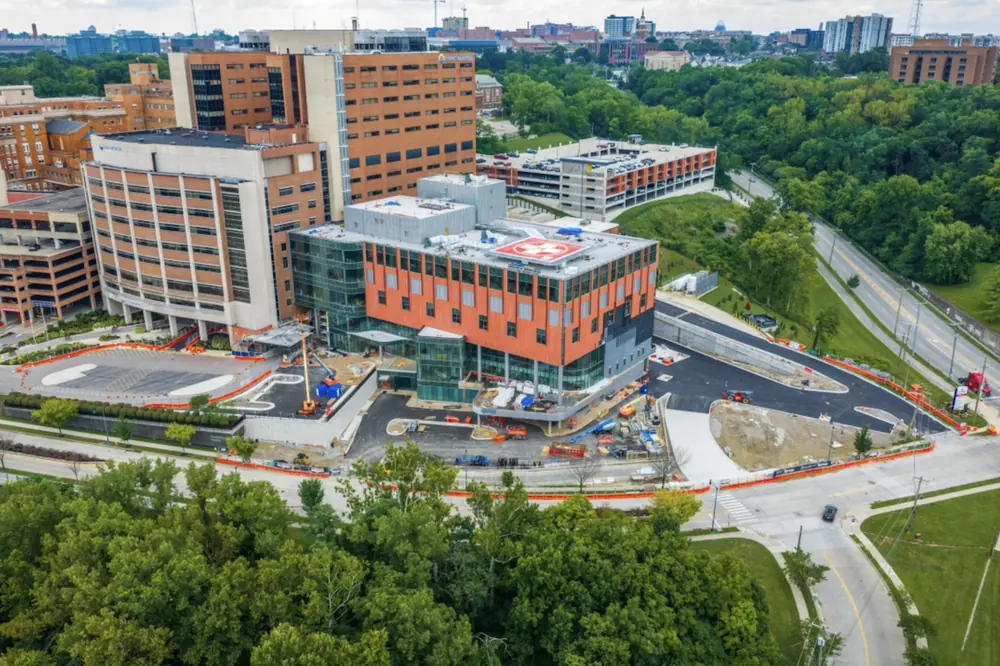
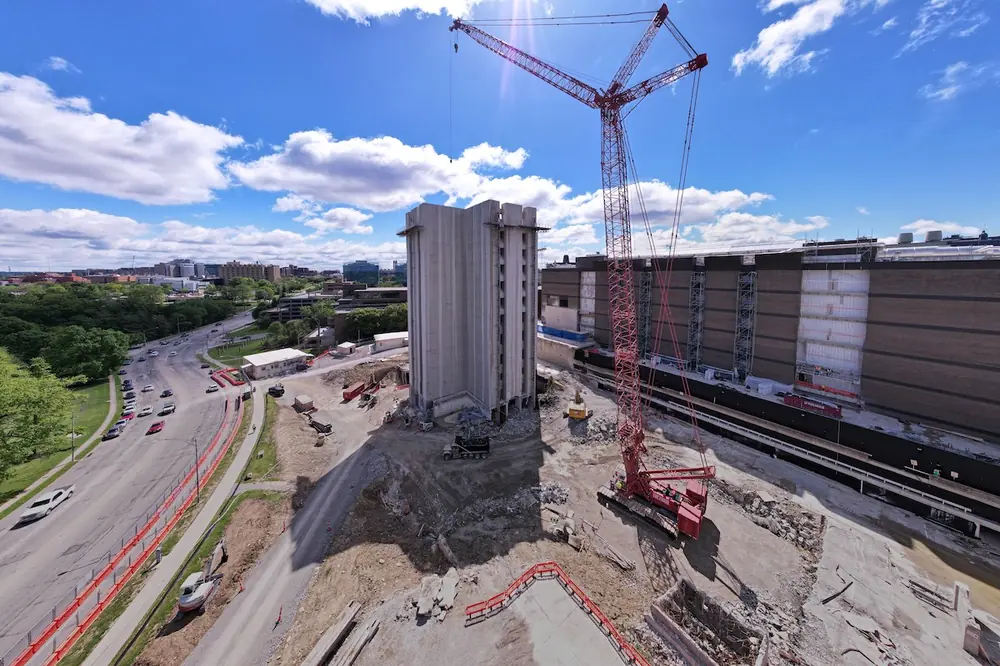
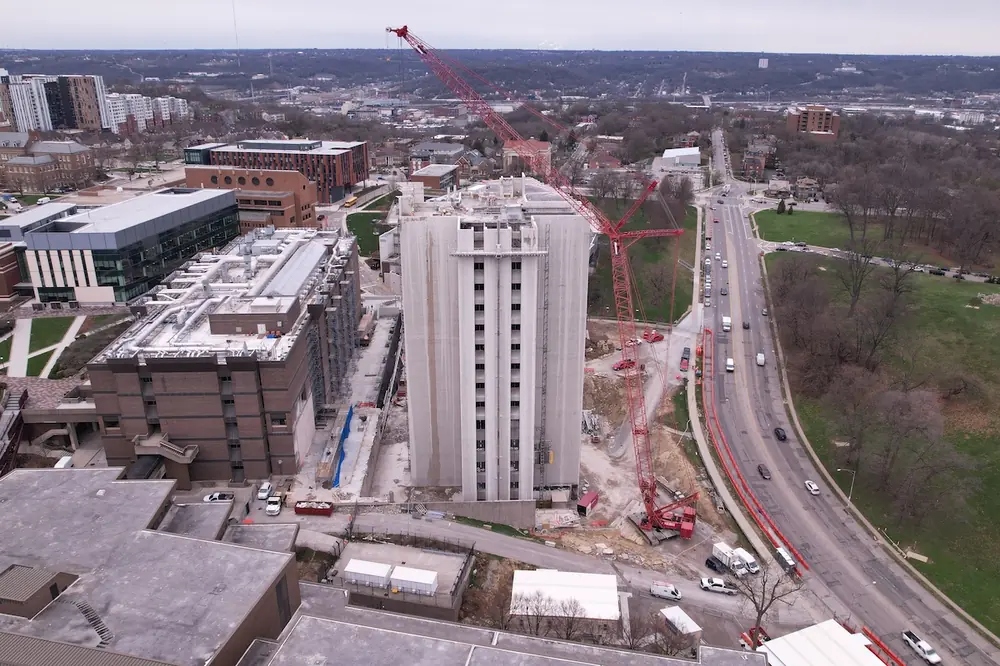
The campus setting added another level of complexity. Crosley sits near academic buildings, medical facilities, residences, utilities, public infrastructure, pedestrian corridors, and Burnet Woods. With restricted space for equipment and no safe collapse zone, the project team ruled out implosion early in planning.
According to O’ROURKE, implosion presented unacceptable risks related to air overpressure, debris footprint, and proximity to occupied buildings. Full mechanical demolition from grade also was limited by the tower’s height and reinforced concrete structure.
As a result, O’ROURKE selected a top-down, slab-by-slab deconstruction approach because it offers the most control, the highest level of safety and precision, and minimizes dust, vibration, and structural impact to adjacent academic buildings, residences, and nearby Burnet Woods, a 90-acre park.
The demolition process focuses on removing the structure in engineered concrete sections. Individual slab sections typically range from about 8 feet by 10 feet to 10 feet by 12 feet, depending on the structural layout. The largest sections weigh approximately 16 tons.

| Your local Bobcat dealer |
|---|
| O'Leary's Contractors Equipment & Supply |
“Separation requires saw cutting into engineered sections rather than breaking apart at joints,” Mike said. “The cutting is more intensive than typical reinforced concrete, and the structural behavior as sections are removed must be carefully modeled in advance.”
Before crews make a single cut, engineers model how the structure will respond. Track-mounted saws and core drilling equipment create exact separation points based on column spacing, beam drops, reinforcement, and mechanical penetrations.
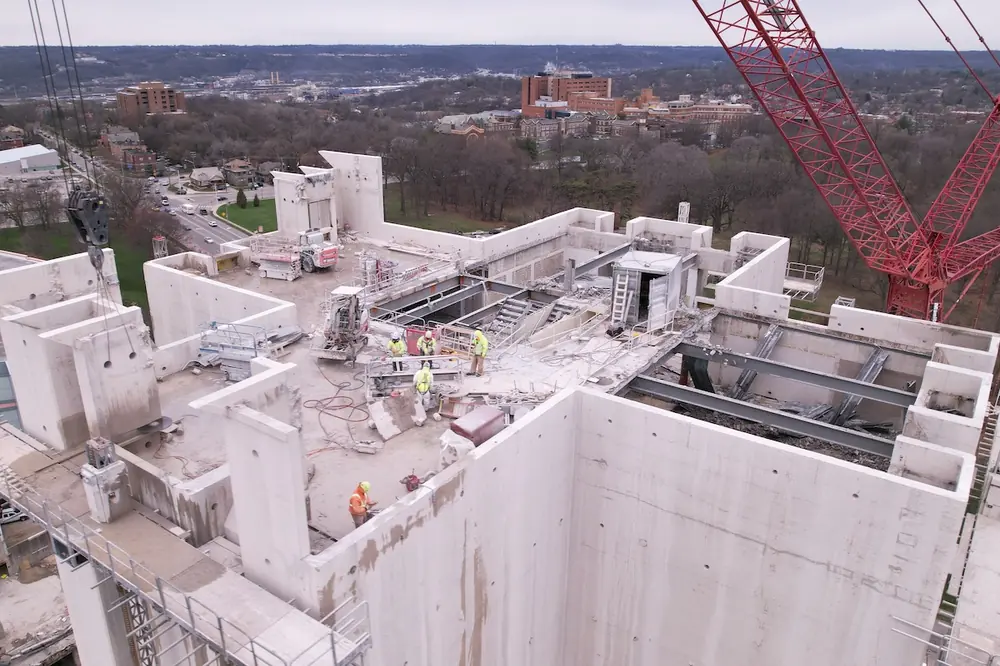
“Each wall section is saw-cut into engineered, rectangular sections using track-mounted saws and carefully planned core drilling to achieve clean separation,” Mike said.
Once rigging is attached and verified, cranes lift the sections clear of the structure and lower them into staging areas for processing and recycling. Supporting beams, floors, and columns are then removed in planned sequences before crews advance to the next level below.

| Your local Case Construction Equipment Inc dealer |
|---|
| Birkey's Construction Equipment |
Speed is secondary to control on this project.
“Every slab section is designed, rigged, cut, lifted, and lowered in a highly controlled sequence,” Mike said. “The emphasis throughout the project is on precision, stability, and safety rather than speed or brute force.”
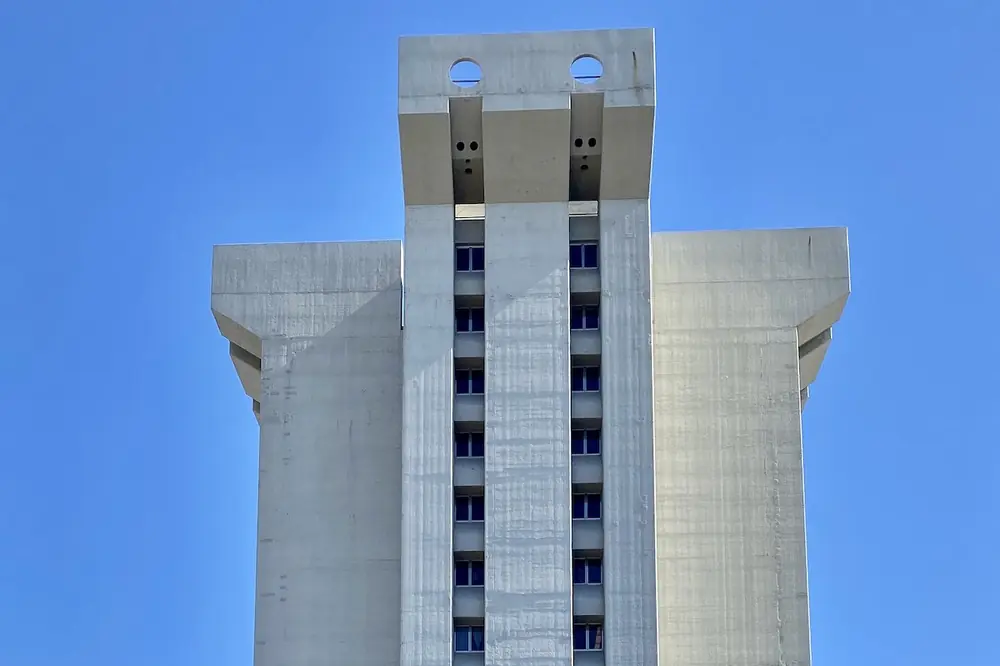
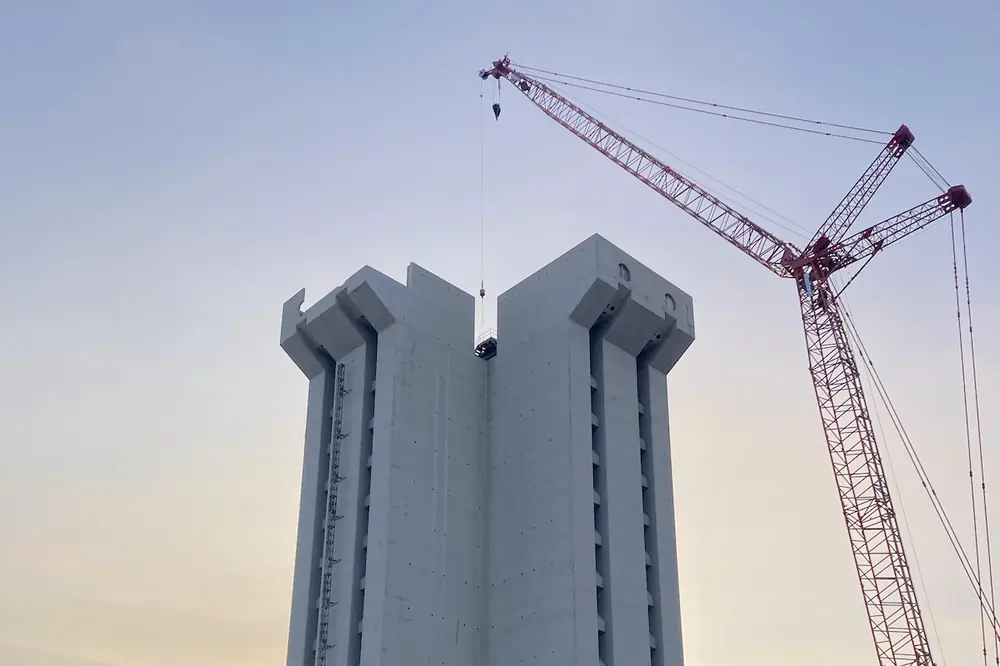
Because demolition progresses from the top down, crews began with one of the tower’s most technically demanding elements: the cantilevered concrete crown, located 244 feet above ground level.
The crown included flat and angled slabs formed as part of the tower’s continuous-pour wall system. Those conditions eliminated natural break points and required crews to follow the engineered removal sequence exactly as designed.

| Your local Wirtgen America dealer |
|---|
| Brandeis Machinery |
“The sequence, engineering, and execution of removing the tower’s crown was one of the most challenging parts of the project,” Mike said.
Months of engineering and preplanning went into the crown removal before the first section was lifted away. Because the crown was part of the overall structural system, crews could not simply detach it from the rest of the building.
“Crosley was not built in a way that provides natural break points,” Mike said. “Those elements required that we follow the plan details specifically with respect to how each piece was cut, rigged, and removed.”
The demolition sequence was developed through structural analysis performed by THP in coordination with O’ROURKE’s field operations team. The main objective is maintaining structural stability as load paths shift during demolition.

| Your local LeeBoy dealer |
|---|
| Brandeis Machinery |
The top-down approach allows the lower portions of the structure to remain stable while crews work downward floor by floor. Beam and column removal sequences are carefully planned to control load redistribution.
“The sequencing was determined through detailed structural engineering analysis by THP in collaboration with O’ROURKE’s field team,” Mike said.
Field conditions, however, do not always match original assumptions. When crews encounter unexpected reinforcement or embedded structural elements, work pauses until engineers review and validate adjustments.
“When field conditions differ from what was anticipated during preconstruction, the team pauses, conducts field verification, and brings in real-time engineering review before adapting the approach,” Mike said.

| Your local Sennebogen LLC dealer |
|---|
| Brandeis Machinery |
As of this writing, crews were working on Floor 11 using the crane-assisted top-down approach. Once demolition reaches approximately Floor 8, O’ROURKE plans to transition to an ultra-high-reach demolition excavator capable of reaching the remaining structure from grade.
“The biggest challenge has been combining precision structural demolition within the confines of an active college campus,” Mike said.
Skanska is coordinating demolition operations with ongoing university activities, including pedestrian routing, traffic management, deliveries, site access, and communication with campus stakeholders.
According to Skanska, all work is contained within clearly defined barricaded areas designed to keep the public away from active demolition operations. Skanska said every subcontractor is required to complete a Construction Work Plan identifying hazards and safe work procedures before beginning work.

| Your local Case Construction Equipment Inc dealer |
|---|
| Burris Equipment |
“Protection starts with separation,” said Michele O’Rourke, CEO of O’Rourke Wrecking Company. “Controlled perimeters, overhead protection where needed, and strict access control keep the public clear of active work zones at all times.”
High-impact activities are scheduled during off-peak campus hours whenever possible. Dedicated haul routes separate construction traffic from pedestrian movement, while perimeter signage directs students and visitors around active work areas.
“Nearly every movement on the site must be choreographed,” Mike said. “Those cuts and picks, crane movements, truck routing, dust control operations, pedestrian routing, and protection must all happen in harmony.”
Running crane operations in the middle of an active campus leaves little room for improvisation. Each lift must account for rigging geometry, swing control, load balance, surrounding clearance, nearby buildings, utilities, and pedestrian activity.

| Your local Takeuchi Mfg Ltd dealer |
|---|
| Brandeis Machinery |
“Cranes are central to the entire deconstruction operation because every engineered slab section must be lifted clear of the structure and lowered to a staging area for processing,” Michele said.
Typical daily operations begin with pre-task safety meetings where crews review work activities, identify hazards, and confirm controls. After work zones are secured, crews begin saw cutting designated sections before rigging and lifting operations begin.
“There is very little room for error,” Mike said. “When conditions differ from what was expected, the team stops, verifies, and adjusts plans before moving forward.”
The project relies on specialized demolition equipment designed for controlled cutting, lifting, and structural removal.

| Your local Wirtgen America dealer |
|---|
| Brandeis Machinery |
Key equipment includes track-mounted concrete saws, core drilling equipment, high-capacity crawler cranes, and ultra-high-reach demolition excavators equipped with concrete processors and shears. O’ROURKE is using equipment from manufacturers including Manitowoc, Caterpillar, and Genesis, along with custom-engineered rigging systems designed specifically for the project.
Monitoring systems are embedded throughout nearly every phase of the work. Dust suppression systems and misting equipment control airborne particulates during cutting and processing activities. Real-time noise monitoring supports community impact management, while vibration monitoring protects nearby structures.
According to Skanska, structural behavior is monitored continuously throughout demolition to confirm the building is responding as expected while sections are removed.
“What we are managing is not simply a demolition sequence, but an active campus environment around it,” Michele said.

| Your local Trimble Construction Division dealer |
|---|
| SITECH Midway |
| SITECH Mid-South |
| SITECH Indiana |
| SITECH Ohio |
| SITECH Mid-America |
The amount of material being removed from Crosley Tower is substantial. The 107,253-square-foot reinforced concrete structure is expected to generate approximately 25,000 to 30,000 tons of concrete and 1,000 to 1,500 tons of reinforcing and structural steel during demolition.
Concrete is being processed for beneficial reuse as aggregate, while structural steel and other metals are being separated and recycled.
“A significant majority of Crosley Tower’s materials are being recycled,” Mike said. “On a structure of this scale, recycling is not an afterthought. It is part of the overall execution strategy.”
According to Skanska, the project demonstrates how top-down deconstruction can provide greater control than implosion or traditional mechanical demolition when adjacent operations must remain active.

| Your local New Holland dealer |
|---|
| Burris Equipment |
“This project reinforces that top-down deconstruction is the right tool for heavily reinforced high-rises amid constrained, active environments,” Mike said. “The level of structural engineering integration required sets a high bar but delivers unmatched control and predictability.”
The project also carries a personal connection for Mike, a University of Cincinnati alumnus who once worked inside Crosley Tower as a student.
“There is a sense of history tied to that building,” he said. “It has been part of the campus skyline for decades, and for a lot of people, it holds memories.”
Still, he said demolition represents more than removing an aging structure.

| Your local Gomaco dealer |
|---|
| Fabick CAT/MO |
“At the same time, being part of its removal and knowing it is making way for something new that better serves the university today is meaningful,” Mike said. “It is what demolition is really about — not just taking something down but creating opportunity for what comes next.”
- Owner: University of Cincinnati
- Construction Manager: Skanska, New York, New York
- Demolition Subcontractor: O’Rourke Wrecking Company, Cincinnati, Ohio
- Engineering Partner: THP Limited, Cincinnati, Ohio