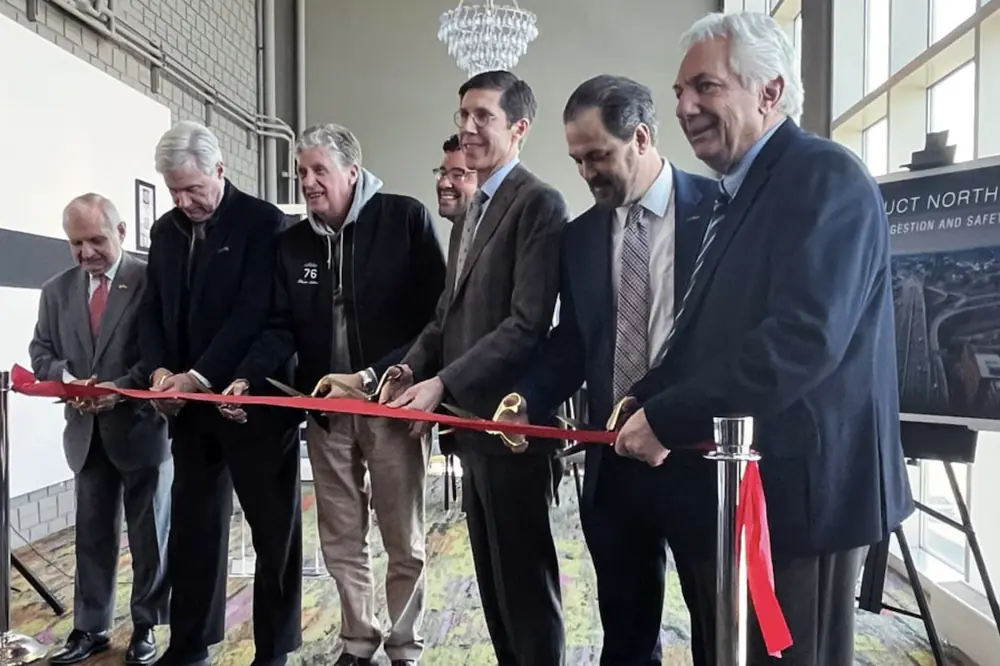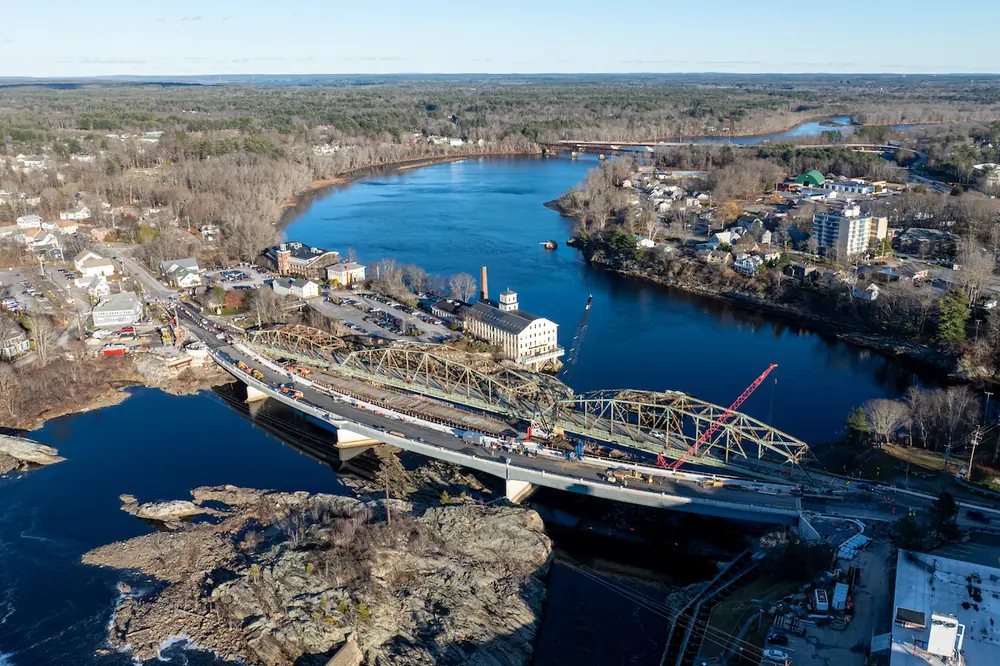
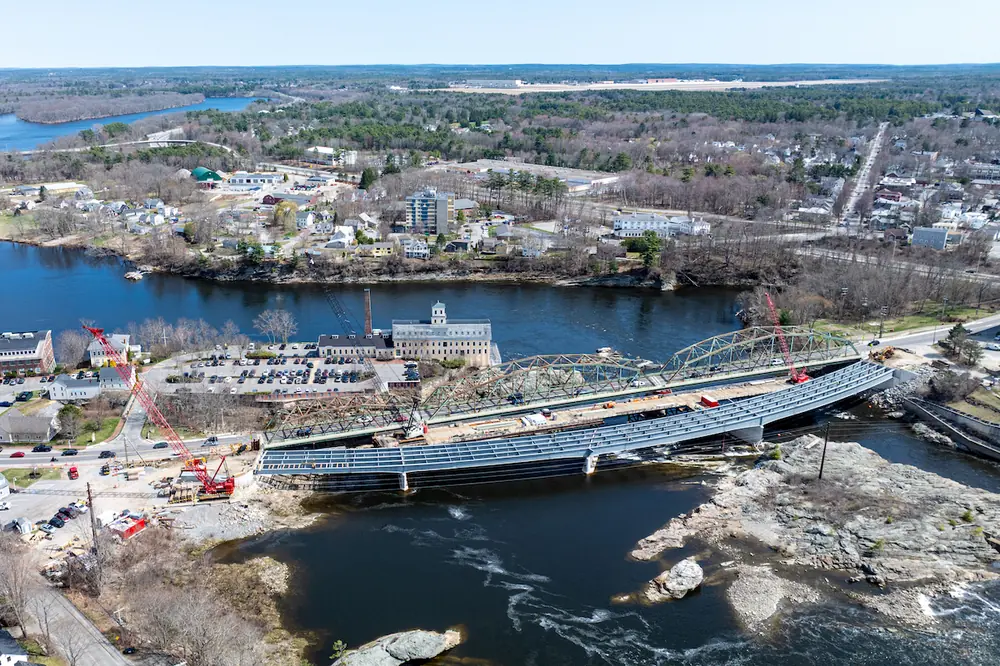
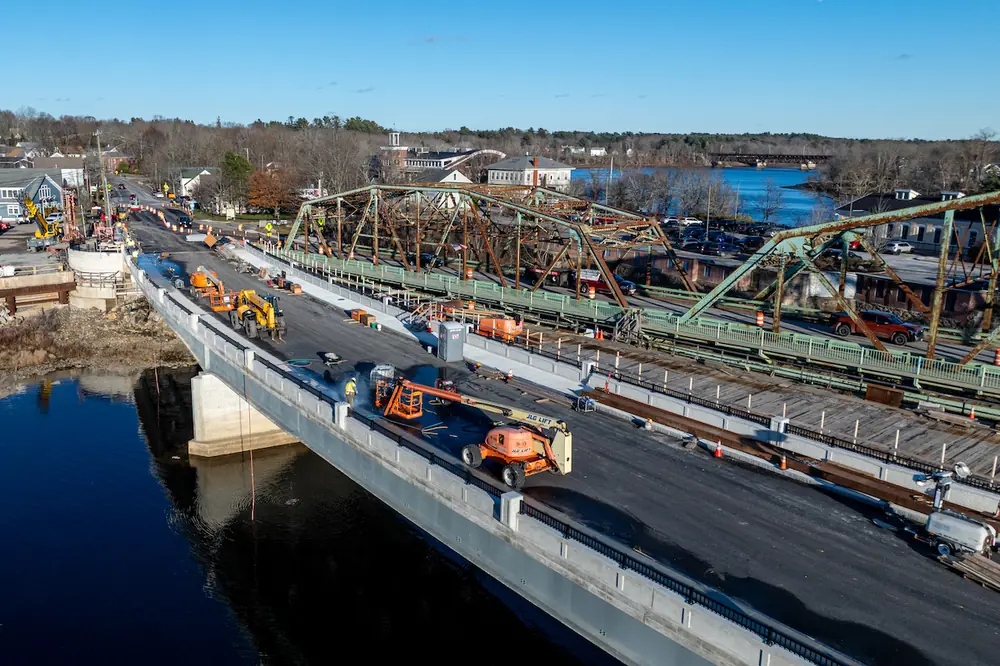

In December 2025, two-lane traffic opened on the Frank J. Wood Bridge in Maine, marking a major milestone on work to provide a new, modern connector for the towns of Brunswick and Topsham.
The $50 million project, managed by Reed & Reed in partnership with the Maine Department of Transportation (MaineDOT), officially began in June 2023. Construction on the new bridge — an 815-foot-long, four-span steel plate girder and concrete structure that spans the Androscoggin River — is expected to be completed in late 2026 or early 2027.
Construction was significantly sidelined due to flooding along the Androscoggin in December 2023. Throughout the project, crews have also been required to pause work between March 15 and August 1 to avoid disrupting sturgeon spawning season in the river.
The new bridge, designed by TYLin, is expected to last at least 100 years thanks to its integration of corrosion-resistant rebar, metalized steel girders, and solid concrete pier foundations.
Reed & Reed crews began demolition of the previous bridge, a three-span truss bridge built in 1932, in January 2026. The older bridge will be completely dismantled and removed by this summer or early fall.

| Your local Esco Corporation dealer |
|---|
| Genalco |
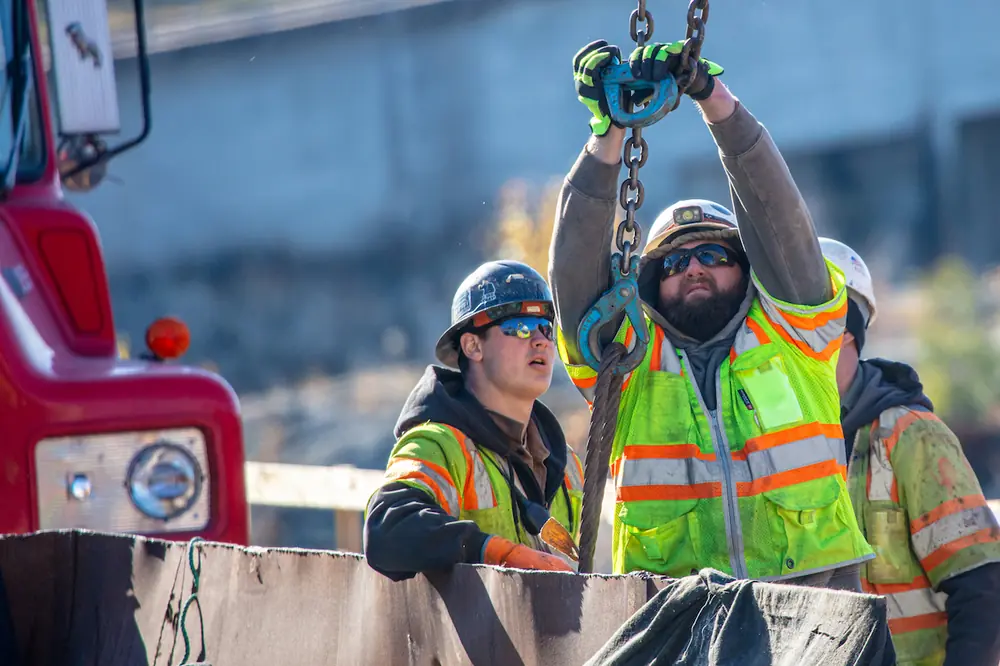
Teams have reinforced the old bridge with temporary shoring, while they work section by section to cut its steel framing apart using Oxylance thermic torches. The final step in demolition will be removal of the older bridge’s existing concrete piers.
“We’re basically just using oxygen burning to achieve really high temperatures so we can cut through the steel of the existing structure,” said Dustin Littlefield, a Project Manager with Reed & Reed, which is headquartered in Woolwich, Maine.
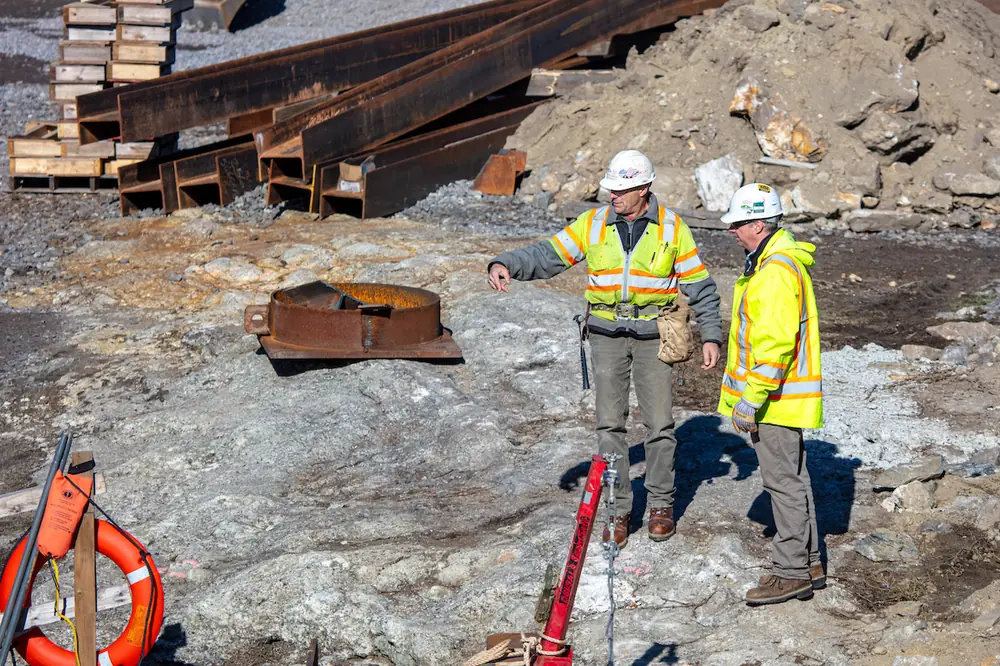
Once dismantled, the obsolete bridge sections will be loaded out and then sent to a recycler. Roughly a dozen workers are involved in the dismantling project, including three to four doing the cutting work, plus a crane operator, a foreman, and additional workers focused on shoring up the remaining structure.
The previous, 805-foot-long Frank J. Wood Bridge had been operating with a 25-ton weight limit since 2016, having been deemed structurally deficient and “fracture critical” upon inspection by MaineDOT.

| Your local Volvo Construction Equipment dealer |
|---|
| Tyler Equipment |
The opening of the new bridge to two-way traffic marks the first time that U.S. Route 201 — a major north-south connector — has been equipped to accommodate full freight traffic between Brunswick and Topsham in roughly a decade. The new bridge is expected to carry roughly 19,000 vehicles daily.
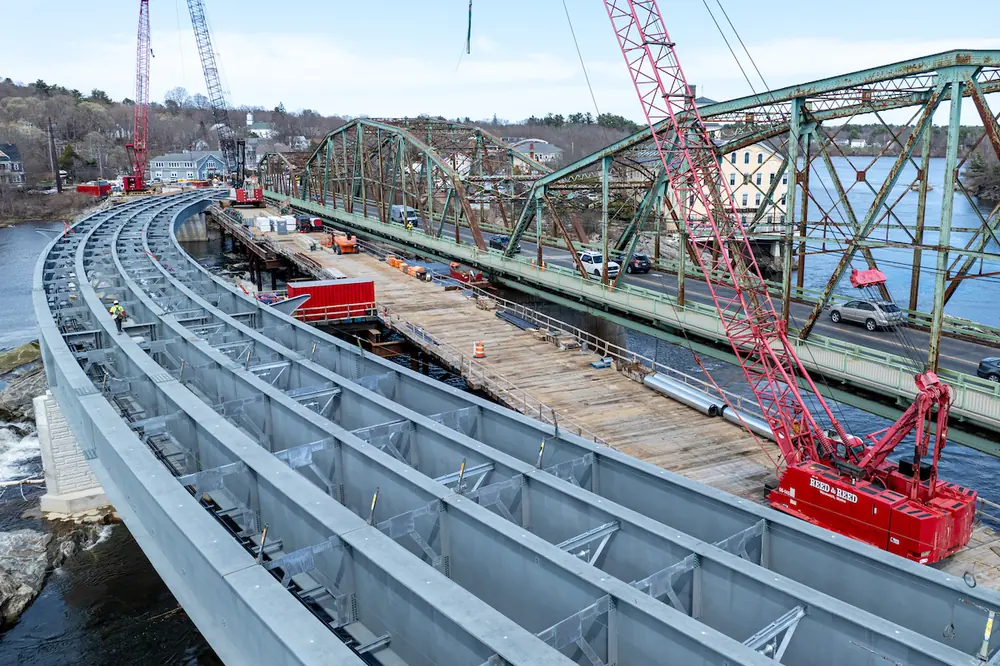
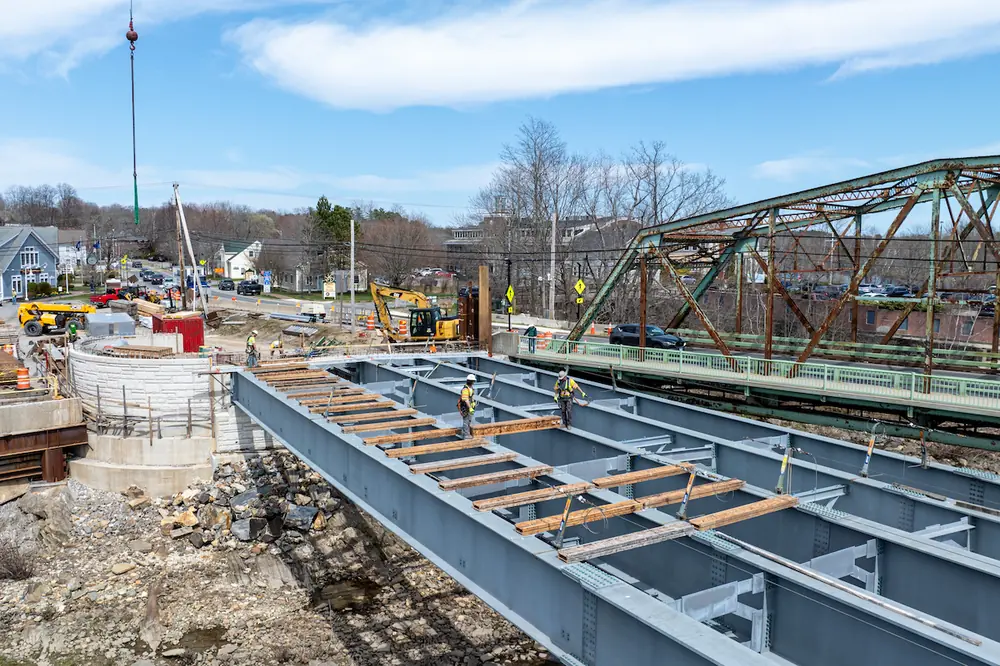
The new bridge adopts a steel girder design, giving it a strong strength-to-weight ratio compared to heavier, all-concrete bridges. High Steel Structures, based in Lancaster, Pennsylvania, served as the steel girder fabricator. Reed & Reed installed all the concrete on the project and did all the steel erection.
The curved girders vary in length and weight, ranging up to 119 feet and 95,000 pounds. Girder installation occurred quickly, once crews reached that stage of construction. In early January 2025, the first two steel girders were received, and by the end of the month, 18 of the total 40 fabricated girders had been erected. By the end of March that year, only seven girders remained to be installed, and by July 2025, crews were able to install the final span of the bridge and complete installation of all deck forms.
“One of the biggest hurdles in the entire project was coordination during steel erection,” Littlefield said. “Because the fabricator was multiple states away, the transit to the bridge site was taking three or four days depending on the weather and traffic logistics. So, we had to line everything up carefully ahead of time to make sure we were getting our pieces erected on time, so the pieces for the next day didn’t get delayed.”

| Your local Hyundai dealer |
|---|
| Equipment East |
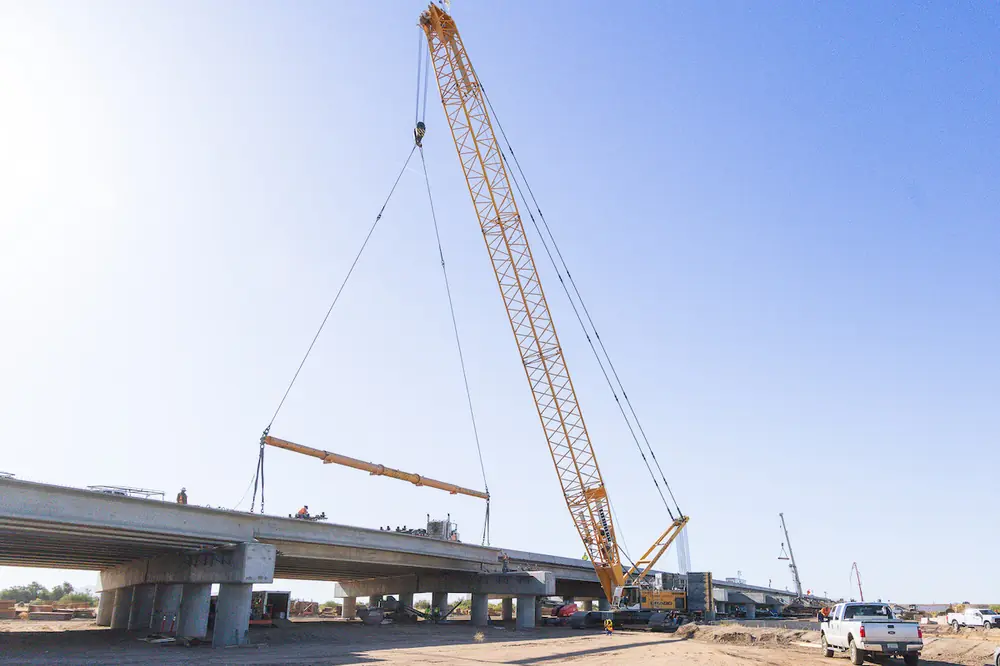
Because of limited staging space on site, crews had to erect the steel girders the same day they were delivered, in a just-in-time construction approach. The bridge’s steel erection required the power and versatility of Reed & Reed’s vast boom-crawler crane fleet. In all, the project incorporated the lift power of the Manitowoc 16000, the Manitowoc 999, the Manitowoc 165, the Manitowoc 10000, and the Link-Belt LS-278.
“Many lifts required two cranes at a time due to girder weights of near 100,000 pounds and large radius-setting distances,” Littlefield said.
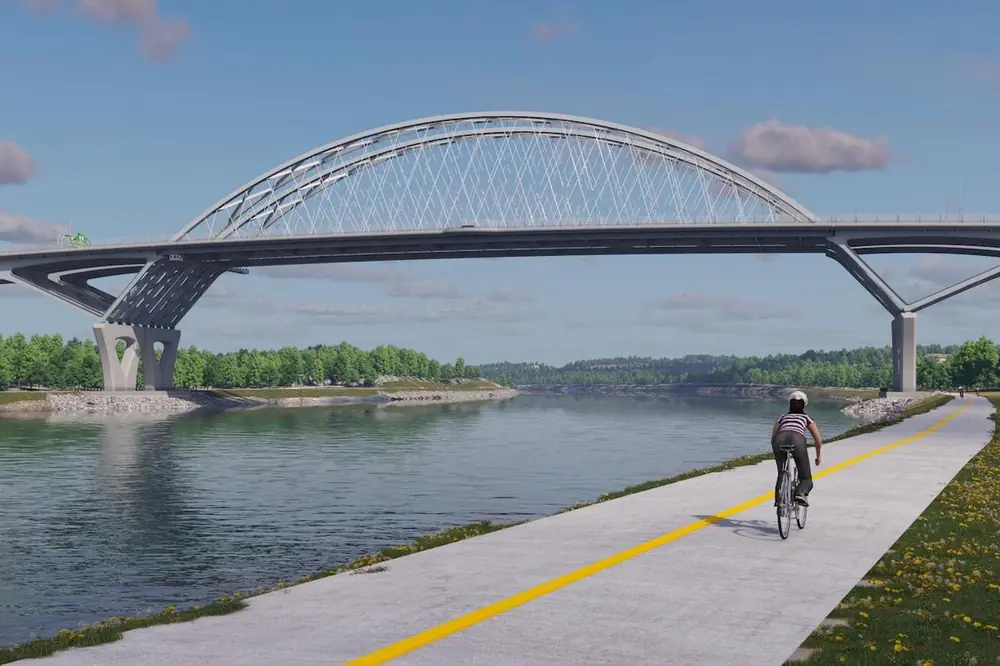
The new bridge structure sits on three structural piers in a curved alignment just upstream from the older bridge. It will include bike lanes and pedestrian sidewalks on both sides along with viewing bump-outs, so walkers and bikers can enjoy unobstructed views of the natural and architectural features of Brunswick Falls and the nearby Brookfield Hydroelectric Dam, roughly 100 yards upstream.
Compared to the older structure, the new bridge will also include wider shoulders on both sides and higher-end design features, including aluminum, architectural railings, and embedded feature lighting. Upon completion, new park areas will beautify the bridge abutments at both ends of the connector.

| Your local Case Construction Equipment Inc dealer |
|---|
| Beauregard Equipment |
| Monroe Tractor |
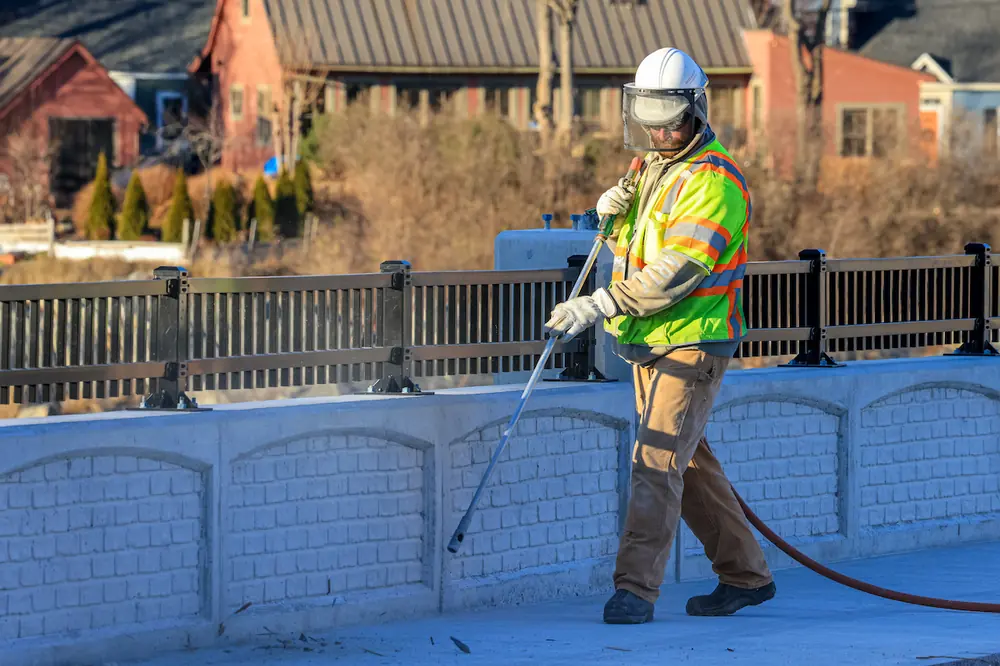
“It’s a good-looking bridge,” Littlefield said. “It has a brick inlay formliner that looks really nice. And the overlooks are nice architectural features that offer a clear view of the river, both upstream and down.”
While traffic flow has been reinstated on the new structure, work continues on its finishing touches. One side of the pedestrian walkway is complete, while construction continues on the other side, Littlefield said. Work will begin on abutment beautification to create the Brunswick-side park facility in summer 2026, while the Topsham-side park should be complete by early spring 2027.
Along with the aforementioned cranes, civil construction on the bridge project has also incorporated use of three Caterpillar (Cat) excavators (Cat 335, Cat 314, and Cat 304), a Cat D6 Dozer, a Cat vibratory roller, a Cat 920 Wheel Loader, and two Peterbilt 567 Tri-Axle Dump Trucks.
Throughout the project, the Androscoggin River’s erratically shifting depths complicated the new bridge construction. At times, crews had to pause installation of the new bridge’s piers and substructure when the river’s flow became too deep or treacherous. And following intense flooding in December 2023, construction had to stop altogether.

| Your local Trimble Construction Division dealer |
|---|
| SITECH Northeast |
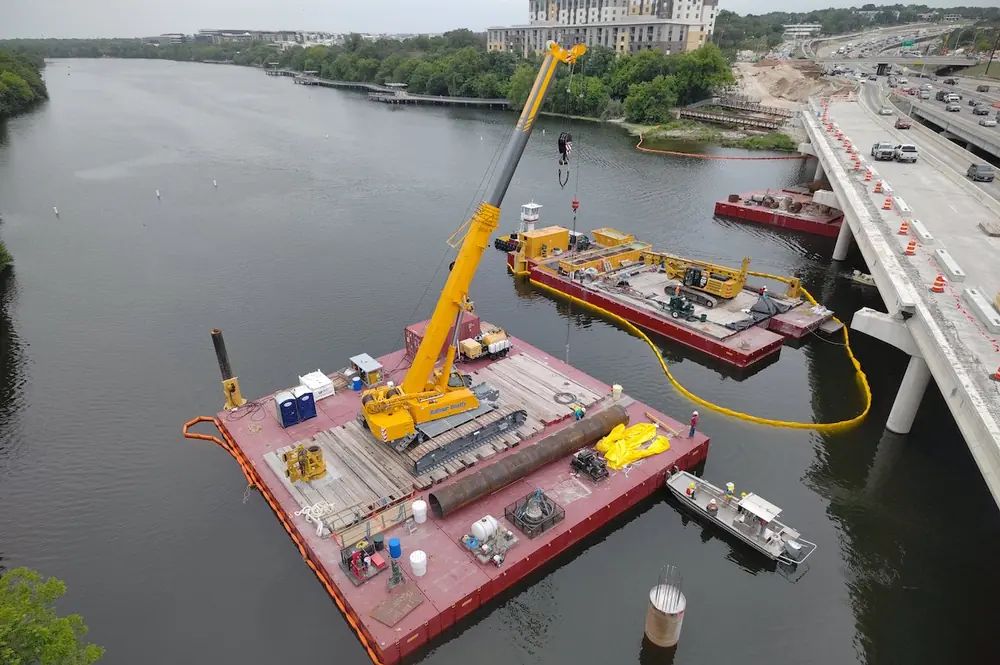
For nearly a year, two of Reed & Reed’s cranes have been stranded on temporary trestles in the middle of the river — without access to either shore — because portions of the trestle span near the shore had to be removed so that steel erection for the final span could be completed.
“Demolition of the north span of the existing bridge was required to be complete before the trestle spans could be realigned to the [new] abutment,” Littlefield explained. “As a result, before we could finish the fourth span of the new bridge, we had to pull and disassemble some of the temporary work trestles, which eliminated our access from the shore.”
Once shore access to the work trestle returns, trucks will be able to get on and off the trestle again, speeding demolition and haul away of the old bridge structure.
Along with the challenging logistics of finalizing the new bridge and demolishing the old one simultaneously, Reed & Reed also had to work closely with MaineDOT to limit disruptions to traffic flow across Route 201, as much as that was possible.

| Your local Wirtgen America dealer |
|---|
| United Construction & Forestry |
| WI Clark |
| Dobbs Equipment (SC) |
Another hurdle arose when crews discovered unexpected obstructions on sites slated for the new bridge approaches, including unmarked concrete duct banks, concrete slabs, and abandoned trolley tracks — all of which had to be dug out.
Still, Littlefield said the constant communication between MaineDOT, Reed & Reed teams, and all of the project’s various subcontractors has helped keep the project on track and moving positively.
“The new bridge provides unrestricted traffic flow between Brunswick and Topsham for the first time in years,” he said. “Once it’s complete, it will also make pedestrian and non-vehicular traffic between the two towns much more accessible.”
- Owner: Maine Department of Transportation
- General Contractor: Reed & Reed, Woolwich, Maine
- Architect: TYLin, San Francisco, California
- Subcontractors: Project Flagging, Ursula Bernier (flaggers); C.A. Newcomb, William Cichocki (guard rail/fence); Lyford, Ryan Lyford (landscape); A.D. Rossi, Evan Kropa (membrane); Glidden Paving, Todd Griffeth (paving); Darrah Welding Contractor, Nancy Darrah and Ralph Darrah (shear connectors); Fine Line, Nicole Frost (striping); H.B. Fleming, Scott Linscott (trestle drilling); Derek Gendron (concrete cutting)
- Major Suppliers: Con-Serv, Chelsi Sapp (bearings); Arc Enterprises, Jake Kilbreth (bridge rail and finger joints); Auburn Concrete, Remi Delcourt (concrete); Harris Rebar, Michele Young (reinforcing steel); High Steel, Dave Buckwalter (structural steel); Nicom Coatings LLC, Vincent Lachance (high-performance waterproofing membrane)