
In a discussion about hybrid technology in heavy equipment, it’s often assumed that we’re talking only about electric-diesel hybrid engines that are designed to reduce fuel consumption and emissions.
But hybrid technology for off-road machines comes in many forms, and it can serve as an accessible bridge for fleets that want to lower their total cost of ownership and improve site sustainability without immediately investing in charging infrastructure upgrades.
At its core, sustainability is about managing energy efficiency. The goal should be optimizing the energy required to do the work, and saving fuel is just one piece of that puzzle. There are many ways to incorporate varying levels of electrification, hybrid, alternative fuels, and other energy-saving technologies into your construction site as you look to transition to more sustainable operations.
Managing energy efficiently can directly improve your operational costs and environmental footprint.
The most helpful roadmap should recognize that no solution is one size fits all for every application. A multi-power strategy will help your fleet move toward its goals, and hybrid solutions can play an important role as a stepping stone to electrification and other sustainable technologies across the job site. Available hybrid system configurations that can be used in heavy equipment include:

| Your local Broce Broom dealer |
|---|
| Nueces Power Equipment |
Series Hybrids
A primary engine-driven generator charges energy storage components (batteries or capacitors), while an electric motor handles the drive/load. Both systems are controlled by onboard power management that uses the stored or generated electricity to deliver the power the machine needs to do the job.
Parallel Hybrids
Combustion engines and secondary power systems work together through a coupler to jointly power the load. As the load varies up and down from peak power demands, one or the other system will kick in and be the dominant system, with the other as backup.
System and Attachment Hybridization
Beyond an equipment drivetrain, hybrid technology can also be used to electrify or assist specific machine components on attachments and special application components. We can replace the long hydraulic lines and engine-driven pumps with wire and local electric drive motors, eliminating many of the energy losses. These systems have demonstrated a reduction of over 15 percent in energy transfer losses in the right applications.
Hydraulic Energy Recovery
Hybrid technology can be used in these systems to capture kinetic or potential energy directly into fluid pressure accumulators without requiring complex high-voltage electrical setups. This accumulated pressure can then be used to power the work application.

| Your local Bobcat dealer |
|---|
| Compact Construction Equipment, Inc |
| Bobcat of North Texas |
While discussions around hybrid technology naturally default to high-voltage electric motors and battery packs, heavy equipment hybrid options involve a broader perspective.
Fleet managers often hear the word hybrid and assume they must choose between a traditional diesel drivetrain and a complex electrical setup requiring new charging infrastructure or specialized technical training. However, one of the most accessible ways to boost efficiency in heavy equipment doesn’t rely on batteries at all — it relies on fluid power that is already native to the equipment.
While battery-electric technology in compact and mid-size excavators is progressing in many segments, the shift toward reduced diesel use and lower emissions remains a multi-solution effort. Hybrid technology offers an immediate energy-saving solution for high-production excavators where fast-charging infrastructure is still catching up to demand.
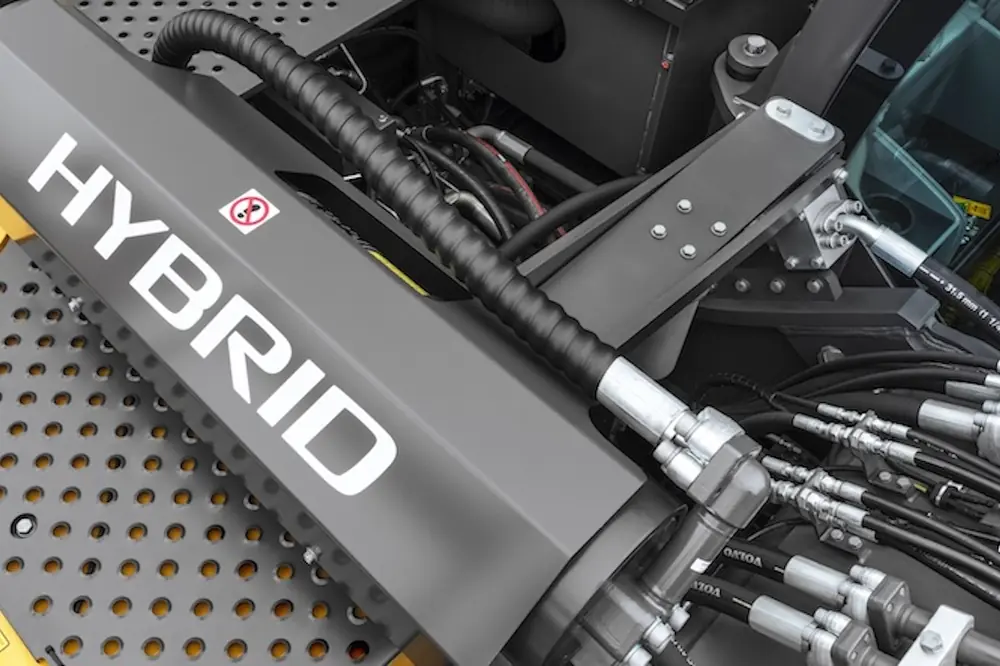
There are different ways to build hybrid systems. Some focus on electrical swing recovery, while others use hydraulic energy recovery. The hydraulic approach is a great example of how to capture what would otherwise be wasted energy and turn it into usable power that helps lower costs.

| Your local Takeuchi Mfg Ltd dealer |
|---|
| Kirby-Smith Machinery |
| Nueces Power Equipment |
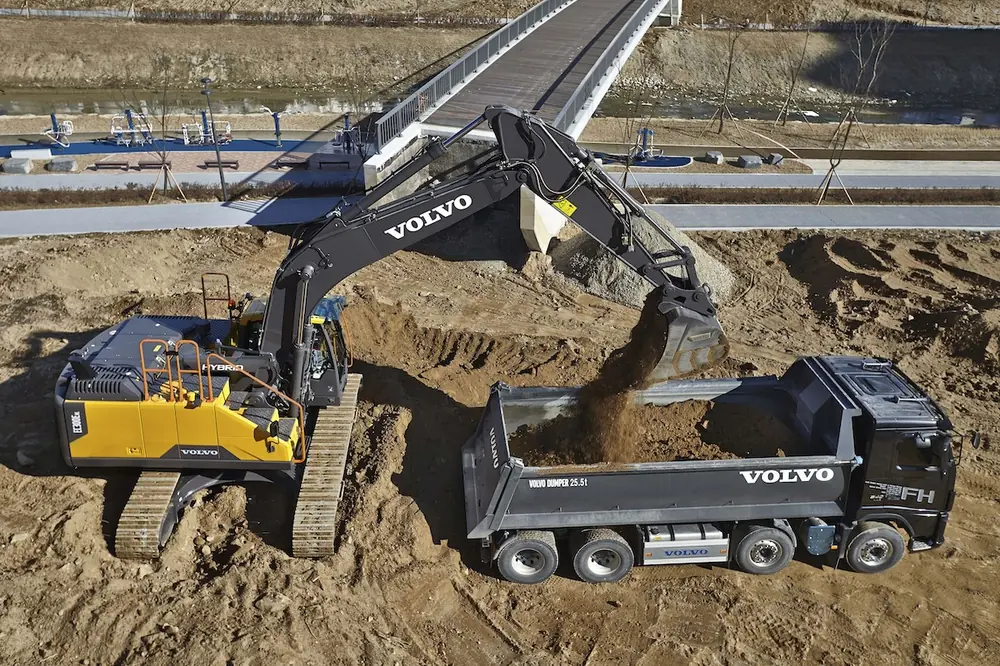
Every time an excavator lowers its boom and bucket, a large amount of kinetic energy is generated by gravity acting on the mass of the boom and arm. With a conventional excavator, that downward force is lost, absorbed by the hydraulic system and dissipated as heat.
The main concept of a hydraulic hybrid system is to harness free energy and put it to work.
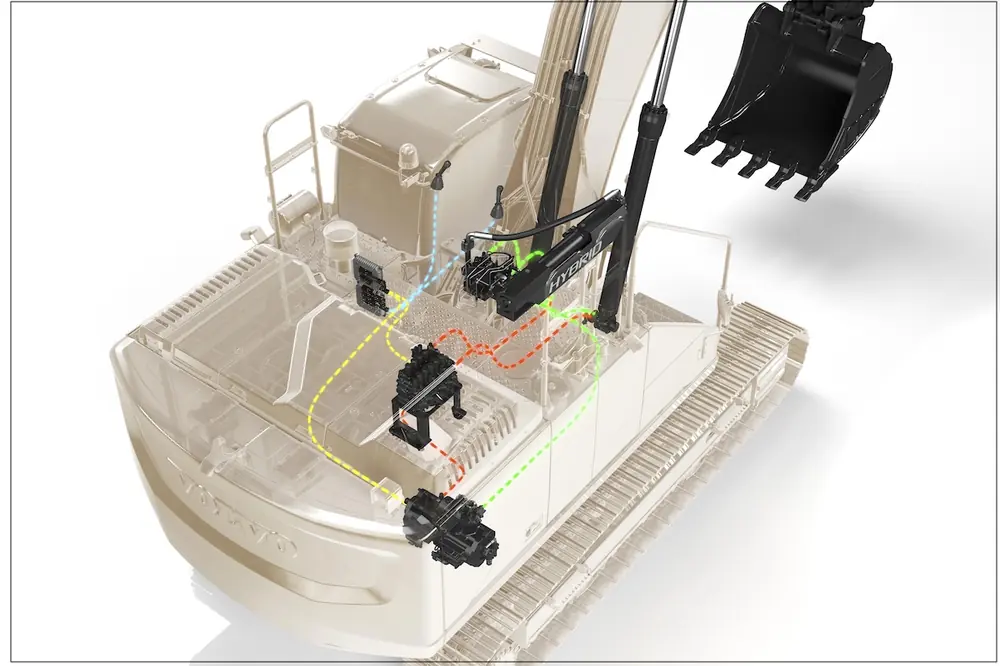
While some hybrid systems prioritize capturing the excavator’s swing energy using electrical components and supercapacitors, hydraulic hybrids take a different approach. Instead of converting motion into electricity, they harvest the downward force of the boom and store it as fluid pressure in an accumulator. When the accumulated pressure is subsequently used to power the machine, the engine and hydraulic pumps do not need to work as hard, and the machine burns less fuel. Net result is the excavator maintains the same levels of performance and productivity by reusing energy that would otherwise be lost.
One of the biggest benefits of this design is that the system relies on components that are already native to the machine’s hydraulic architecture. It’s a straightforward approach that uses familiar hardware to capture and reuse energy.

| Your local LeeBoy dealer |
|---|
| Closner Equipment Co Inc |
| Romco Equipment Co |
Hydraulic hybrid systems can deliver a return on investment (ROI) on several fronts. Hydraulic hybrid excavators can reduce carbon dioxide emissions by about 15 percent, which can help you make strides toward any sustainability goals you might have. In addition, they offer these three primary benefits:
Fuel Efficiency
The immediate payoff of harvesting boom-down energy is a reduction in fuel consumption. In high-production environments, the boom is constantly cycling up and down. Volvo tests have shown that a hydraulic hybrid system in these applications can improve fuel efficiency by up to 17 percent.
Maintenance
Another big benefit of the hybrid approach is how uncomplicated the hardware is. Because the system is built with just a handful of add-on hydraulic components, such as accumulators and assist motors, it doesn’t require any high-voltage electrical systems. That means there’s no change in how the machine is engineered or serviced, and technicians don’t need special certifications or high-voltage tools to work on it. It can be maintained just like a standard excavator.
In addition, the assist motor managing some of the torque load means the engine doesn’t have to work as hard, which reduces wear and tear on the engine components.

| Your local Wirtgen America dealer |
|---|
| Nueces Power Equipment |
| Kirby-Smith Machinery |
Operator Experience
A common concern with any new efficiency technology is that you’ll have to sacrifice breakout force or speed, but that’s not the case with hydraulic hybrids. The system continues working in the background, so the operator won’t notice a difference in how the excavator handles. The machine delivers the same controllability and power, and the operator doesn’t need to change their digging style or flip any special switches.
Electrification is advancing in construction applications, but the energy transition is multi-faceted. Hydraulic hybrid technology in excavators offers a practical, high-ROI approach that delivers immediate fuel savings, lower emissions, and familiar maintenance protocols.
To determine if it’s the right step for you, consider your duty cycles and shift lengths as well as your site energy inputs. In many cases, hybrid technology can help you turn previously wasted energy into savings.
Dr. Ray Gallant is Vice President of Sustainability and Innovation at Volvo Construction Equipment.