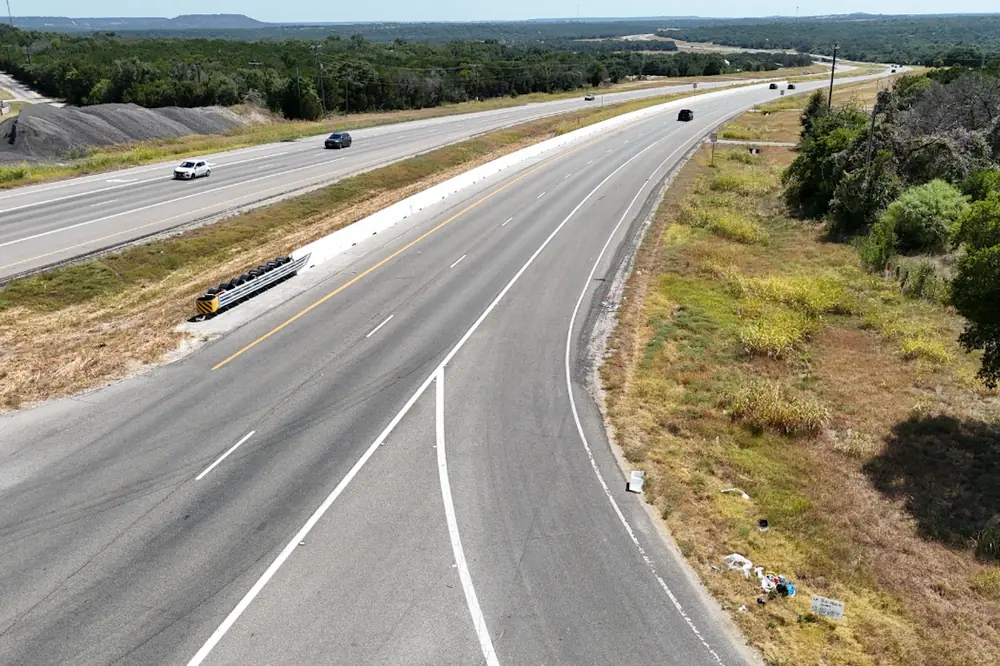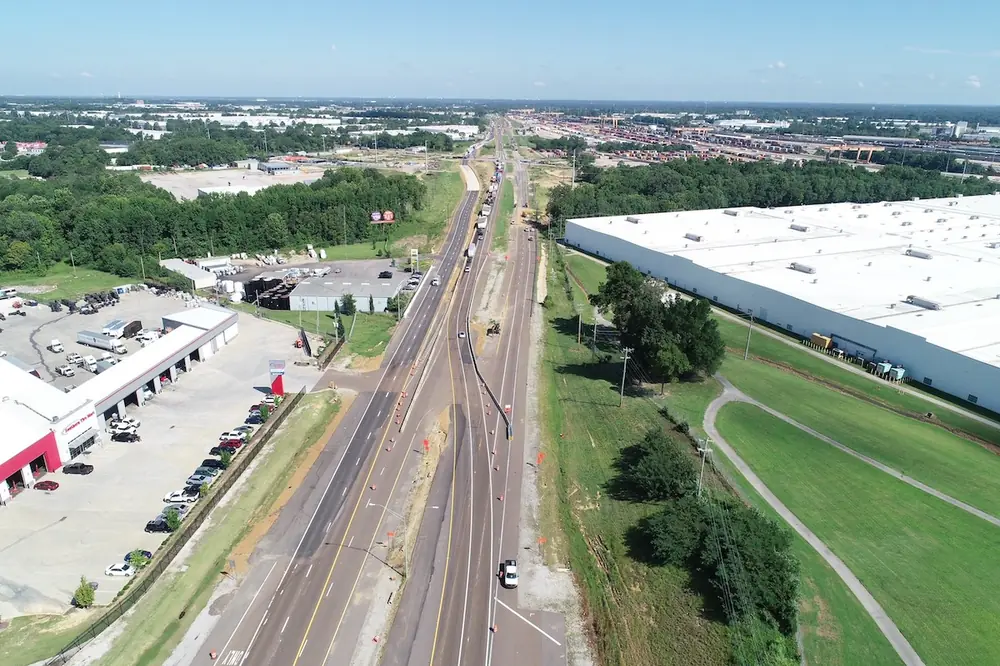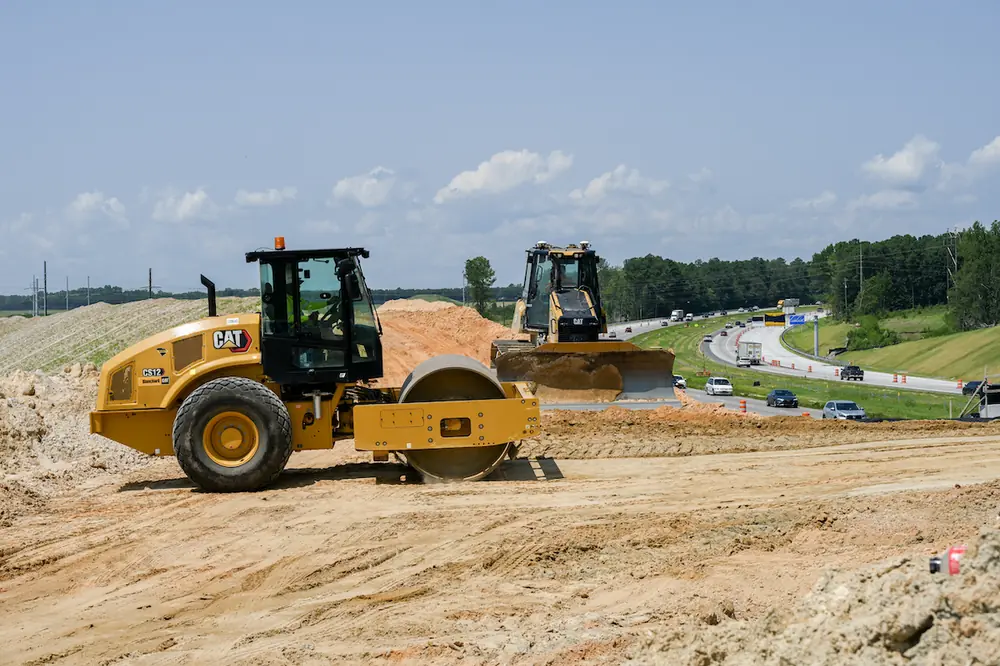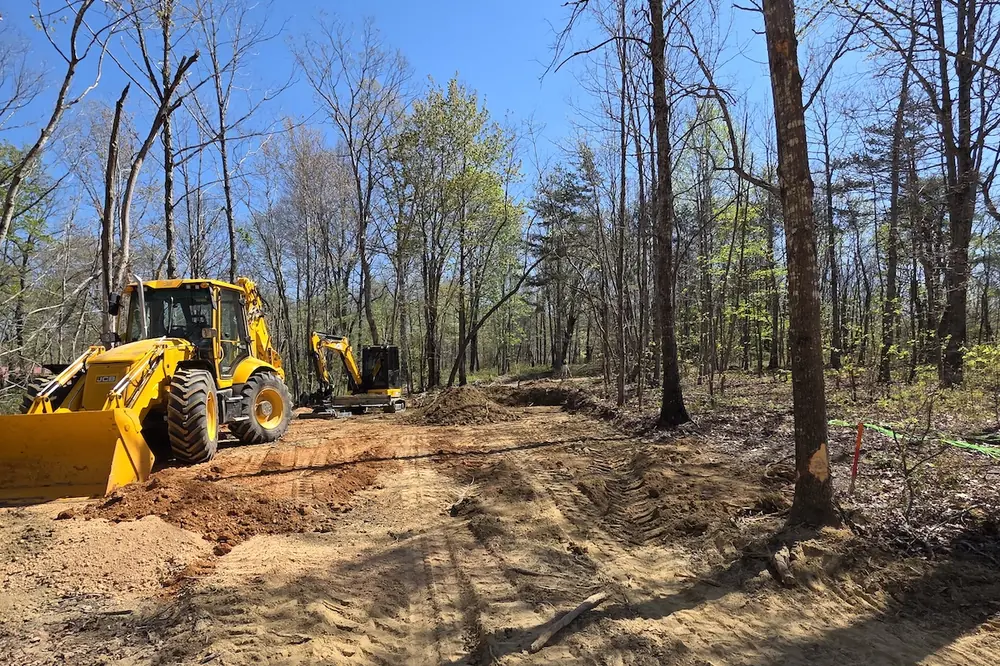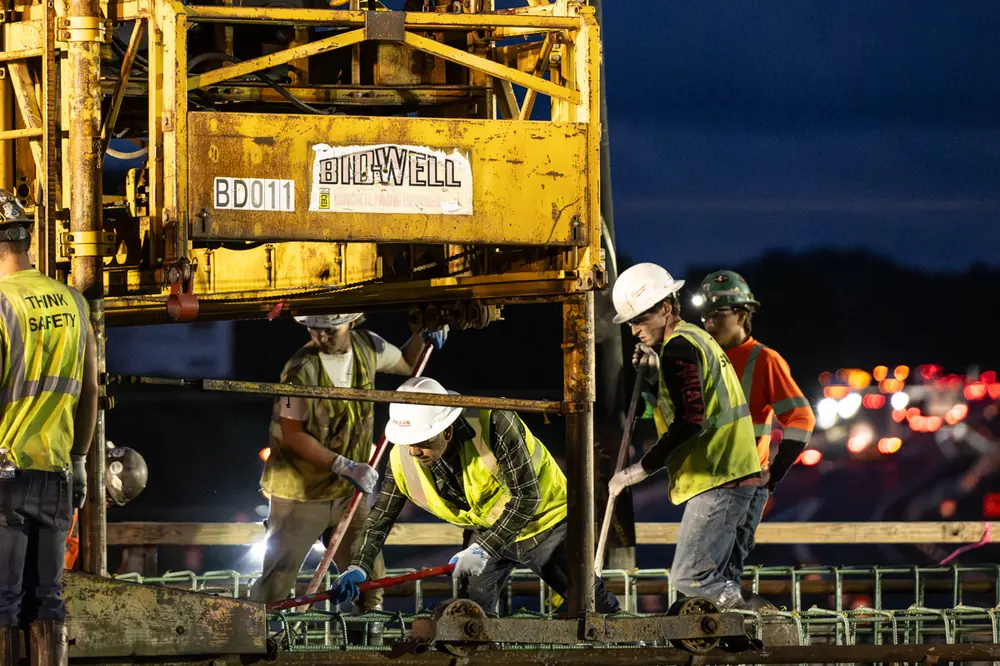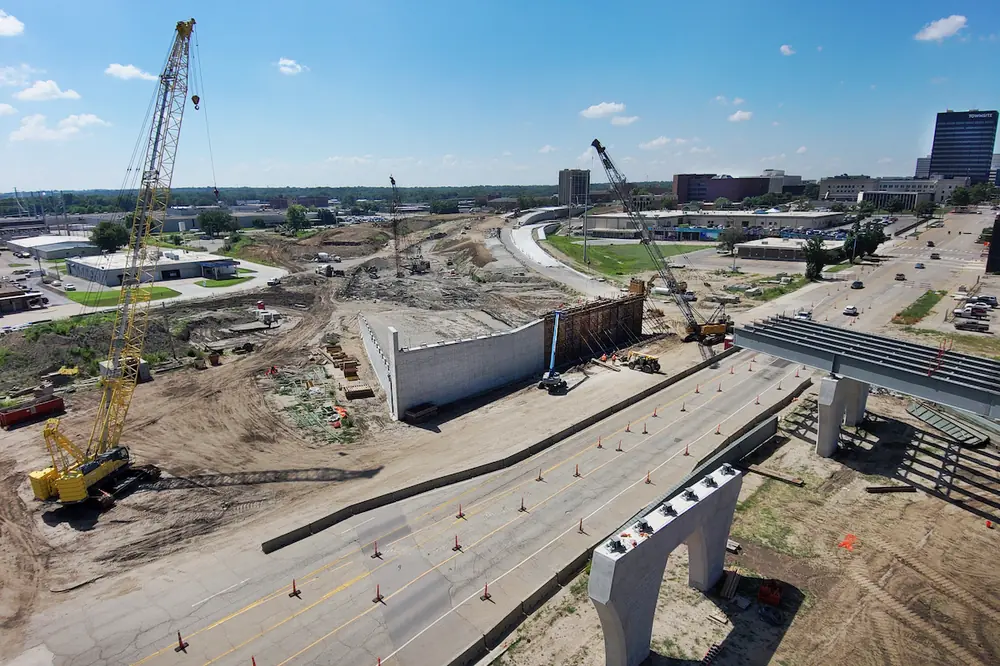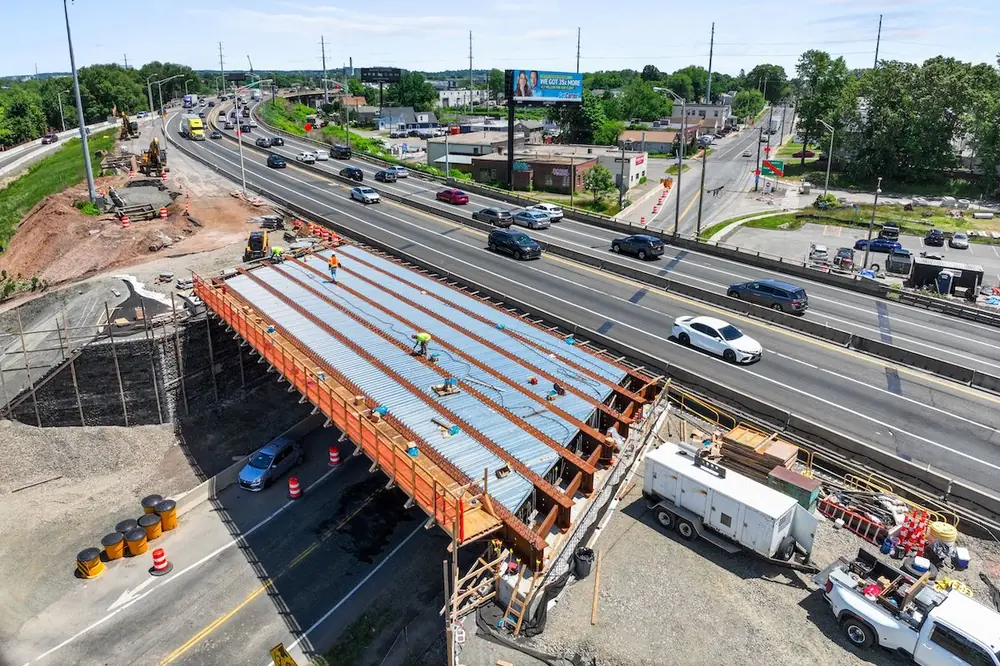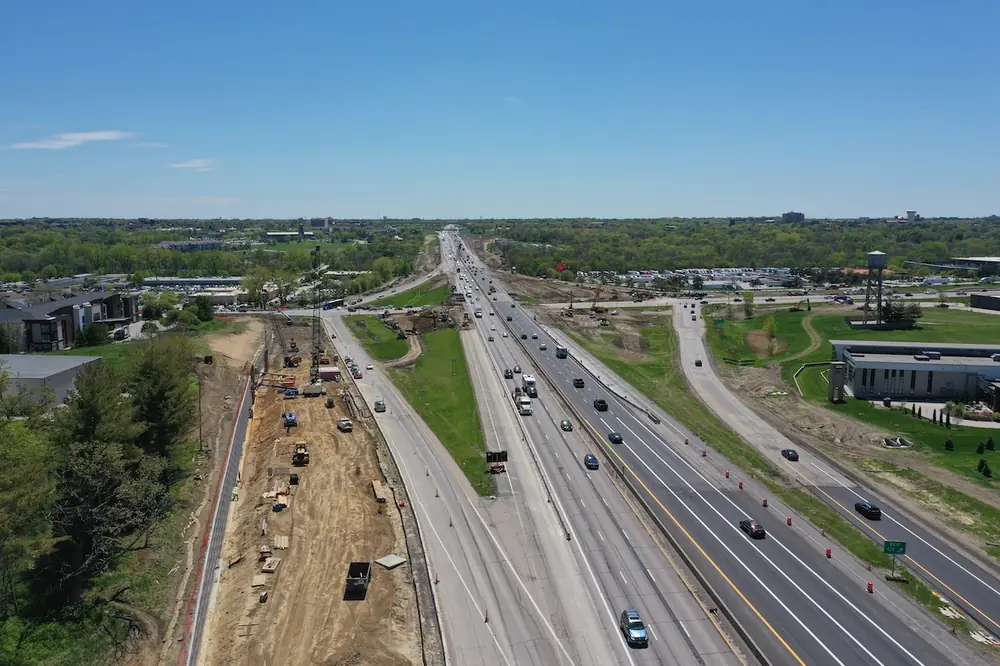
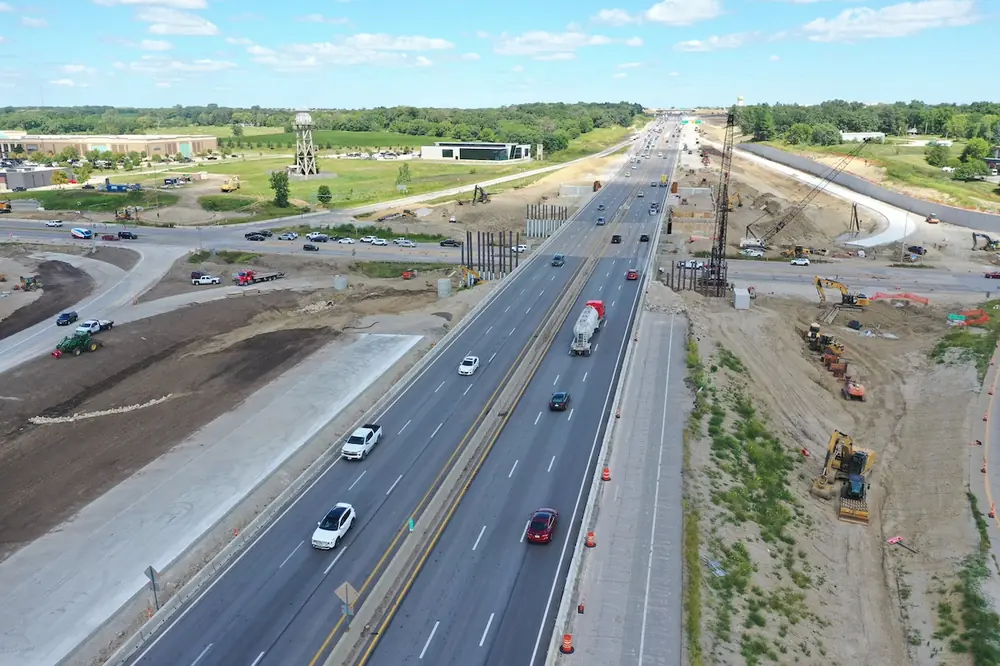
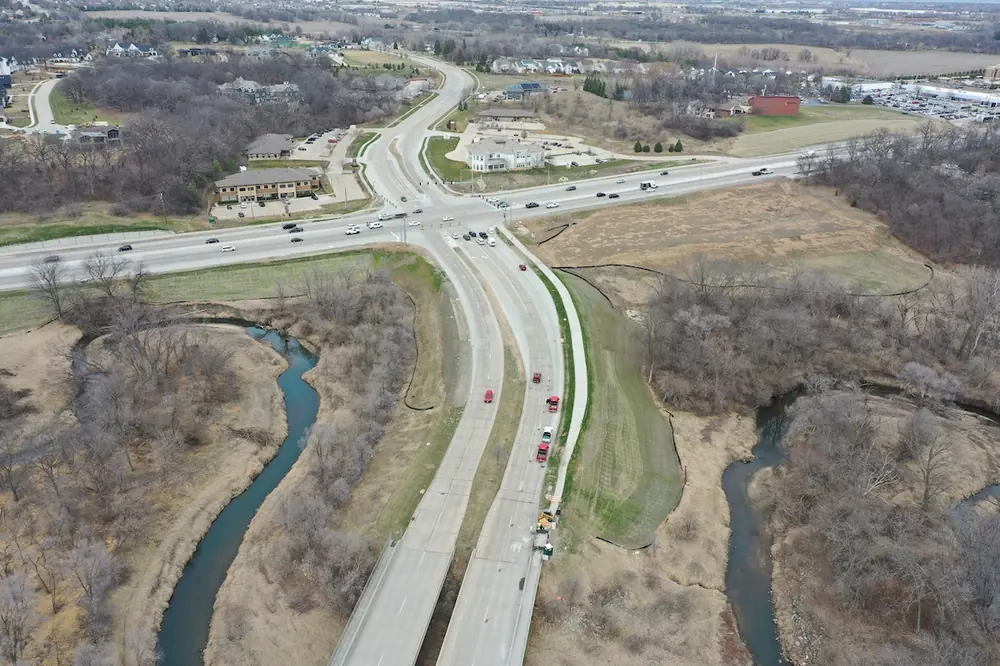
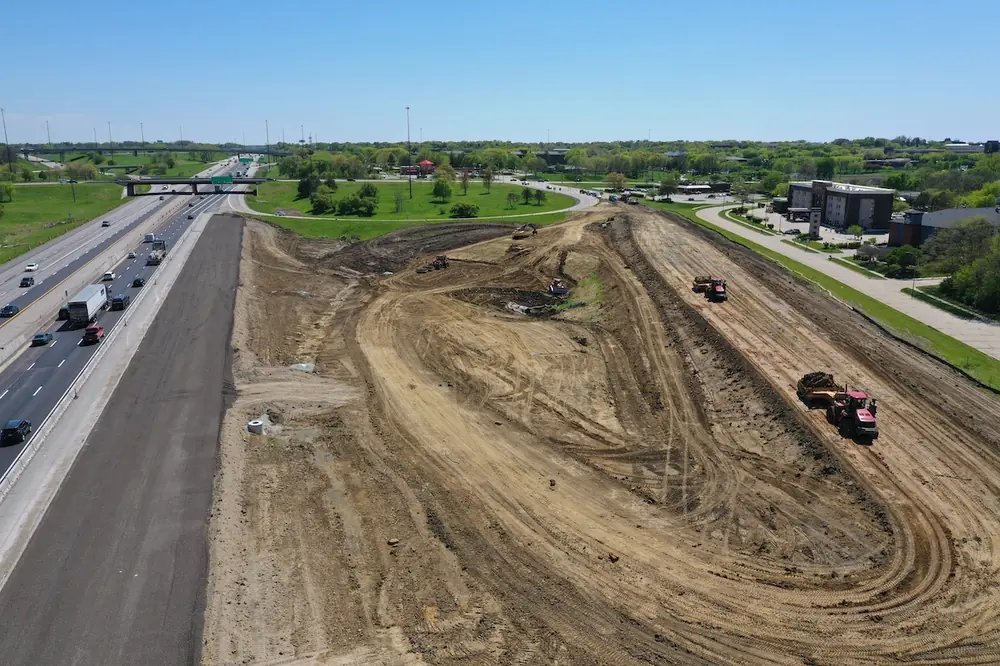

As development has accelerated throughout the western suburbs of Des Moines, Iowa, congestion, longer travel times, and safety concerns have made the corridor one of the Iowa Department of Transportation’s (Iowa DOT) highest priorities for improvement. At the interchange where Hickman Road crosses Interstate 35/80, a transformation is now underway to prepare for future demand and improve safety and traffic flow.
“The primary goal behind the project was to improve safety and help reduce congestion through this corridor,” said Caleb Wright, Transportation Engineer Associate for Iowa DOT. “Projections are showing a 35 percent increase in traffic by 2042. This further points to a need for improvement along this corridor.”
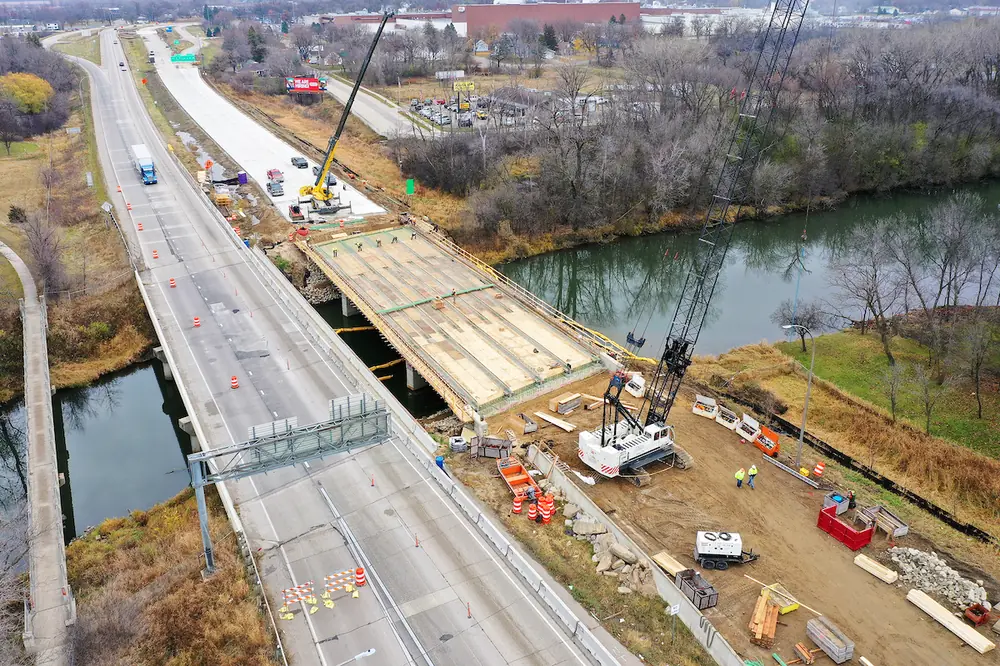
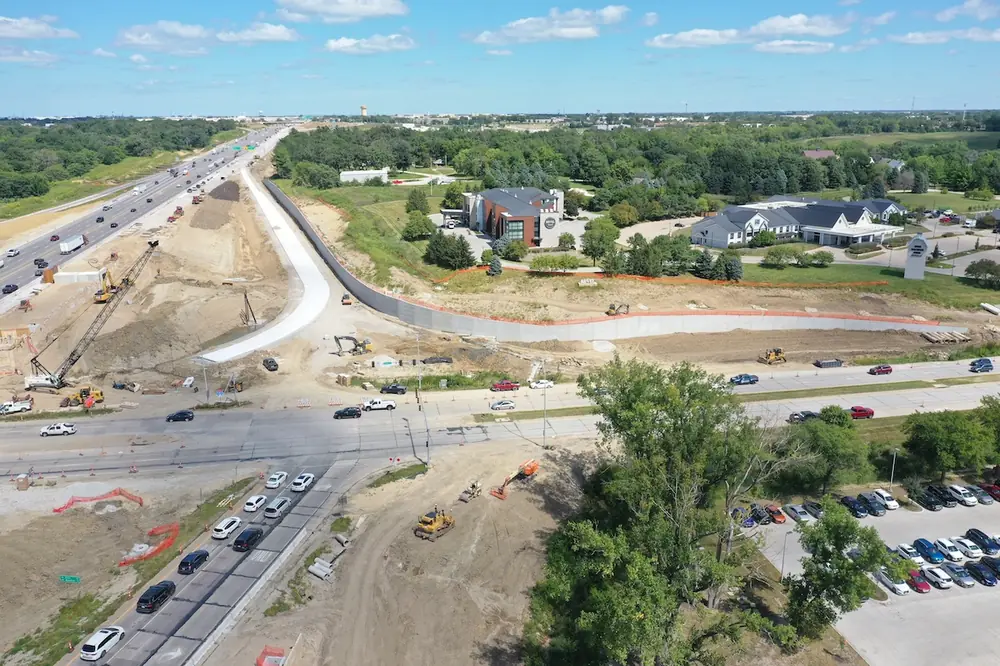
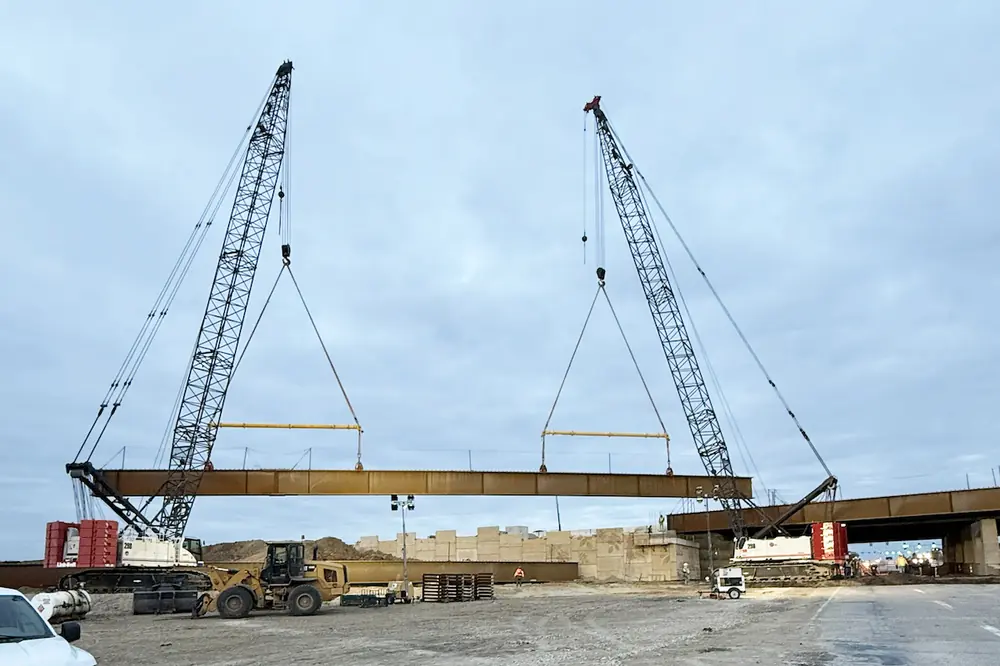
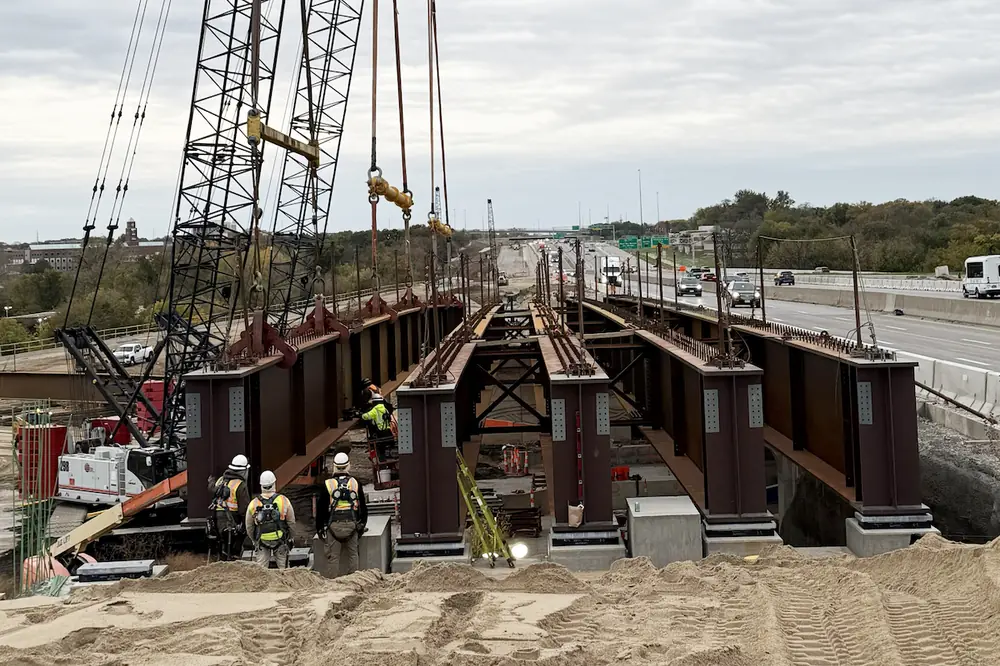
The Hickman Road Interchange project is replacing the existing diamond interchange with a modern diverging diamond interchange, reconstructing bridges, adding retaining walls, and completing extensive roadway improvements. The work is being carried out by Johnston, Iowa-based United Contractors Inc. as part of a larger multi-contract effort that will modernize one of the state’s busiest transportation corridors.
The centerpiece of the project is the new diverging diamond interchange, a design that has become increasingly popular across the country for its ability to improve traffic operations while reducing conflict points.
Unlike a traditional diamond interchange, vehicles briefly cross to the opposite side of the roadway, allowing left-turning traffic to access interstate ramps without crossing opposing traffic.

| Your local LeeBoy dealer |
|---|
| Closner Equipment Co Inc |
| Romco Equipment Co |
According to Iowa DOT, the design offers measurable safety benefits while improving overall efficiency.
“Making the switch from a standard diamond interchange to a diverging diamond interchange should help reduce the total number of crashes on this corridor,” Wright said. “Rough estimates show the total number of crashes could decrease by around 15 percent, with the potential for a 45 percent reduction in serious crashes.”
The redesigned interchange also allows traffic signals to operate more efficiently.
“By removing the need for left turns across traffic, signalization can be streamlined to move vehicles through in a more efficient manner and help reduce queue times,” Wright said. “This is one of several diverging diamond interchanges planned for the state of Iowa.”

| Your local Hyundai Construction Equipment USA dealer |
|---|
| Nueces Power Equipment |
Although the diverging diamond interchange tends to receive the most public attention, much of the project’s complexity lies beneath and around the roadway.
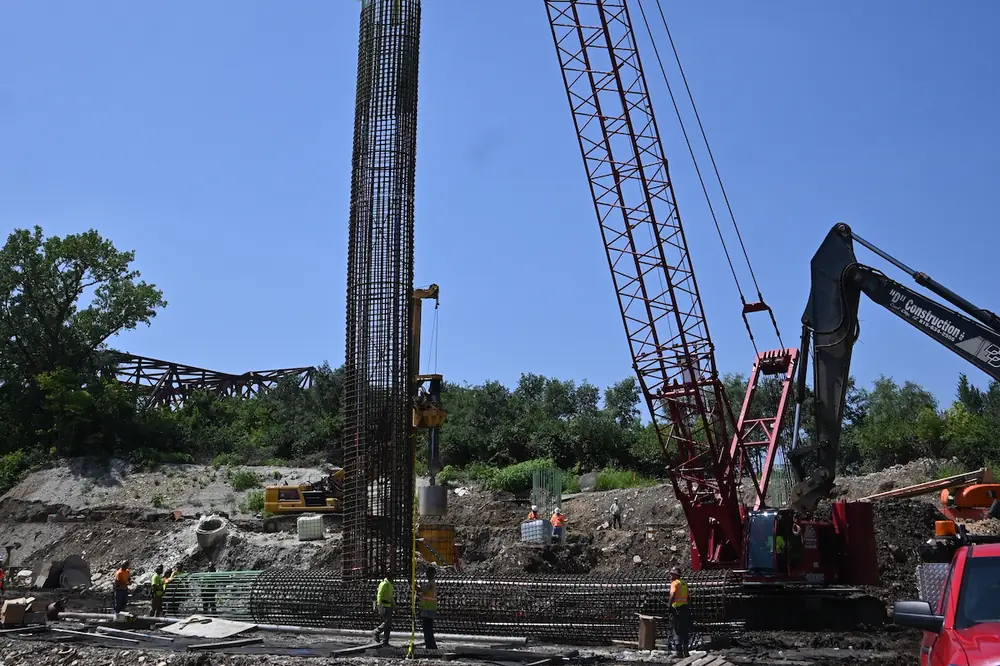
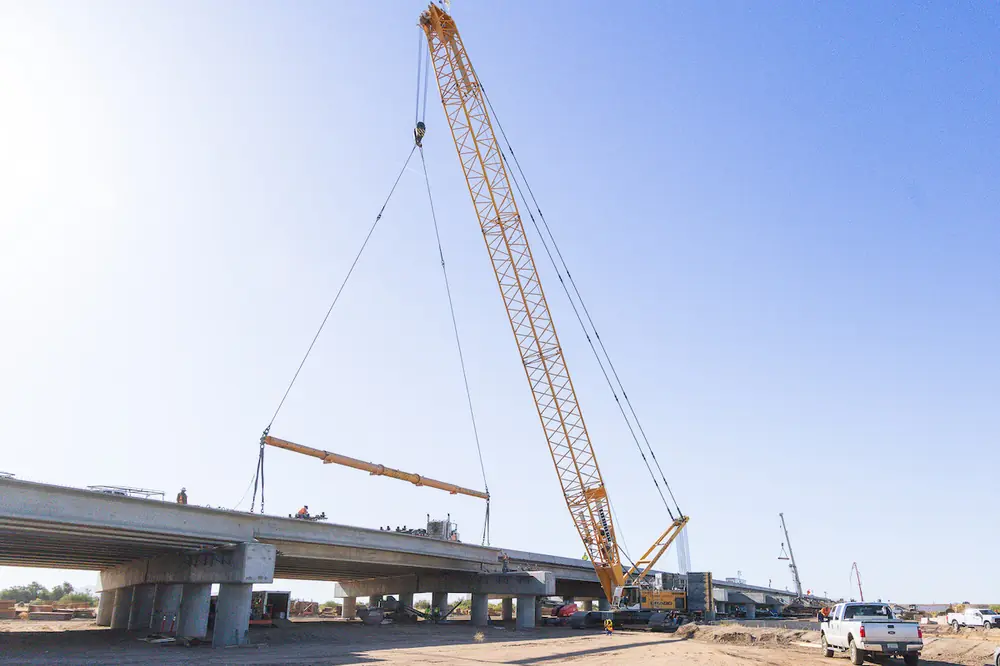
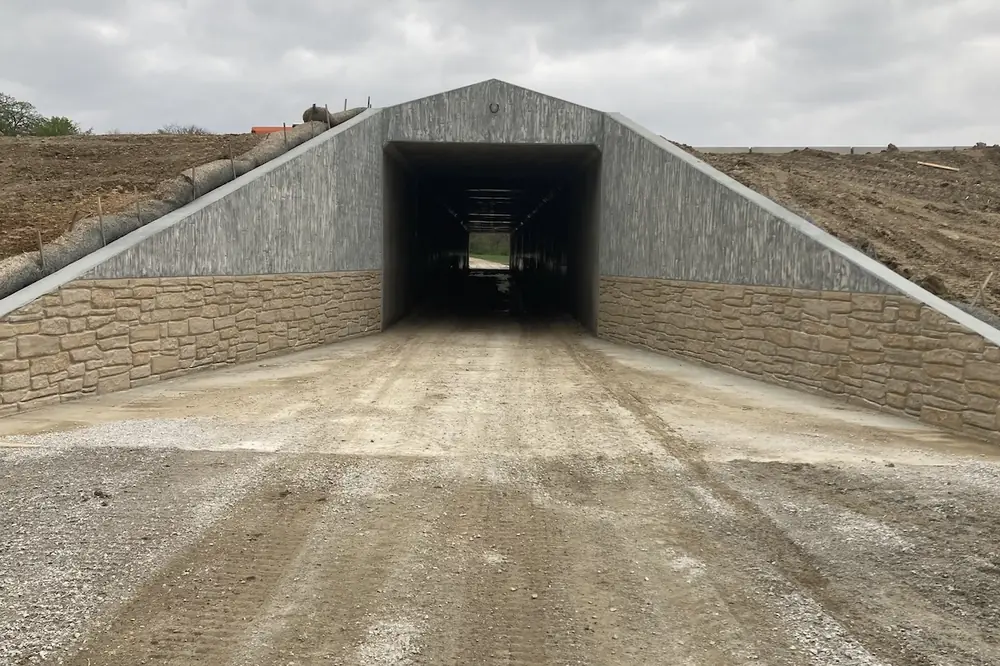
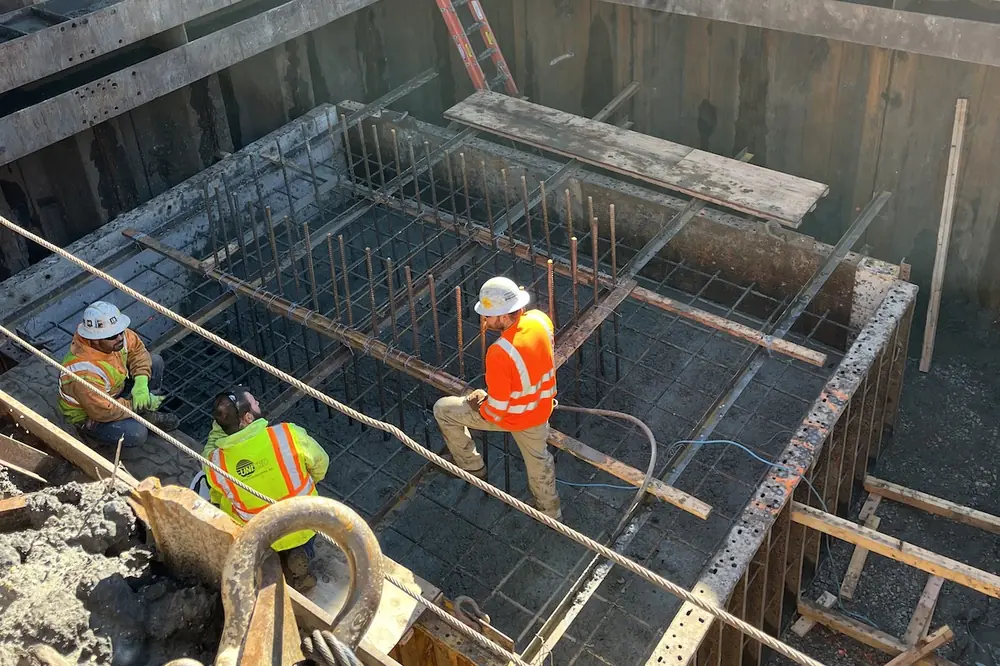
The work includes significant bridge reconstruction, mechanically stabilized earth retaining walls, roadway reconstruction, and utility coordination — all while maintaining traffic throughout the corridor.
To date, space has been one of the project’s biggest obstacles.
“The most complex element of this project was the linear nature of the work and the amount of work that needed to happen in the very small work area given by the DOT,” said Ryan Cheeseman, PE, Vice President of United Contractors. “This was coupled with the extremely aggressive schedule established for the project.”

| Your local Gomaco dealer |
|---|
| Closner Equipment Co Inc |
Maintaining that schedule has required careful sequencing between bridge construction, roadway reconstruction, and utility work.
Before construction even began, United Contractors developed a detailed schedule identifying the project’s critical path and coordinating work among multiple subcontractors.
“DOT allowed certain phases to be worked on at the same time,” Cheeseman said. “We scheduled operations so that each contractor could move from phase to phase and maximize the amount of work being completed during each stage.”
Wright noted that much of that sequencing was established long before crews arrived on site.

| Your local Wirtgen America dealer |
|---|
| Nueces Power Equipment |
“Prior to beginning the project, our contractor created a schedule to determine the critical path for construction,” he said. “For example, before any of the new ramp paving could begin, several mechanically stabilized earth walls had to be constructed first.”
The design and construction of the mechanically stabilized earth walls have presented one of the project’s greatest engineering challenges.
“Each wall functions by locking the soil and reinforcement together so the entire mass acts as a single stable gravity structure, and every wall on this project has required a unique design and construction approach,” Wright said.
While construction crews have worked within a confined footprint, motorists have continued traveling through the corridor. Maintaining that traffic safely has required extensive planning long before each phase began.

| Your local Yanmar dealer |
|---|
| WPI |
| CLM Equipment Co |
“Throughout the project, our contractor has followed specific staging requirements developed during the planning phase to minimize disruption to the traveling public,” Wright said. “One example was limiting ramp closures so consecutive ramps were never closed at the same time.”
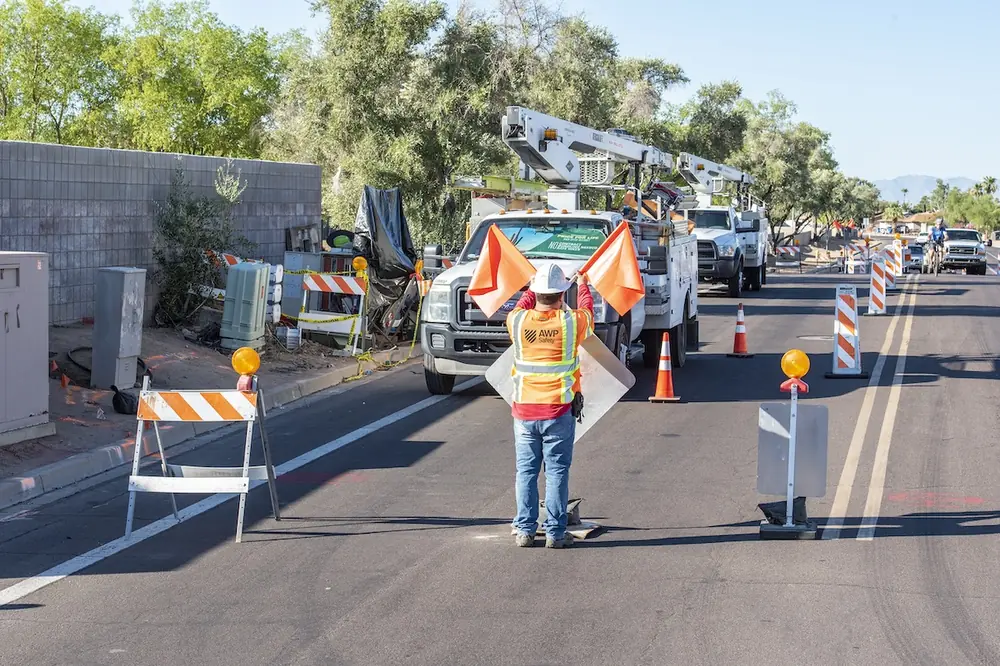
Most lane closures have been limited to overnight hours, with assistance from the Iowa State Patrol when needed. Emergency pull-offs were also incorporated throughout construction to provide additional shoulder space during incidents.
Constant communication has also been important once work moved into the field.
“Traffic control and staging were established by the DOT, and constant communication between all contractors and DOT personnel has been key to making small adjustments so traffic impacts are minimized as much as possible,” Cheeseman said.

| Your local Trimble Construction Division dealer |
|---|
| SITECH SE Texas |
| SITECH Tejas |
Weekly progress meetings have allowed both teams to anticipate upcoming work and resolve issues before they affect the traveling public.
“Every week since August 2024, progress meetings have been held to discuss the project and review potential issues,” Wright said. “Depending on the issue, additional coordination may be needed with other DOT departments or the design team.”
The Hickman Road interchange improvements have required the project team to adapt to unexpected conditions while maintaining progress toward an aggressive schedule. One of the largest efforts occurred before major construction even began.
“Before the first phase of the project could begin, many utilities had to be relocated,” Wright said. “A separate contract was created that provided one common path for the utilities to follow, reducing the size of the exclusion zone and minimizing conflicts. That required a tremendous amount of coordination between the state and all of the utility companies.”

| Your local Astec dealer |
|---|
| Closner Equipment Co Inc |
Even though much of that advance work helped reduce conflicts later in construction, the contractor still encountered several utility issues once work was underway.
“We had some minor utility conflicts involving critical-path activities that we worked through with the DOT,” Cheeseman said. “We also had a couple of major utility conflicts on non-critical-path activities that required several months to resolve. For the most part, though, the DOT had done an excellent job getting utilities cleared before construction started.”
Daily field conditions have also required flexibility.
“With any construction job, there is always the unexpected,” Wright said. “Each day, minor adjustments may be made due to differing site conditions.”

| Your local Hitachi dealer |
|---|
| ASCO Equipment |
That ability to adapt has become an important component of maintaining momentum throughout the project.
While utility coordination presented one set of obstacles, Mother Nature created another. Heavy rainfall during the 2025 construction season significantly affected production.
“The greatest challenge from the resident construction engineer office’s perspective has been maintaining the schedule,” Wright said. “Weather plays a large role in many of the contractor’s operations. During July and August alone last year, we experienced more than 30 days of rain, which significantly impacted several construction activities.”
To maintain the schedule, work had to continue through the winter months.

| Your local Bobcat dealer |
|---|
| Bobcat of North Texas |
| Compact Construction Equipment, Inc |
“We’re proud of the amount of work we were able to accomplish despite the aggressive schedule,” Cheeseman said. “It certainly wasn’t easy after losing part of June and essentially all of July to rain.”
Even with those weather setbacks, the project team continued advancing critical activities whenever conditions allowed, carefully coordinating crews and subcontractors to recover lost time.
Throughout construction, close collaboration between Iowa DOT, United Contractors, and the project’s design partners has helped keep work moving while minimizing disruptions.
“We’ve held weekly progress meetings with the DOT since the start of the project,” Cheeseman said. “Those meetings have been extremely helpful in identifying upcoming issues and keeping construction activities on schedule.”

| Your local Gradall Industries dealer |
|---|
| Kirby-Smith Machinery |
| WPI |
“When necessary, additional coordination takes place with other DOT departments or members of the design team to work through questions before they affect construction,” Wright added.
That constant communication has proven particularly valuable given the number of moving parts involved in the project, from bridge construction and retaining walls to paving operations, utility relocations, and traffic staging.
According to Wright, the collaborative approach has helped keep the project on track despite numerous challenges.
“From the DOT’s point of view, the contractor has done a great job with the overall execution of the project,” he said. “Together, we’ve worked through countless issues to keep this project on track and ultimately met our goals for progress last year.”

| Your local Astec dealer |
|---|
| Closner Equipment Co Inc |
With the project scheduled to finish by the end of 2028, additional contract work will continue over the next couple of years — but Iowa DOT noted that motorists can already begin to see the transformation taking shape.
“We expect motorists to benefit from congestion relief, shorter wait times around the interstate ramps, and improved safety,” Wright said.
The new diverging diamond interchange is expected to move traffic more efficiently through one of central Iowa’s busiest freeway crossings while accommodating continued growth throughout the western Des Moines metropolitan area.
As traffic volumes continue to climb over the coming decades, officials believe the investment will position the corridor to meet future transportation demands while reducing crashes and improving reliability for thousands of motorists each day.

| Your local Link Belt dealer |
|---|
| Nueces Power Equipment |
| Central Texas Equipment |
- Owner: Iowa Department of Transportation
- General Contractor: United Contractors Inc., Johnston, Iowa
- Subcontractors: Abaci, Absolute Group, Advanced Traffic Control, Concrete Technologies Inc., DM2, Des Moines Steel Fence, Dormark Construction, Elder Corporation, Gryp Construction, Gus Construction, InRoads, Iowa Plains Signing Inc., Iron Works, Keller, Linhart, Manatts, Voltmer