


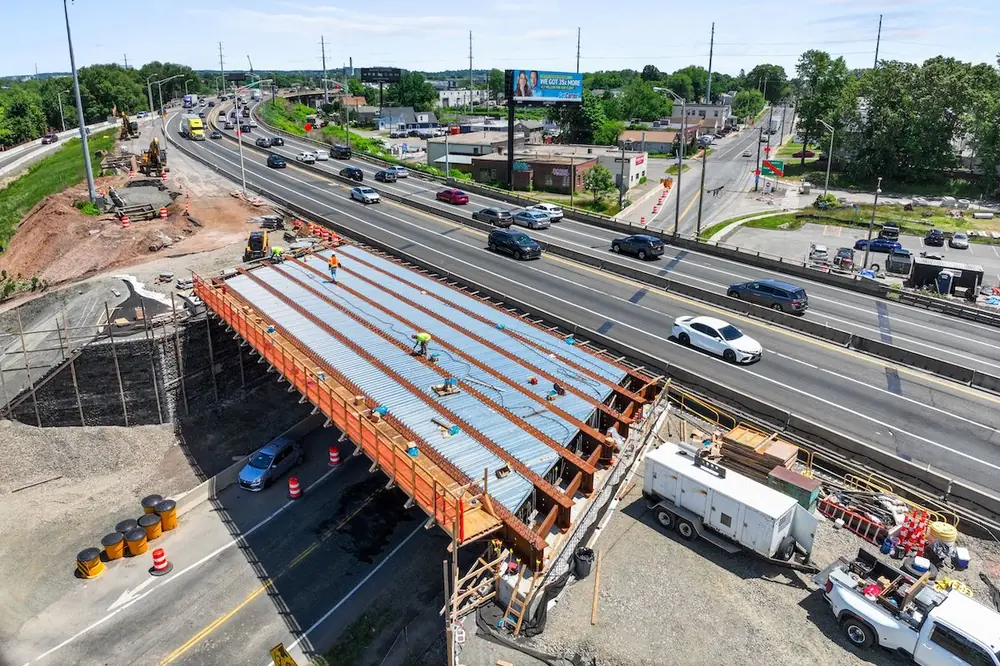
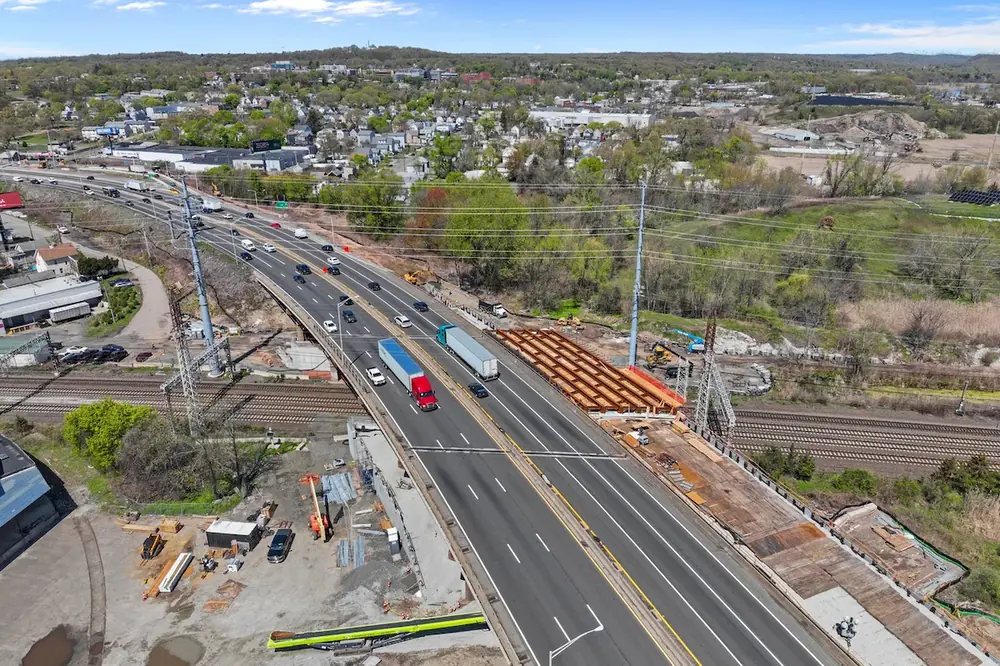
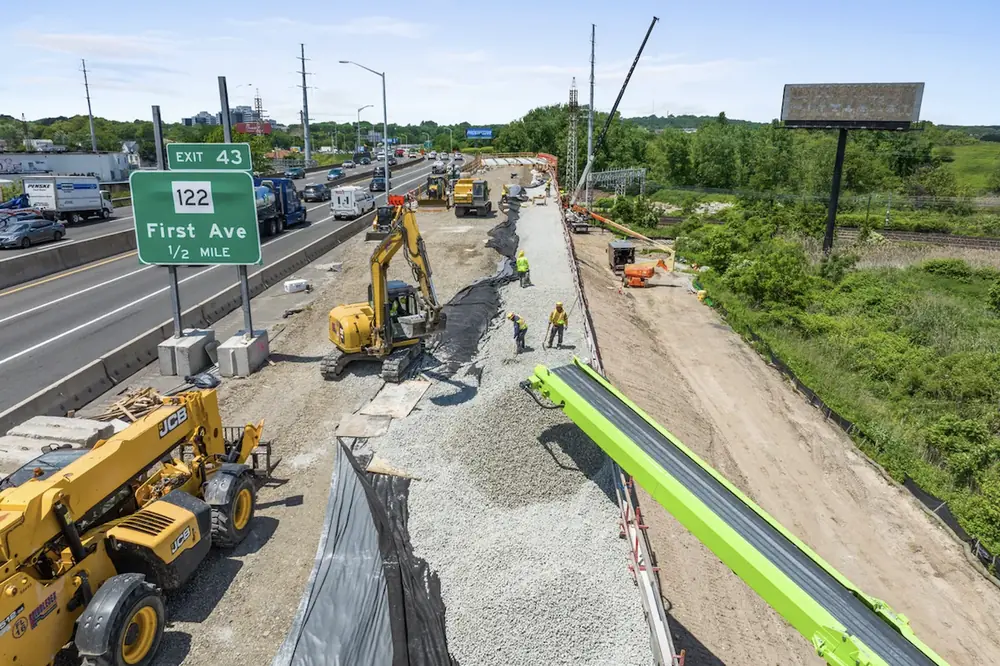
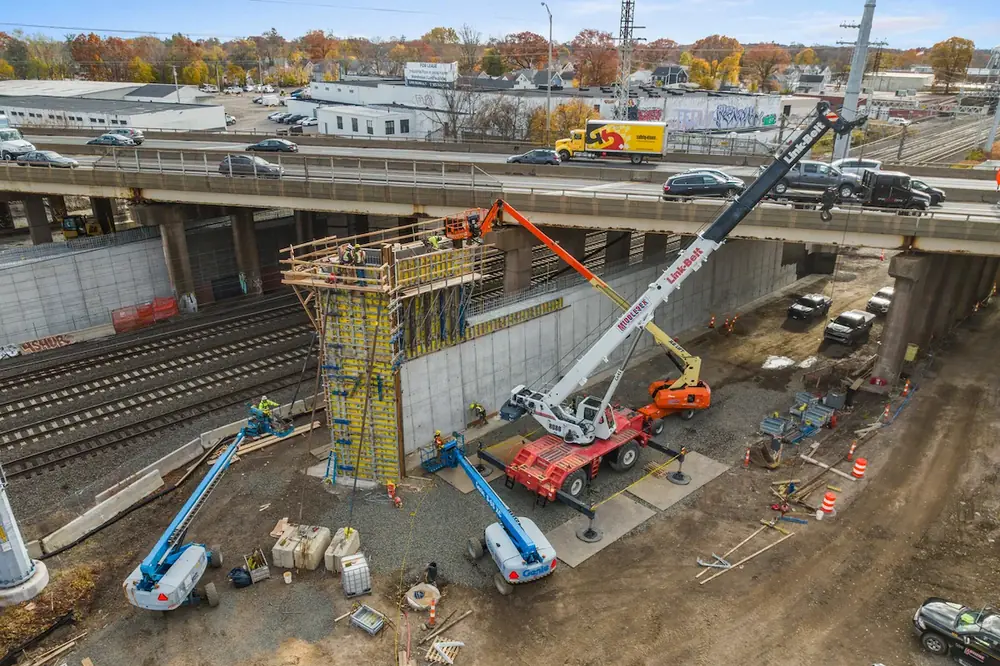
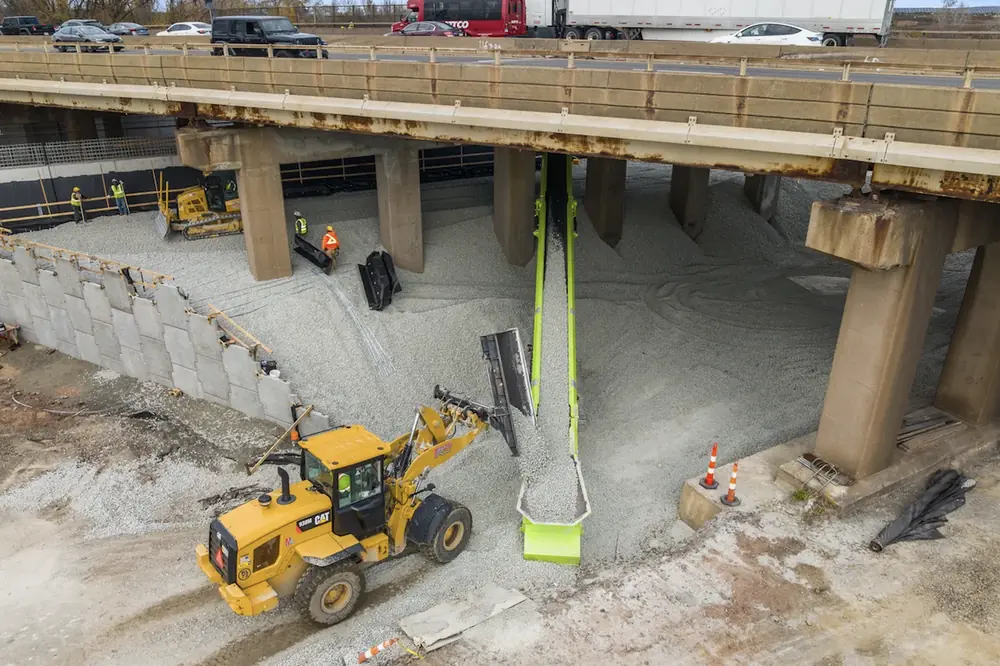
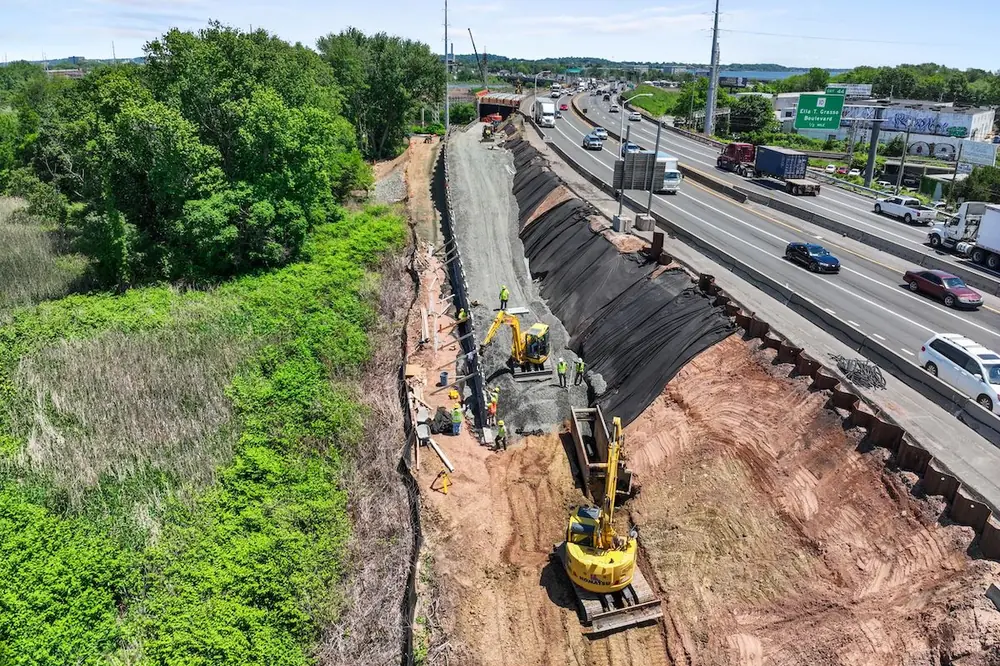
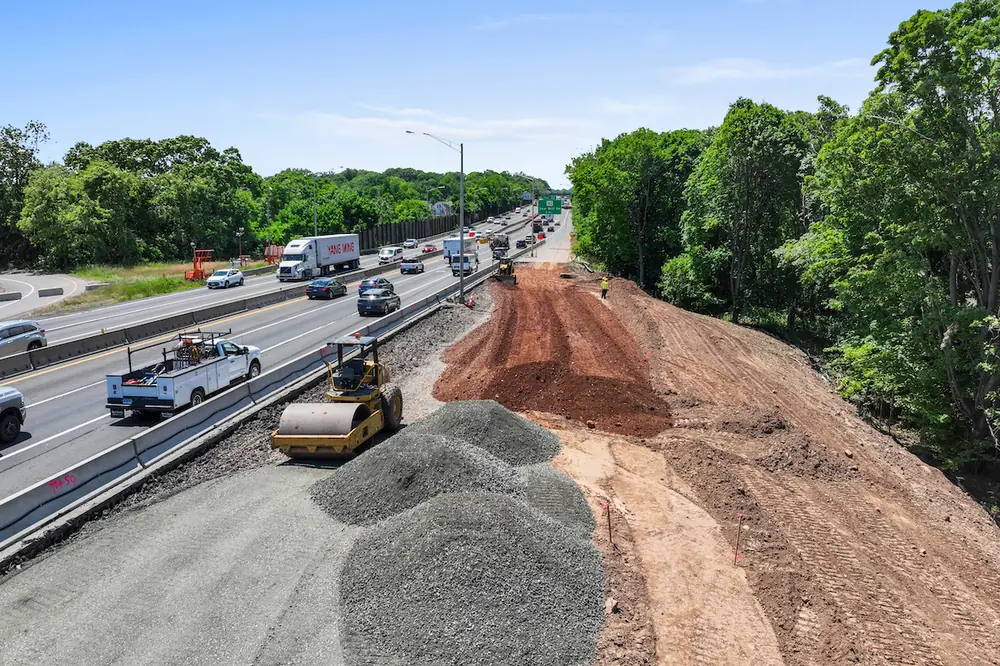

Replacing two aging bridges on Interstate 95 would be a major undertaking under almost any conditions, but a project at Interchange 43 in West Haven, Connecticut, presents additional challenges. The work must accommodate one of New England’s busiest highway corridors, a local street network, an active Metro-North Railroad right of way, and a long-term closure of a heavily used entrance ramp.
The Connecticut Department of Transportation (CTDOT) is addressing those challenges through a $136.5 million program combining bridge replacement with highway widening, ramp improvements, signal upgrades, and reconstructed roadway approaches. The Middlesex Corporation is leading the design-build team, with H&H serving as lead designer. GM2 Associates is providing construction engineering and inspection services for CTDOT.
Advance work began in 2024, followed by major bridge construction in 2025. The project is expected to continue through fall 2027. A $96.7 million design-build contract was awarded to The Middlesex Corporation with H&H in August 2023, while the broader project is funded with 90 percent federal and 10 percent state funds.
The project is more than simply replacing two deteriorated structures. Eva Zymaris, a spokesperson for CTDOT, described it as a corridor-wide effort intended to correct traffic and geometric shortcomings that have developed over decades.
“The purpose of the project is to reduce traffic congestion, enhance traffic flow, and increase safety at I-95 Interchange 43 in the City of West Haven,” she said. “The work includes widening and reconstructing I-95 and replacing the bridges over First Avenue and the Metro-North Railroad, both of which are in poor condition.”

| Your local Gomaco dealer |
|---|
| Gomaco -Contact For a Dealer Near You |
Both bridges date to 1956. Bridge No. 00161 over First Avenue was reconstructed in 1990, while Bridge No. 00162 over the railroad was rehabilitated in 1988. The replacement structures are being designed for a minimum service life of 75 years.
According to Zymaris, the new First Avenue bridge will increase vertical and horizontal clearance while providing broader shoulders and additional space for the northbound acceleration lane. The railroad bridge will be widened to accommodate three southbound travel lanes, a 12-foot operational lane, and substantially larger shoulders.
Bridge condition was only part of the problem. The existing interchange forces motorists to merge and exit within constrained distances that no longer match current traffic demands.
“The biggest safety issue at this interchange is the short acceleration lane for the Exit 43 northbound on-ramp,” Zymaris said. “There also was no deceleration lane for the southbound Exit 43 off-ramp to First Avenue, and the bridge over the railroad tracks did not have adequate shoulders.”

| Your local Volvo Construction Equipment dealer |
|---|
| Nuss Truck & Equipment |
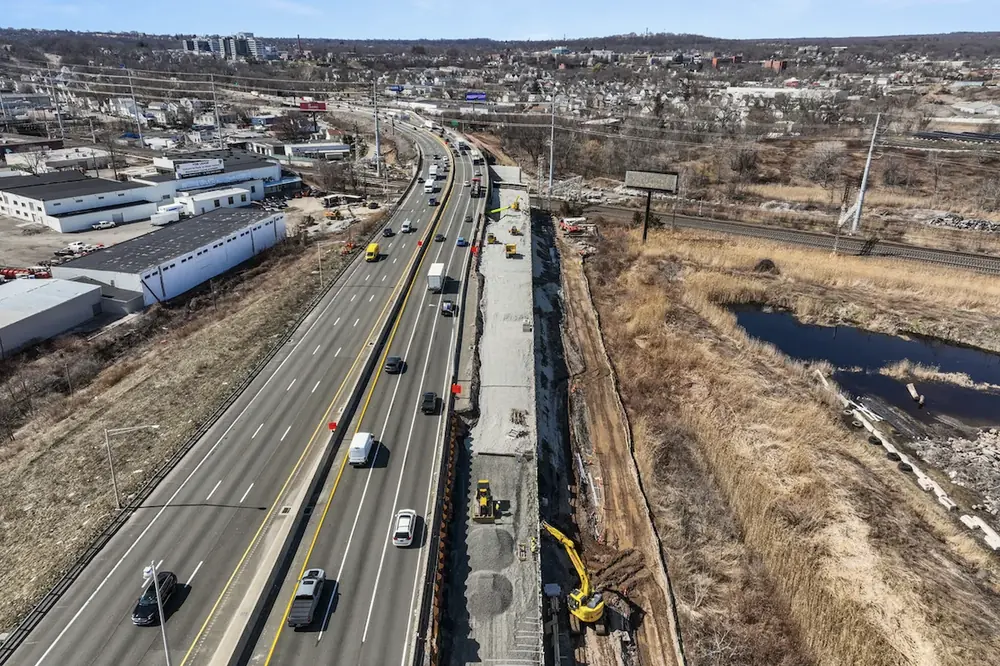
Approximately 2,200 feet of I-95 will be reconstructed to extend the southbound lane from the Exit 44 on-ramp toward Exit 43. The lane will function as an operational lane before transitioning into an exit-only deceleration lane. Additional roadway work extends the project limits to roughly 3,000 feet to address the highway’s cross slope through the curve.
CTDOT selected design-build delivery to compress the schedule on a corridor where prolonged construction would create significant impacts. The approach allows design and field work to advance concurrently rather than requiring the entire design to be completed before construction begins.
“The design-build approach accelerates the design process and ultimately reduces construction time by allowing design and construction to occur at the same time,” Zymaris said. “The delivery method also enabled innovations in design and the consideration of different construction techniques.”
CTDOT’s design liaison consultant and construction engineering consultant became involved early, creating a review structure intended to identify conflicts before they reached the field.

| Your local Trimble Construction Division dealer |
|---|
| SITECH Northwest |
| SITECH Mid-America |
| SITECH Dakotas c/o Butler Machinery |
“Coordination among CTDOT, Middlesex, and H&H was accomplished through weekly design coordination meetings, over-the-shoulder design reviews, and comment resolution meetings,” Zymaris said.
Crews also completed work needed for future traffic shifts and advanced foundation activities beneath the existing bridges before the main replacement stages began. That early work created room for the larger sequence without immediately disrupting normal interstate traffic.
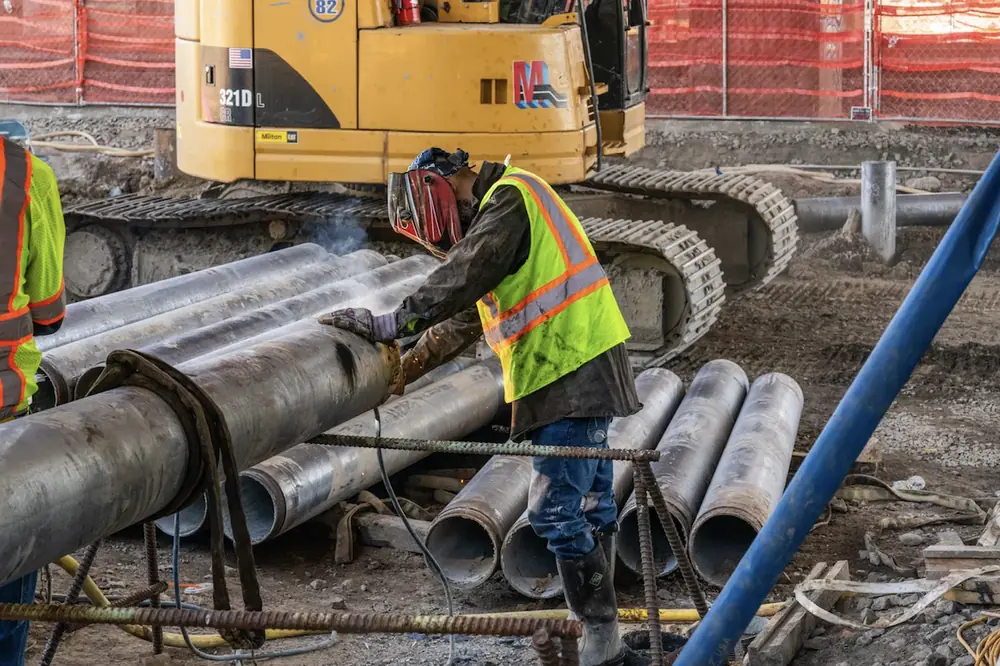
Conditions below the roadway have presented some of the project’s most significant engineering difficulties. Unsuitable soils and elevated groundwater required the team to account for conditions that could affect stability, excavation, and staging.
“One of the engineering challenges was meeting the geotechnical requirements,” Zymaris said. “The project has unsuitable soils and high groundwater elevations.”

| Your local Komatsu America Corp dealer |
|---|
| Road Machinery and Supplies Company |
Environmental approvals created a parallel schedule concern.
“Advancing the plans beyond 60 percent completion was necessary to obtain permit registration,” Zymaris said. “The team worked closely to ensure the permits were obtained without affecting the project schedule.”
The finished corridor will include stormwater quality measures developed to meet CTDOT and Connecticut Department of Energy & Environmental Protection requirements. Increased clearances at First Avenue will also create room for potential future improvements below the interstate.
More than 142,000 drivers use this section of I-95 on an average day, leaving little room for extended reductions in highway capacity. The project is being staged to maintain three lanes in each direction during daytime hours, with lane closures generally limited to lower-volume periods.
| Your local Gomaco dealer |
|---|
| Gomaco -Contact For a Dealer Near You |
The most visible disruption is the closure of the Exit 43 northbound entrance ramp. The ramp closed in July 2025 and is expected to remain unavailable through November 2027, allowing crews to reconstruct the northbound side of the interchange and lengthen the acceleration lane.
Currently, motorists entering I-95 northbound are directed to Interchange 44 through signed detours using First Avenue, Route 122, Campbell Avenue, Boston Post Road, and Ella T. Grasso Boulevard.
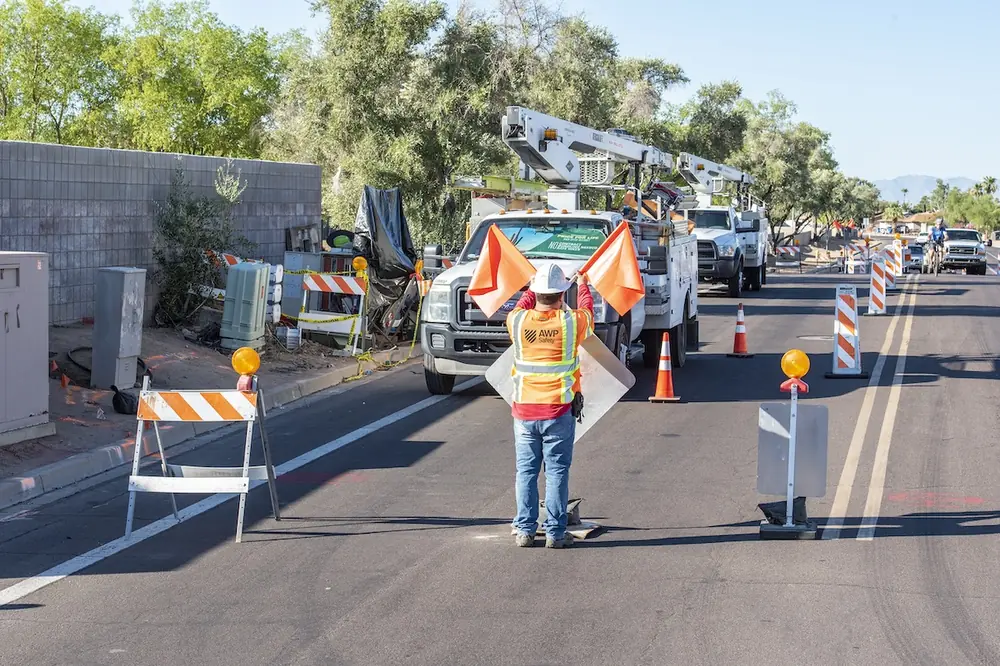
“Maintaining traffic on I-95 while keeping workers and the traveling public safe is imperative,” Zymaris said. “Careful staging, limited lane closures, and signage help keep people moving safely through the corridor while construction progresses.”
The work is organized around successive shifts rather than one large closure. Southbound bridge and lane construction is followed by median reconstruction, after which the project moves into the northbound bridge and roadway work. Traffic must be moved onto newly completed pavement before the next section becomes available to crews.
| Your local Gomaco dealer |
|---|
| Gomaco -Contact For a Dealer Near You |
The bridge over the Metro-North right of way adds another critical interface, requiring the interstate structure to be renewed without avoidable disruption to highway or rail operations.
CTDOT is supplementing conventional traffic control with technology intended to give drivers better information before they reach changing conditions.
For instance, Smart Work Zone equipment uses real-time sensors and messaging to communicate congestion and work activity. Project cameras and CTDOT traffic cameras provide additional visibility, while the project website posts construction advisories, detour information, and schedule updates.
“Know the Zone work zone speed cameras are also active in this work zone,” Zymaris said.
| Your local Gomaco dealer |
|---|
| Gomaco -Contact For a Dealer Near You |
Public communication began before major construction through an open house and coordination with West Haven and New Haven. Outreach continues as traffic patterns and ramp access change.
The extended entrance-ramp closure makes consistency particularly important. Drivers will be informed where detours are located and why those routes will remain in place through several construction stages.
The completed project will create operational changes in both directions of I-95. Southbound traffic will gain a continuous operational lane between the Exit 44 entrance and Exit 43 exit, reducing the pressure created when entering vehicles merge into the mainline only to encounter traffic preparing to leave the interstate. Northbound drivers entering from Exit 43 will have a longer acceleration lane and more distance to reach highway speed before merging.
Traffic signals at the southbound Exit 43 off-ramp and Spring Street intersections will be upgraded and coordinated by time of day, helping prevent congestion at the ramp terminal from feeding back toward I-95.
| Your local Gomaco dealer |
|---|
| Gomaco -Contact For a Dealer Near You |
“The capacity of I-95 southbound will be improved by extending the operational lane from the Exit 44 on-ramp to the Exit 43 off-ramp,” Zymaris said. “Northbound capacity will be improved by lengthening the Exit 43 acceleration lane, providing vehicles with an easier merge onto the highway.”
Wider shoulders will provide additional recovery space and improve access for emergency response and maintenance. Eliminating bridge joints over bearings and other maintenance-intensive components is also expected to reduce long-term upkeep costs.
The work at First Avenue extends the benefits beyond the interstate. Greater vertical and horizontal clearance will improve sight distance on the local roadway and allow future improvement projects to be considered without the same constraints imposed by the existing bridge.
As of late summer 2026, permit registration, final design, and the advanced construction stage have been completed. The project team is now working through the bridge and roadway sequence that will move traffic from the existing structures onto newly built sections before reconstruction shifts across the corridor.
| Your local Gomaco dealer |
|---|
| Gomaco -Contact For a Dealer Near You |
The first major phase focuses on southbound bridge and lane construction. Median work follows, with the northbound bridges and lanes forming the final major stage. The northbound entrance-ramp detour will remain in effect until the work approaches completion.
Construction is scheduled to conclude in fall 2027, ending a program that will have rebuilt two interstate bridges, widened I-95, and reconfigured traffic movements through one of West Haven’s most constrained transportation locations.
“This project delivers long-term benefits by increasing safety, easing congestion, and improving overall traffic flow along I-95,” Zymaris said. “Replacing aging bridges, extending merge and operational lanes, and coordinating critical intersections will create a smoother, more efficient transportation network for years to come.”
- Owner: Connecticut Department of Transportation
- General Contractor: The Middlesex Corporation, Littleton, Massachusetts
- Lead Designer: H&H, New York, New York
- Construction Engineering and Inspection: GM2 Associates, Glastonbury, Connecticut
- Subcontractors: McLellan Tree, Farace Company, Nutmeg Piping, Concrete Cutting Co., NYM Group, New England Infrastructure, JR Vinagro, New England Boring, AR Trucking, FHI Studio, VHB, GZA, Martinez Couch, GZA GeoEnvironmental, Atlas Drilling, Eagle Fence, John Paul Garcia, Corr Tech, Hardesty & Hanover, Quaker Corp., Warning Lights, Structural Services, Safety Markings, Kinetic Demo, American Coating, Davis Tree, All Seasons Landscaping, Designs By Ilde, ETC Electrical, Alvarez, Strategic, McVac Environmental