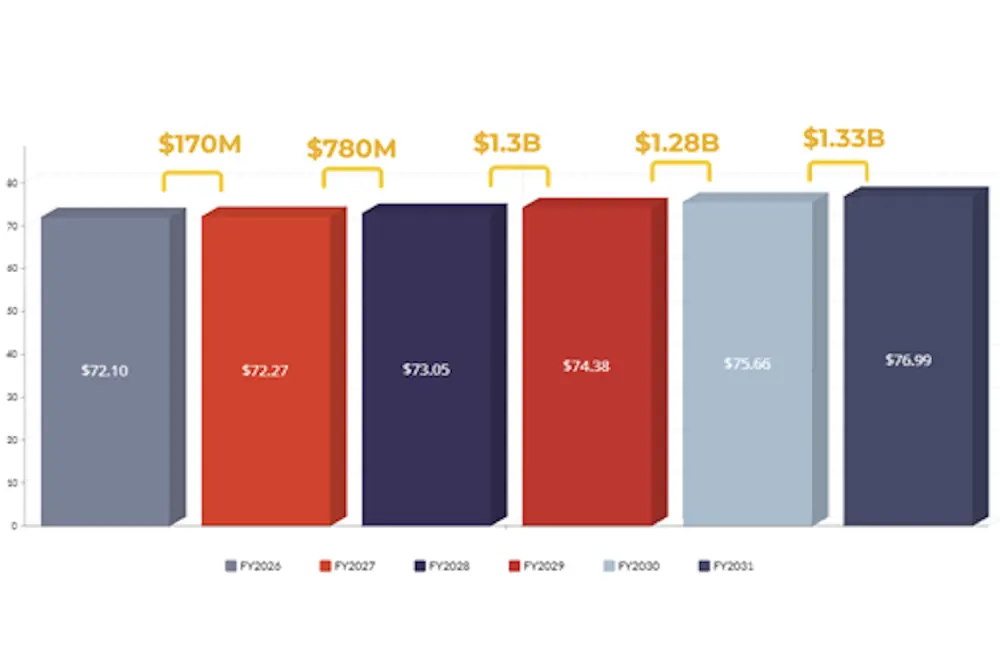

House Transportation and Infrastructure Committee Chair Sam Graves (R-Missouri) and Ranking Member Rick Larsen (D-Washington) released a five-year surface transportation reauthorization bill called the Building Unrivaled Infrastructure and Long-Term Development for America’s 250th Act (BUILD America 250 Act). The bill would authorize $580 billion in funding for highway, transit, and safety programs through September 30, 2031.
According to the American Road & Transportation Builders Association (ARTBA), the measure would maintain core formula programs, create new revenue for the Highway Trust Fund, and include reforms to enhance project delivery and work zone safety.
“I’m extremely proud of the historic level of investment in America’s bridges — at more than $50 billion, it’s the largest such investment in our history,” Graves said. “And the BUILD America 250 Act ensures that electric vehicle owners begin paying their fair share for the use of our roads. The bill also makes smart and targeted reforms to our surface transportation programs, focuses on strengthening our core infrastructure system, drives innovation, bolsters safety, ensures states have the flexibility they need, and cuts red tape to get projects built faster.”
Below are highlights from ARTBA’s initial analysis of the bill.
The Build America 250 Act continues total highway investment at current levels, with slight growth adjustments as the duration of the bill goes forward.

| Your local Komatsu America Corp dealer |
|---|
| Brandeis Machinery |
The highway formula programs would increase by more than 3 percent in year one, with more modest growth in the out-years. Formula funds would receive 90 percent of the proposed resources, and the remaining 10 percent would be directed to discretionary and allocated programs.
The bill would eliminate $3.7 billion in annual funding for three climate-focused formulas programs, the Carbon Reduction Program, National Electric Vehicle Infrastructure Program, and the PROTECT Resiliency Program.
The measure would increase bridge formula program funding from $5.5 billion to $9 billion annually, but would make the current bridge discretionary grant program subject to annual appropriations. Total funding of $45 billion in bridge investments over five years would represent a 12 percent increase over prior law.
The program would require at least 25 percent of funds go to local and off-system bridges.

| Your local Case Construction Equipment Inc dealer |
|---|
| Burris Equipment |
The proposal modifies or eliminates several discretionary grant programs and, in some cases, rolls that money into formula programs.
A new discretionary grant program called the Surface Transportation Accelerator Grants (STAG) Program would provide $2.4 billion annually, with 50 percent of funding reserved for local and regional grants, 25 percent for rural grants, and 25 percent for urban grants.
The Safe Streets and Roads for All Program would continue, but would lower guaranteed investment levels by half, relative to the current authorization: $500 million for fiscal year 2027, rising to $1 billion for fiscal year 2031.
Numerous other discretionary grant programs — including the INFRA, MEGA, and RAISE, which support multimodal, regional, and freight-related projects — would be authorized at current investment levels, but are no longer guaranteed. Instead, the responsibility for funding these programs would shift to the congressional appropriations process.

| Your local Case Construction Equipment Inc dealer |
|---|
| Birkey's Construction Equipment |
Mass transit programs would receive a $2 billion investment cut to $16.9 billion in fiscal year 2027, with modest growth thereafter. This cut is due, in large part, to the elimination of $1.6 billion in annual guaranteed Capital Investment Grants (CIG) included in current law.
The CIG program, which supports transit capital projects, is authorized at $3 billion each year, but all resources would need to be secured through the annual appropriations process.
The BUILD America 250 Act would establish a $130 annual fee on electric vehicles (EVs) and $35 annual fee for hybrid vehicles to ensure all users of the highway system support its maintenance and upkeep. These provisions would represent new revenue to the Highway Trust Fund for the first time in decades.
The fees would gradually increase every two years but are capped at $150 for EVs and $50 for hybrids.

| Your local Trimble Construction Division dealer |
|---|
| SITECH Indiana |
| SITECH Mid-America |
| SITECH Ohio |
| SITECH Mid-South |
| SITECH Midway |
ARTBA called the EV and hybrid user fees “a welcome recognition of the importance of the user pays system” but said Congress will have to identify additional resources to cover the measure’s total expenditures.
The bill would shorten page and time limits for environmental review for major projects.
The threshold for projects qualifying for a categorical exclusion is raised from $6 million to $12 million.
States are now able to renew their assignment status under the National Environmental Policy Act (NEPA) every 10 years, up from every five years.

| Your local Takeuchi Mfg Ltd dealer |
|---|
| Brandeis Machinery |
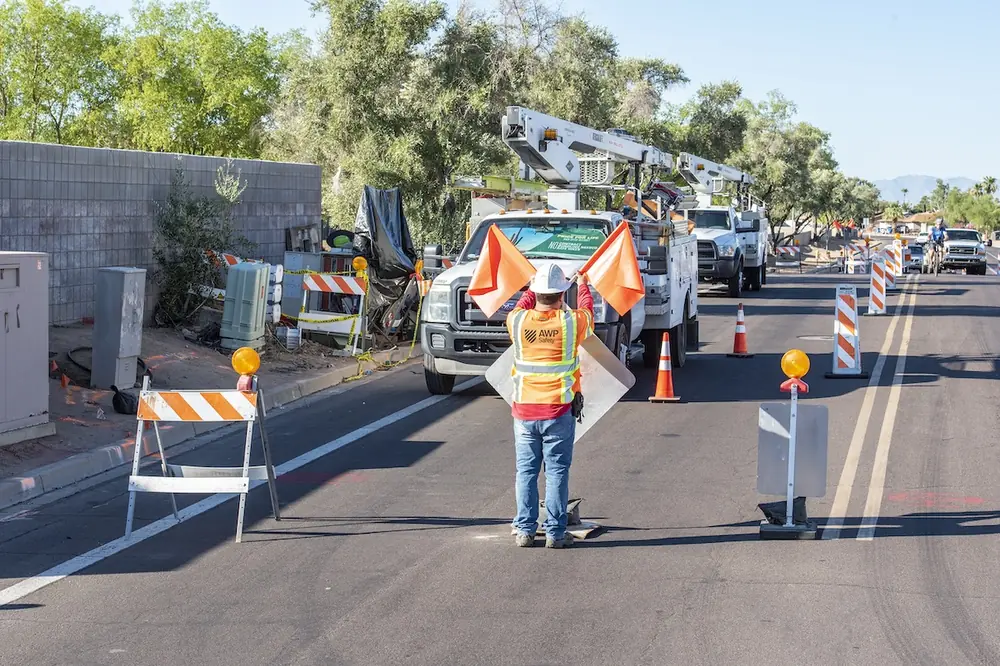
Roadway workers are a specific focus throughout the Highway Safety Improvement Program (HSIP) section, including in safety data collection, construction zones as hazardous locations, and the definition of road users. These provisions will help differentiate roadway workers from other pedestrians in the policymaking process.
An interagency working group would be established to develop recommendations for work zone protections and require stakeholder input.
Recipients of federal funds are encouraged to use digital technologies like 3D models and cloud-based platforms when completing environmental reviews.
Digital technologies, including eticketing, are included as eligible HSIP activities.

| Your local Sennebogen LLC dealer |
|---|
| Brandeis Machinery |
The Advanced Digital Construction Management Systems Program is reauthorized.
The BUILD America 250 Act would reauthorize the Disadvantaged Business Enterprise (DBE) program, setting a “national, aspirational goal” of at least 10 percent to be achieved “through good faith efforts” of state and local transportation agencies.
The provisions are consistent with the U.S. Department of Transportation’s (USDOT) recent interim final rule and removes references to “discrimination” and minority- and women-owned businesses, instead citing “social and economic disadvantage” as the basis for continuing the program.
The measure would instruct the Secretary of Transportation to develop “objective criteria” for states to use in evaluating individuals applying for DBE certification.

| Your local Wirtgen America dealer |
|---|
| Brandeis Machinery |
The bill would direct the Secretary of Transportation to issue guidance so states can audit procurements and identify “anticompetitive bidding patterns” and “reduce reliance on historical data when developing engineer’s estimates.”
If enacted, it would establish a committee within USDOT, including representatives of state departments of transportation and industry associations, for recommendation of federal regulatory revisions to prevent anticompetitive bidding practices on federal-aid highway projects.
The House Transportation and Infrastructure Committee is scheduled to act soon. The House Energy and Commerce Committee, Science, Space, and Technology Committee, and Ways and Means Committee will also consider sections of the bill prior to consideration by the full House.
The Senate Environment and Public Works Committee is aiming to release their highway portion of a reauthorization bill this summer, ARTBA said.

| Your local Bobcat dealer |
|---|
| O'Leary's Contractors Equipment & Supply |
Existing highway and transit authorizations are set to expire September 30, 2026.