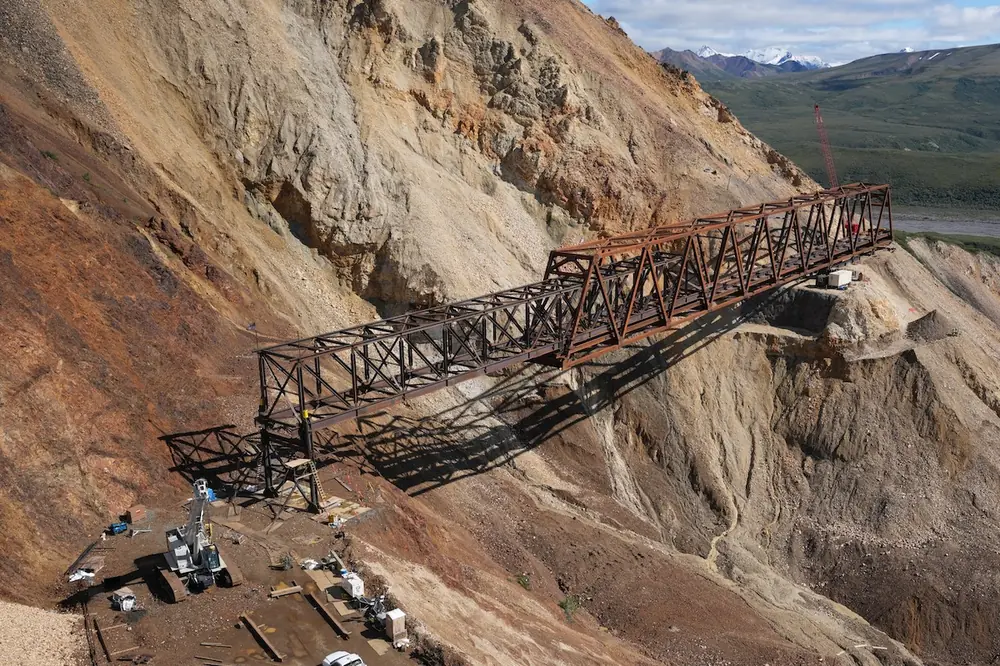

Editor’s Note: This is part two of the Pretty Rocks Bridge story, which first appeared in the March issue. Part one told the story of Granite Construction’s revised approach to the bridge design. The new single-sided truss bridge will connect two sides of the Denali Park Road that had been cut off by a landslide.
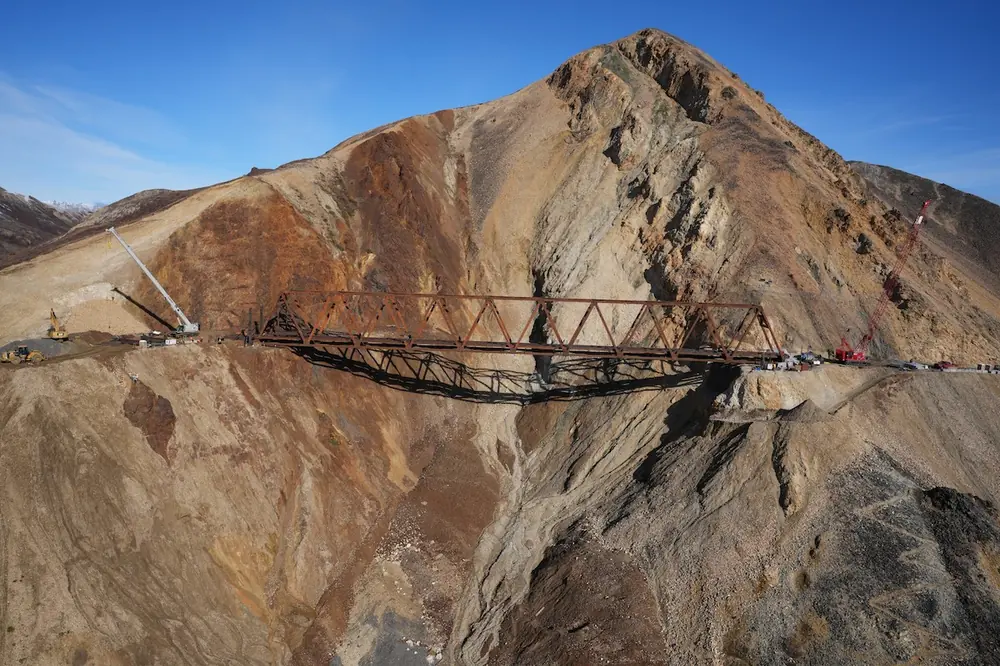
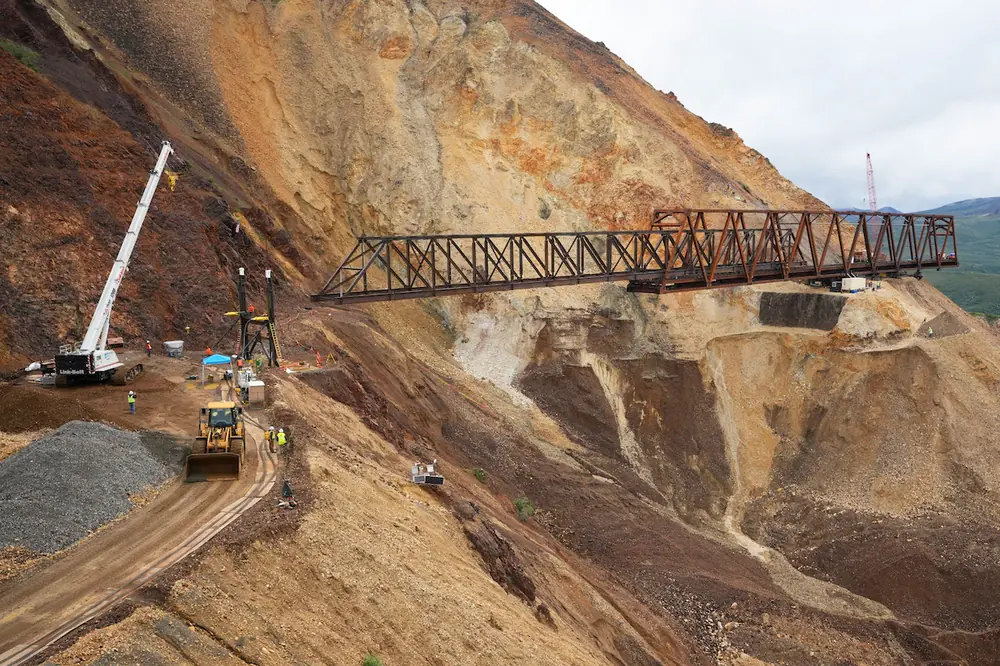
In Alaska’s Polychrome Pass, the Pretty Rocks Landslide located at mile 45.4 of Denali Park Road displaced a portion of the roadway infrastructure, prompting the Pretty Rocks Bridge project.
For California-based Granite Construction Company, the remote location and access at the job site was a significant challenge, requiring crucial upfront planning to execute the unique single-sided truss design in a challenging permafrost region.
With the underlying ground conditions changing on geologic whims, the team early on implemented the construction manager/general contractor (CMGC) contracting method, allowing the builders to understand the design process so they could adapt as the landslide changed.
With the CMGC approach, the team worked through constructability concerns — including where to use a high-line system or a one-sided approach — and created a more accurate budget estimate.

| Your local Komatsu America Corp dealer |
|---|
| Linder Industrial Machinery |
“There are always unknowns in construction, but this process allowed the project team to mitigate a lot of challenges ahead of time, which kept the project on schedule and under budget,” said Patrick Murphy, Project Manager, Granite Construction Company. “This is a unique location with unique geological hazards, so you need to get people that are experienced and understand how to handle these situations.”
“Doing a [traditional] hard bid on this kind of project wouldn't have delivered the results that were needed,” he added. “This job would've been delayed so much if that were the case. This contracting method was definitely the right choice.”
Due to the ice-rich ground and the geology of the western cut of Polychrome Pass, the unstable, shifting slopes could no longer support the anchor loads the suspended cable system used to transport materials. Once the bridge cut off access to the east side, and the landslide took out the road, the project was dead-ended at the eastern abutment.
Purple basalt rock, an igneous or “fire-formed” rock, was created by ancient Denali lava flows. It has a dense, crystal-like structure, making it resistant to deformation and a competent location for the new bridge’s anchor.

| Your local Bomag Americas dealer |
|---|
| Linder Industrial Machinery |
On the eastern side, a different type of material is found called rhyolite. Also an igneous rock, rhyolite is the result of thicker, stickier magma that traps gas as it cools. This forms into a more brittle rock made up of weaker planes, giving to much less predictable behavior.
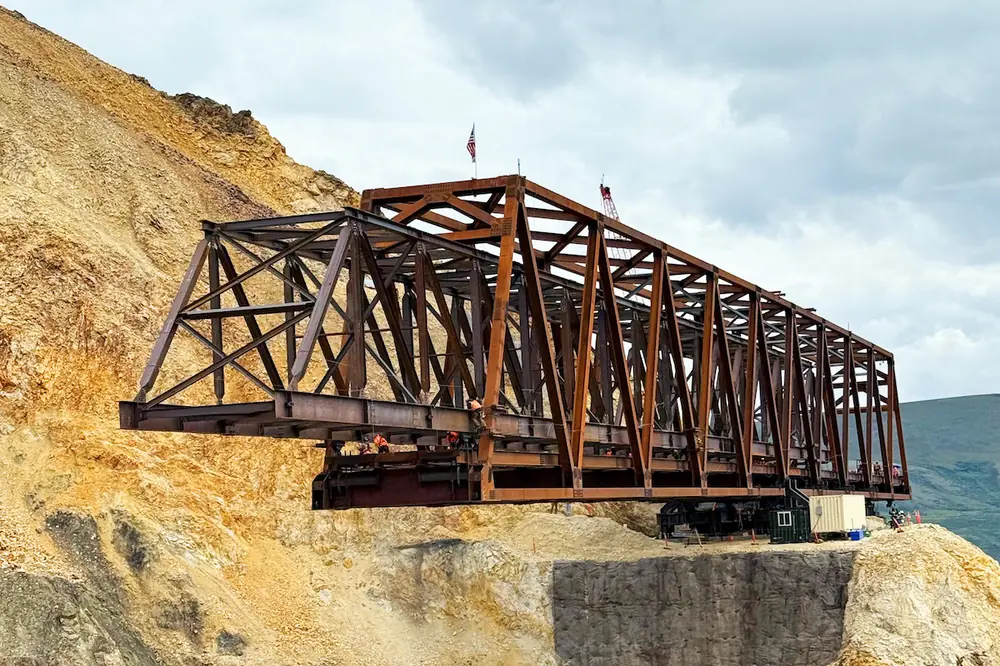
The new single-sided bridge launch approach was specially designed and built for this project.
“It’s not an off-the-shelf system,” Murphy said. “Every connection, bolt, you name it, was analyzed and looked at by Granite Construction, KWH, Somerset, and Jacobs.”
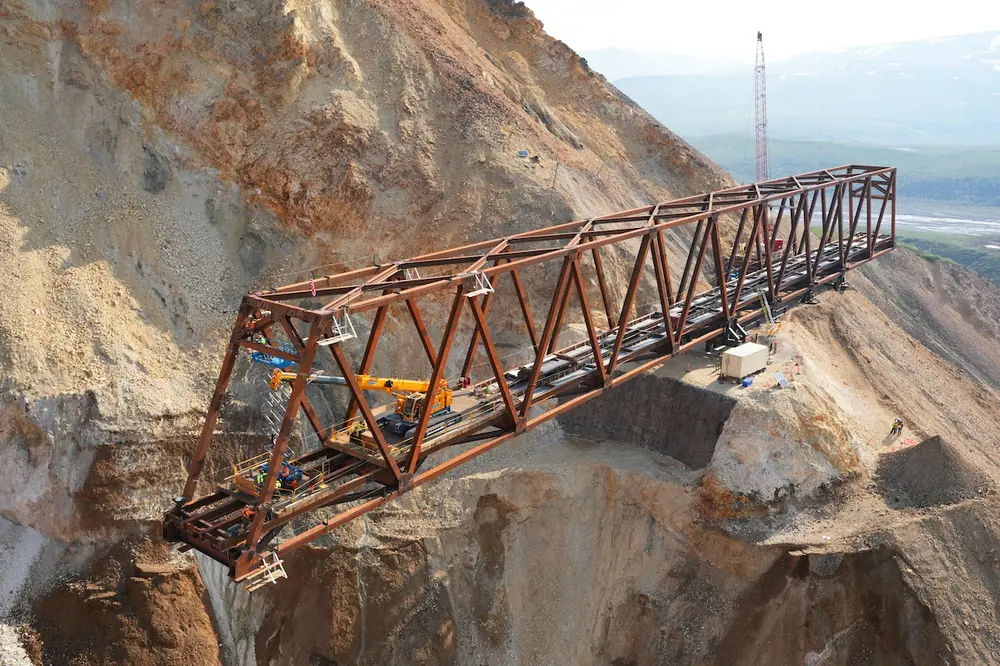
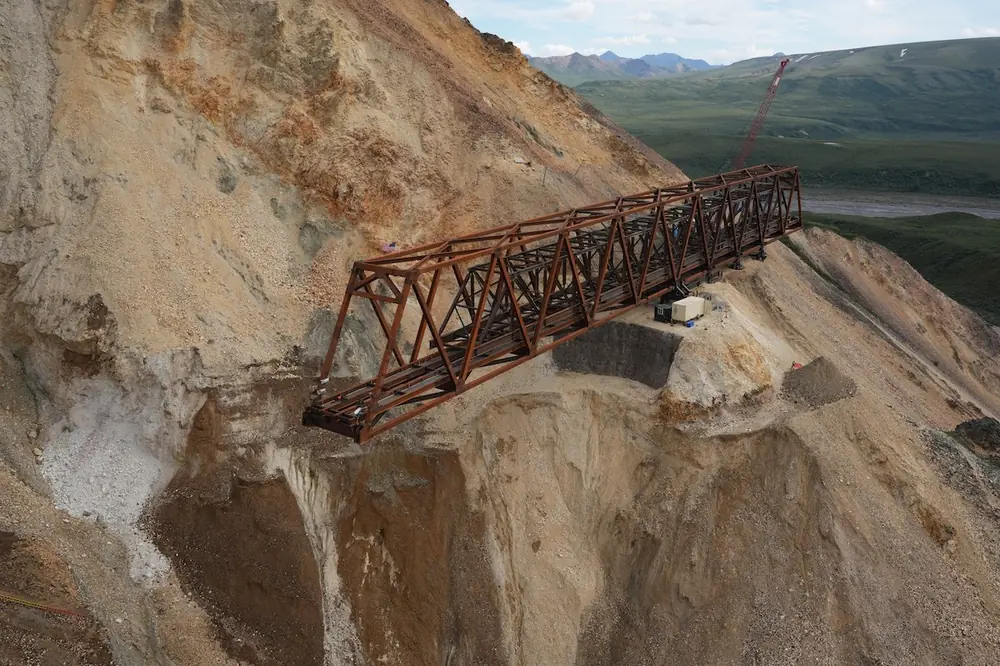
As the team approached the 2025 construction season, they focused on launching the 475-foot bridge and setting it down on its abutments. According to Murphy, roughly 1.65 million pounds of steel were launched across the active landslide.

| Your local Volvo Construction Equipment dealer |
|---|
| Richmond Machinery & Equipment |
Work then began on installing the prefabricated Sandwich Plate System deck paneling, while crews completed utility excavation and the final grading.
“We also completed the east precast wall installation, and the thermosiphon system was installed, charged up, and properly working,” Murphy said.
According to the U.S. Geological Survey (USGS), permafrost hides under 85 percent of Alaska. In the USGS’s “The United States National Climate Assessment - Alaska Technical Regional Report,” it says that the permafrost is warming over most of the state of Alaska, with increasing temperatures broadly consistent with increasing air temperatures. On the Arctic coastal plain of Alaska, permafrost temperatures showed some cooling in the 1950s and 1960s but have been followed by a roughly 5-degree increase since the 1980s.
“In the springtime, anywhere from 2 feet to 8 feet is where you're going to start seeing permafrost,” Murphy said. “It’s wild. A lot of things are moving up there in Alaska because the permafrost is melting off.”

| Your local Topcon Positioning Systems Inc dealer |
|---|
| Linder Industrial Machinery |
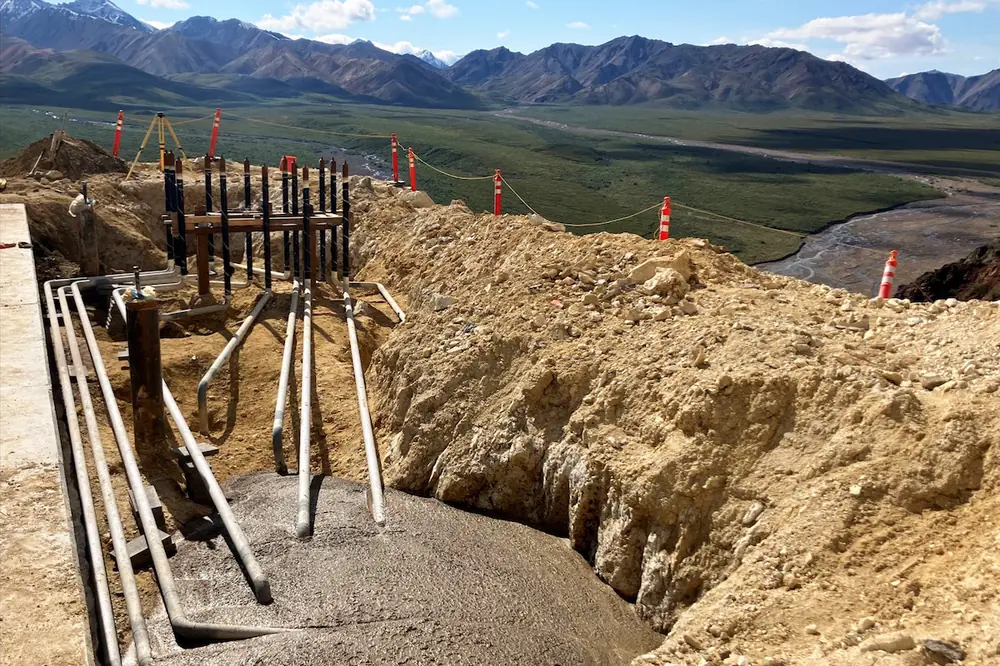
A unique aspect of the Pretty Rocks Bridge project that is growing in popularity is the use of thermosiphons. In locations with permafrost conditions, such as in Alaska, thermosiphons are often used to counter geologic forces on structures caused by thawing.
A thermosiphon is a device that uses passive heat exchange to circulate a fluid without using a pump. It can be used to circulate liquids and volatile gases in applications such as water heaters, boilers, heat pumps, and furnaces.
“If the ice was to melt off, it would be detrimental to the integrity of the bridge, essentially creating a very big slip plane, which is why the landslide happened,” Murphy said. “The whole purpose is to remove heat from the ground and keep the ice frozen beneath the abutment.”
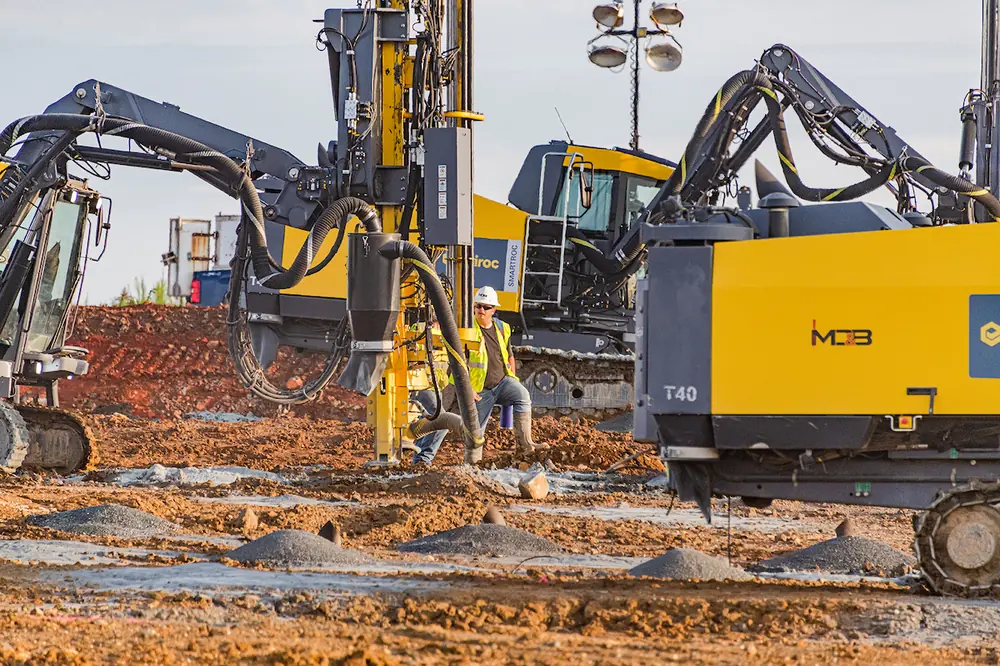
Anchorage, Alaska-based subcontractor Arctic Foundations installed and welded the thermosiphons, while DBM Contractors Inc., a Washington-based drilling contractor, drilled and worked with Granite to set the vertical thermosiphon devices in place.

| Your local Trimble Construction Division dealer |
|---|
| SITECH Mid-South |
The thermosiphons were placed on both sides of the east abutment, going down roughly 105 feet.
A launch truss is a temporary steel framework that attaches to the front of a bridge segment and helps the bridge span a gap prior to the permanent structure supporting itself.
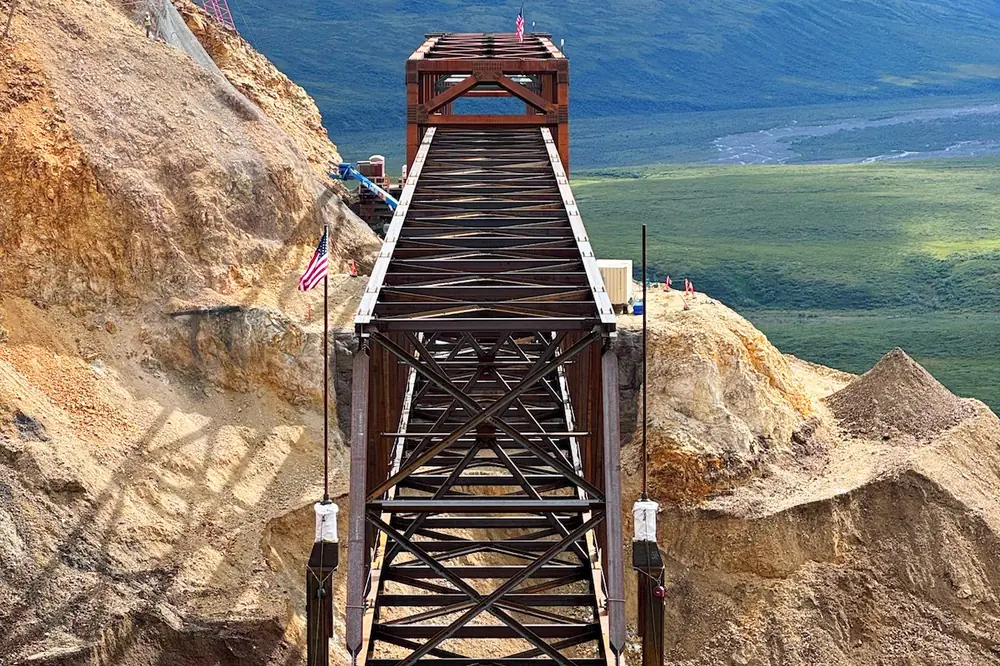
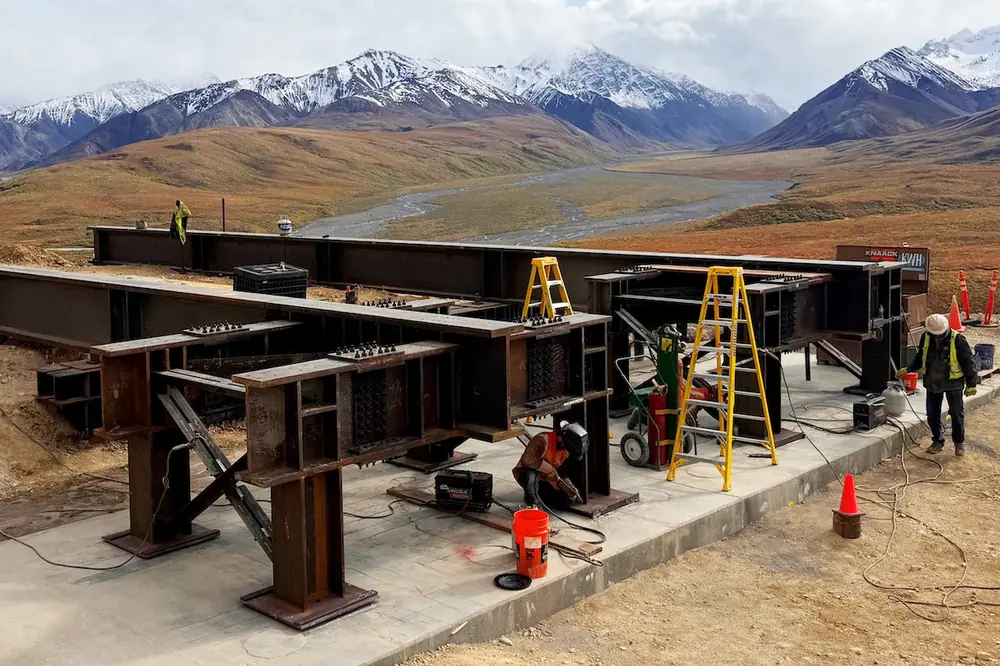
The entire bridge was built on the east abutment, and a smaller launch truss was built inside of that bridge, allowing the team to push it across to meet a receiving tower on the other side. Once it reaches the receiving tower, they pull the whole entire bridge across.
KWH Constructors and Somerset designed and installed the launch truss portion of the project. The team custom built the bridge launch, taking into account the very tight tolerances needed to slide the launch truss through the inside of the actual bridge and across the landslide.
| Your local Komatsu America Corp dealer |
|---|
| Linder Industrial Machinery |
“As you come to these connections, there's different flange widths, there's different rollers, there's different items of this bridge that'll kind of get bound up,” Murphy said.
KWH, a specialty contractor headquartered in Issaquah, Washington, was responsible for construction engineering, truss detailing, preassembly, and the erection and launching of the steel bridge. KWH also worked with Hillman Rollers to make custom rollers for this project.
“KWH did a very good job of knowing this was going to be a problem, and they had crews at each connection point, and each item of concern,” Murphy said. “They'd go for 40 feet to the next connection point, and then they'd ‘all hands on deck’ in those areas to help progress that through, and so forth.”
According to Murphy, the crew spent approximately two days physically sliding the launch truss across the span. Once it was in position, they locked it down, securing the structure to prepare the bridge for the next construction phase.
| Your local Komatsu America Corp dealer |
|---|
| Linder Industrial Machinery |
“After every launch, we'd have to go back and inspect the bridge, inspect the launch truss, and make sure everything was still in good working order,” Murphy said. “A couple of times we saw some items of concern that we had to go back and double check, just reanalyze, make sure things are still good.”
The team used a specialty crawler crane supplied by Liebherr for the project: a Liebherr telescopic LTR 1060. It combines the features of a telescopic crane with those of a crawler crane, offering short set-up times, simple transport, and a powerful boom system adopted from Liebherr’s telescopic cranes.
“It’s a smaller crane that has pretty good capacity for its size,” Murphy said. “We built a crane ramp at the start of the season. This crane was able to crawl up similar to how an excavator would crawl up a steep slope.”
The Liebherr crane crossed a smaller ramp-like bridge, small enough to fit inside the larger bridge, in order to cross over to the actual bridge itself.
| Your local Komatsu America Corp dealer |
|---|
| Linder Industrial Machinery |
“As they cantilevered this bridge out to the west over the slide, this crane would pick up the steel behind it, swing it over in front of it, and then stick build the entire bridge progressing over the slide,” Murphy said.
As the bay was completed, the same crane would shuffle tools, material, and crane mats to the next bay, and then crawl out.
The Granite team also used Propeller Aero, a drone-mapping and construction analytics company based in Sydney, Australia, to provide a cloud-based platform for turning drone data into 3D terrain models and digital snapshots. The team conducted weekly drone flights to monitor progression of the landslide, creating a timelapse of the construction project.
“That was a valuable tool for gathering quantities and up-to-date layouts for planning purposes,” Murphy said. “Each week, we'd fly the drone, and that data would get uploaded to a server where BGC would take that data and analyze the project site. They would then have 3D models of the slide moving.”
| Your local Komatsu America Corp dealer |
|---|
| Linder Industrial Machinery |
Granite Construction and KWH found that building a single-side launch approach is indeed feasible in a remote small footprint within an ice-rich environment.
“It works, but it’s tedious to get everything out there,” Murphy said. “But if you've only got access from one side, this is how you can do it with minimal environmental impact to the national park, the geology, and the rest of the mountainside.”
With one final season this year, finishing the bridge deck is the next major milestone. This will allow the National Park Service to access the western half of the road and allow for efficient construction traffic.
“When we had our access road built for three to four months, we were able to get truck traffic across as well,” Murphy said. “So, a lot of the inholders that haven't been to their homes or accessed their homes for the last few years, finally will be able to. Once this is done, it is back to normal operations for the national park, which is a big success.”
| Your local Komatsu America Corp dealer |
|---|
| Linder Industrial Machinery |
The project site has been shut down since early October 2025. The team will mobilize in early April 2026 to achieve substantial completion by early July.
The remaining work consists of completing the bridge decking and railing; installing the wearing course, west precast walls, and the west drainage culvert; placing in the precast ramps; wall installation; and then final grading of the job.
“I don't think in 10 years from now we could have been able to get access across the slide without doing some substantial work,” Murphy said. “I think we got this done at the last available time.”
Granite Construction is aiming to complete the project for full visitor access by summer 2027.
| Your local Komatsu America Corp dealer |
|---|
| Linder Industrial Machinery |
- Owners: Federal Highway Administration/National Park Service
- General Contractor: Granite Construction Inc., Watsonville, California
- Engineers: Jacobs Engineering, Dallas, Texas; BGC, Vancouver, British Columbia
- Other Contractors: KWH Constructors (bridge erector and temporary works engineering); Advanced Blasting Services (blasting, rock anchors and rock dowels, and rock fall mitigation in 2023 and 2024); DBM Contractors Inc. (micropiles, soil nail wall, ground anchors, and launch frame piles in 2024); Hamilton (concrete precast abutments in 2024 and precast walls in 2025 and 2026); Arctic Foundations (thermosiphons and condensers in 2024 and 2025)