





Someone in a project meeting asks when the job will finish. Someone else says October 15. It goes into the schedule.
A few weeks later, October 15 shows up in the monthly report, then in a slide for management, then in a conversation with the owner. By the time someone asks, “Are we still on track for October 15?” nobody is treating it as a forecast anymore. It’s just the date. Go back far enough, though, and you’ll often find that October 15 started as somebody’s best guess.
I’ve watched this happen on many projects, and it still surprises me how little a number has to do to earn people’s trust. It doesn’t need to get more accurate. It only needs to be repeated. Once it's repeated enough, questioning it starts to feel like questioning the whole project.
How productive will the crew be? When will the steel show up? How many people will the subcontractor actually put on site? Will the design be far enough along when we need it? Is the contingency enough?
Nobody can answer those questions with certainty at the start of a job, and that’s fine. It’s the nature of the work. The problem is what happens to the answers over time.

| Your local Gomaco dealer |
|---|
| Gomaco -Contact For a Dealer Near You |
A planner puts in 20 days because it seems reasonable. An estimator uses a production rate from the last similar job. A project manager carries a delivery date forward because nothing better has come in.
Each of those calls can be perfectly sound when it’s made. But six weeks later, the number is still sitting there and nobody remembers why it was picked. It’s in the baseline, then the report, then everyone’s heads.
It has picked up an authority it never earned.
The longer a number survives, the harder it is to question.

| Your local Volvo Construction Equipment dealer |
|---|
| Nuss Truck & Equipment |
Take that 20-day activity. Maybe a similar job took about that long. Maybe it was simply the best judgment available at the time.
Now it gets tied into other activities. Procurement is lined up around it. A milestone hangs off it. Subcontractors plan their mobilization around the dates it produces. Those 20 days now hold up a whole chain of decisions. And the longer it holds up, the harder it gets to challenge.
Nobody wants to be the one who asks, six months in, why the logic still rests on a number somebody picked during planning. So the number stays until the field proves it wrong — and by then the remaining options are usually expensive.
The same thing happens before a shovel goes in the ground. An estimate might carry thousands of individual assumptions. Some are backed by hard quotes. Others come from historical data, judgment, or not much at all. Add them up, though, and you get something like $47,382,614.

| Your local Komatsu America Corp dealer |
|---|
| Road Machinery and Supplies Company |
A number like that makes it feel like somebody counted every dollar. But the precision of the total tells you nothing about how solid the inputs are.
An allowance backed by a firm quote isn’t the same as one based on what it cost last time. A labor rate from recent production data isn’t the same as one carried over from a job five years ago. All of them can be useful. They just don’t deserve the same level of confidence.
In my experience, false precision is more dangerous than obvious uncertainty. When people know a number is soft, they question it. When it looks precise, they build on it.
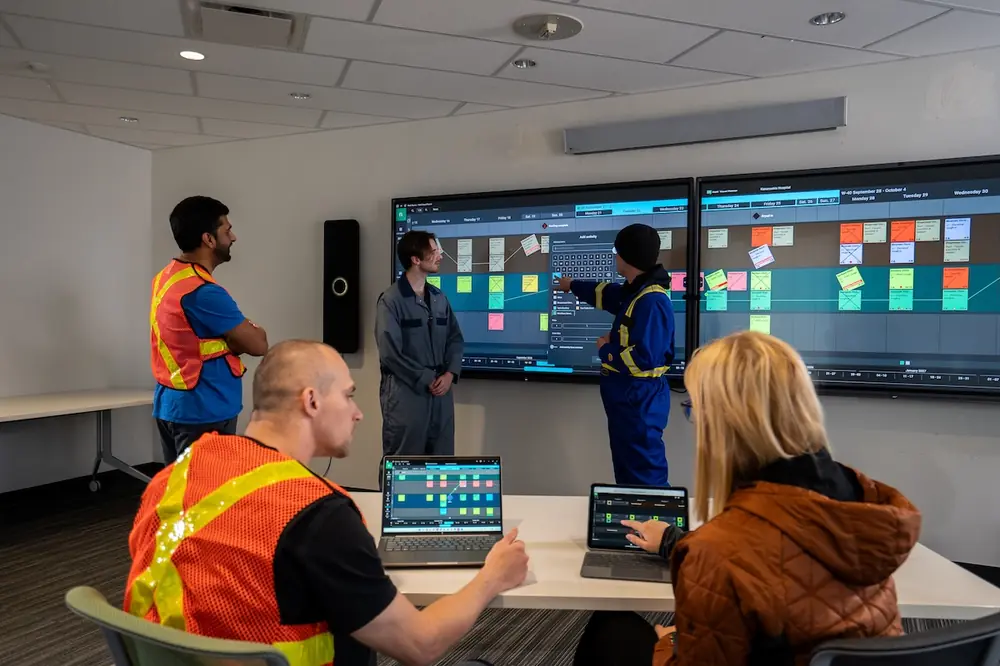
Very little gives an assumption more credibility than a critical path method (CPM) schedule. “We think this’ll take about three weeks” turns into “Activity X, 15 days.” Tie it to a milestone, issue the update, and the guess starts to look like a fact.

| Your local Trimble Construction Division dealer |
|---|
| SITECH Mid-America |
| SITECH Northwest |
| SITECH Dakotas c/o Butler Machinery |
But a schedule is only a model of how we expect the job to go, based on what we knew when we built it. The assumptions behind it matter as much as the dates it produces. If a duration assumes a certain crew size, is that crew actually available? If an activity shows 10 days of float, is that real flexibility, or just the math working out from assumptions somewhere else in the network?
A schedule can pass every logic check and still sit on weak assumptions. The better question is how much of it we actually know, and how much we’re still guessing at.
A forecast that changes isn’t necessarily a bad forecast. One that refuses to change when the job has changed is usually the bigger problem.
Production rates shift, design information comes in late, deliveries slip, crews turn over, and scope grows. The forecast should reflect all of that.
| Your local Gomaco dealer |
|---|
| Gomaco -Contact For a Dealer Near You |
What I see too often is teams getting attached to numbers they’ve already published. The completion date went to management, so there’s pressure to hold it. The cost forecast went to the owner last month, so any movement feels like admitting failure. Slowly, the team stops forecasting the project and starts defending the forecast.
Judge a forecast by whether it reflects the best understanding of the job today, not by how long it has stayed the same.
For the numbers that really matter, a project team should be able to answer five questions:
- Where did this number come from?
- What evidence supports it?
- What assumptions sit behind it?
- When did we last check it?
- What would make us change it?
None of this needs more paperwork. It just stops familiarity from passing for certainty.
| Your local Gomaco dealer |
|---|
| Gomaco -Contact For a Dealer Near You |
Sometimes the honest answer is: “We don’t know yet.” That’s a perfectly good answer, and it’s far more useful than pretending.
If an allowance is provisional, label it. If a forecast hinges on a decision that hasn’t been made, make that visible. If a milestone depends on a delivery nobody has confirmed, don’t let the milestone hide it.
When you can see uncertainty, you can manage it. Uncertainty you can’t see tends to show up later as a surprise.
Every project has wrong assumptions. Even the most detailed schedules and estimates are full of them. The goal is to keep them visible, not to get rid of them.
| Your local Gomaco dealer |
|---|
| Gomaco -Contact For a Dealer Near You |
There’s a big difference between saying, “We expect this to take 20 days,” and saying, “This is 20 days based on this crew, this production rate, and these conditions.” The first is just a number. The second tells you what to check when conditions change.
To me, that’s what good project controls should give a team: a clear line between what we know, what we believe, and what we’re still assuming.
The most dangerous number on a project isn’t simply the wrong one. It’s the wrong one that’s been repeated so often that nobody thinks to question it anymore.
Girish Bhatia is the Founder and CEO of ConstructMind Technologies Inc. (a Compass Consult Venture), where he works with contractors and owners on CPM scheduling, planning, and project controls.