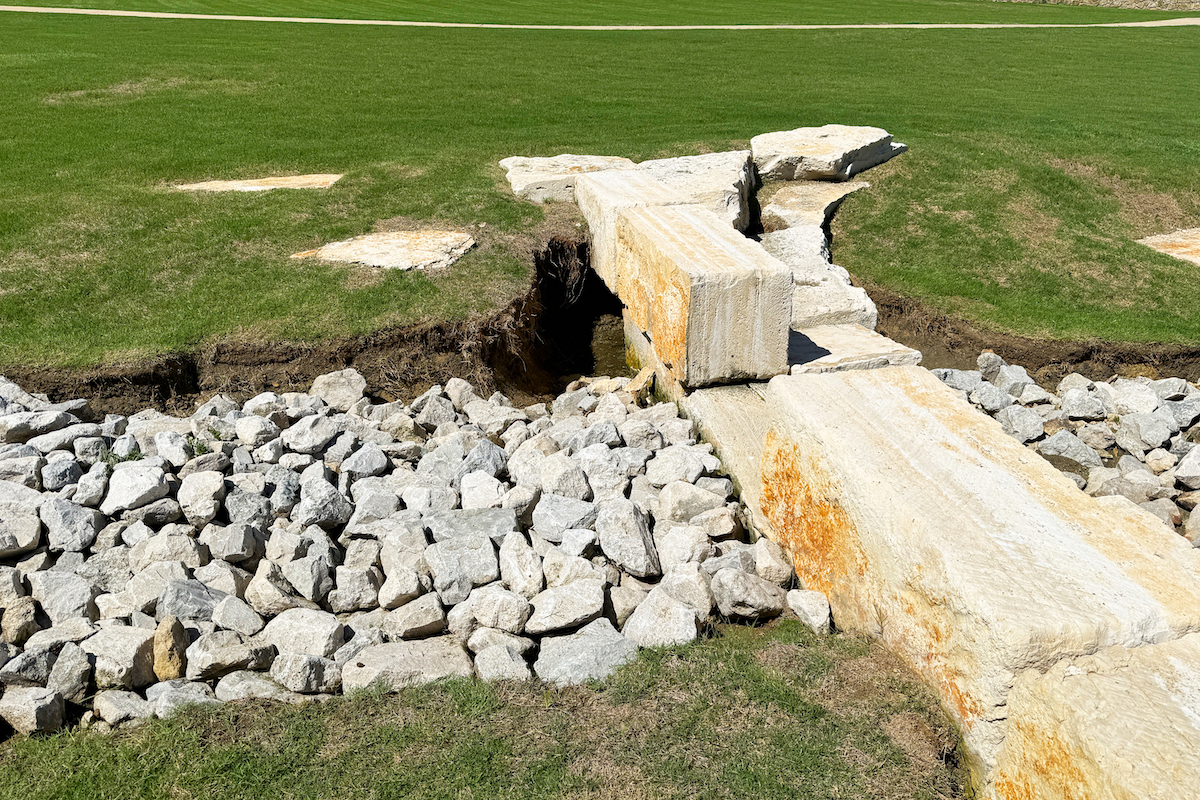

A new study published in scientific journal, Nature Cities, has put major Texas cities in an alarming spotlight: more than 70 percent of the land area beneath Dallas, Fort Worth, and Houston is subsiding at a rate of 3 millimeters (about 0.12 inches) or more per year. Houston is the fastest-sinking city in the United States, with areas subsiding at 10 millimeters (about 0.39 inches) per year.
While such vertical ground movement may seem small at first glance, for contractors, engineers, and developers, this trend carries serious long-term implications. This is especially true when taken in tandem with the region’s other biggest challenges — slope stability and erosion, particularly along waterways, retaining walls, and cut/fill embankments.
Several natural and human causes contribute to soil subsidence in Texas. While not unexpected, Houston is susceptible to coastal subsidence — the gradual sinking of land due to changes in sea level, sediment compaction of alluvial soils, or dissolution of bedrock.
Surprisingly, the Nature Cities study ranks the Dallas/Fort Worth metropolitan area (DFW) among the highest-sinking inland urban areas in the United States. Two primary human activities drive this issue:
- Groundwater extraction: When porous soils or aquifer layers are drained, the support they once gave to overlying strata diminishes, facilitating compaction and settlement. Groundwater extraction for urban and agricultural use is responsible for most of the soil subsidence in the U.S.
- Loading from urban development: The weight of buildings, roads, and infrastructure, or the “loading effect,” can accelerate consolidation of subsoils, particularly in clay-rich environments.
- Foundation damage and differential settlement: As portions of a site settle at different rates, structural cracks, tilting, and misalignment often follow. Distinguishing the root cause of damage becomes more challenging, especially when subsidence is a hidden driver.
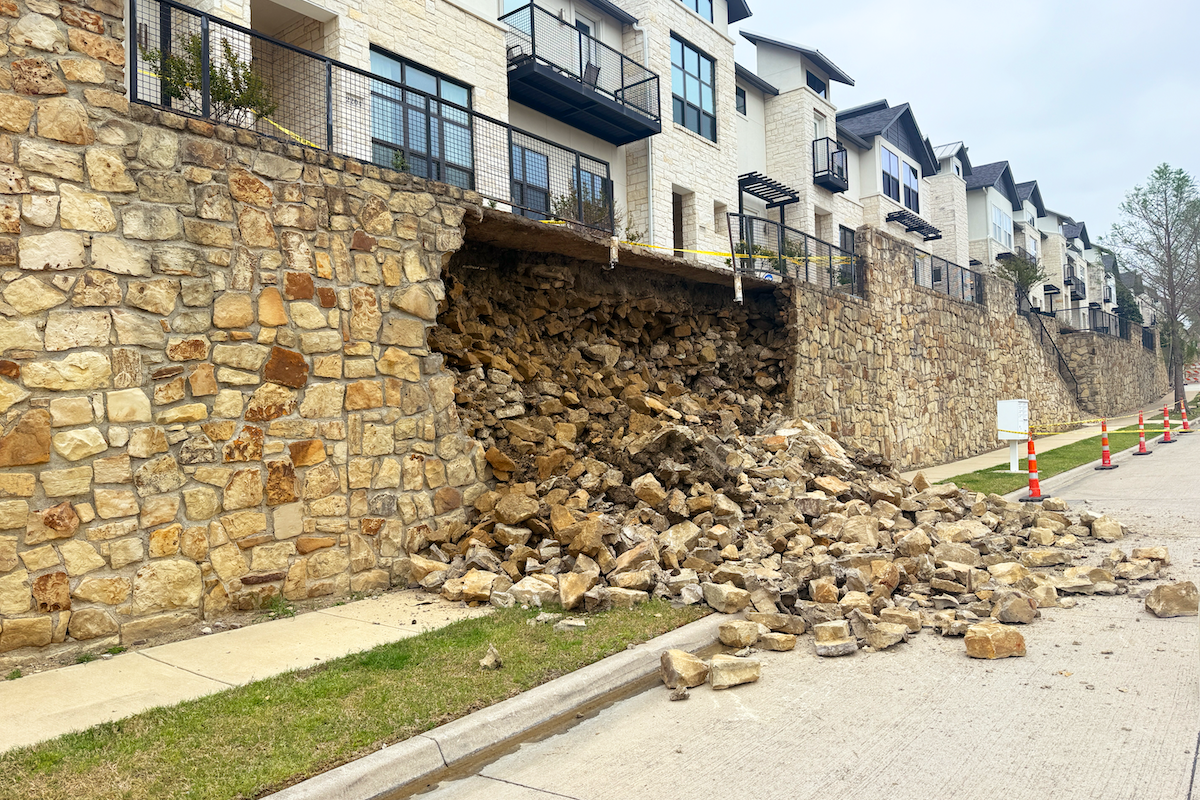
- Slope failures, embankment slides, and retaining wall collapses: Many developments are constructed adjacent to waterways, creeks, drainage channels, or in large cut/fill zones. Heavy rain can saturate back slopes, increase pore water pressure, and trigger failures. Urban loading also increases the surcharge experienced by slopes and retaining walls, contributing to the stress experienced by the surrounding soils.
- Washout, undermining, and erosion damage: Excessive runoff and inadequate drainage can lead to serious problems for site soils and infrastructure. Soil loss of slopes due to erosion or undermining of foundations can also contribute to the failure of infrastructure. Maintaining robust drainage and controlling surface runoff are absolute musts.
- Undertake global and local slope stability modeling, accounting for long-term settlement and progressive subsidence loads.
- Incorporate pore water pressure build-up in transient rainfall events while factoring in antecedent surcharge loads.
- Analyze scour and toe stability to prevent undercut of slopes where watercourses are involved.
- Limit slopes to 3:1 maximum, 4:1 preferred, to reduce surface runoff velocity and increase slope stability.
- Install retaining walls at the toe of embankments, rather than the top, where site constraints prohibit shallower slopes.
- Use dikes or berms above cuts to intercept runoff.
- Route high-velocity flows via paved channels or closed pipes, with adequate outlet protection (riprap, energy dissipators).
- Where permissible, adopt serrated slopes (benched or terraced) to slow flow, increase infiltration, and establish vegetation.
- Minimize irrigation above slopes, retaining walls, and other areas prone to erosion.
- Erosion control blankets or mats on slopes to stabilize soils until vegetation is established
- Hydromulching and engineered topsoil for swift soil cover and targeted soil nutrients
- Use of soil binders or surface tackifiers to resist wash-off
- Native variety seed mix for plant diversity of different growing seasons and deep-rooted species for long-term stabilization
- Outlet protection and scour control at discharge points, such as riprap, gabions, or rock pads to absorb energy and prevent scour
DFW sits atop largely clay-dominated soils (specifically the Texas Blackland Prairie) that are highly expansive and reactive to moisture fluctuations. During wet periods, clay soils swell/expand, then during drought, the soil shrinks. That continual movement back and forth exerts cyclical stress on foundations, slabs, and slope faces.
Compounding matters, climate extremes exacerbate subsidence rates and soil instability. With more frequent “boom and bust” moisture cycles, soils are less likely to maintain equilibrium, and sudden loads or water surcharges may trigger slope failures and cause erosion from increased runoff. In essence, DFW is fighting a two-front battle: long-term soil subsidence and short-term movement from soil instability and erosion risks.
For contractors working in Texas, the implications are far from theoretical. There are several regional climatic and geological factors that affect the design and integrity of local infrastructure. Common modes of failures observed that are influenced by local weather and soils include:
Texas is known as a “construction defect” state, with a 10-year commercial construction statute of repose. Thus, contractors should be aware that climate, urban development, and regional soils can pose long-latency issues that create exposure. Builders must follow design guidelines, use best management practices, and document any decisions or deviations prudently. Designers and planners need to understand the symptoms of soil behavior exacerbated by climate and urban loading.
Given the regional subsidence issues, earthwork designers and contractors must implement additional safety factors and erosion mitigation strategies. Below are some best practices:
A thorough geotechnical investigation should be completed before any design or analysis of site development. The best way to combat soil movement is to understand the soil properties of your site better. Knowing the potential for expansive soils and subsidence is critical to making the best decisions for your project for consideration of both long-term and short-term soil behaviors.
Choose a foundation design that best suits your site. Foundations should be designed to resist subsidence, such as by providing a wide area to distribute loading or by using a deep foundation to transfer loads to a stable bedrock. Removal of unsuitable soil materials or the installation of specialized geo-products may be considered.
Maintaining slope stability is a critical component of any construction or site development project. Slopes that are too steep are inherently more prone to erosion, surface runoff, and even structural failure, which can compromise nearby infrastructure and safety. Properly designed slopes with gradients that balance functional land use and natural stability help reduce long-term maintenance needs and prevent costly repairs. By prioritizing stable slope construction, contractors can ensure durable performance, protect drainage systems, and uphold environmental integrity throughout the project’s lifespan. Further actions may include:
Uncontrolled flows at the top of cut slopes or fills can rapidly intensify erosion and lead to failure. Texas Department of Transportation (TxDOT) and the United States Geological Survey guidelines caution designers to:
Rigid concrete walls aren’t always ideal, especially in a subsiding terrain. One promising alternative is a vegetated mechanically stabilized earth (MSE) system. These systems use layers of reinforcement, such as geogrids or steel strips, combined with compacted soil and facing units to create a reinforced composite structure that resists lateral and vertical soil movement. Many MSE designs include granular backfill and drainage layers that reduce hydrostatic pressure, which is a major contributor to erosion and slope instability. MSE vegetated walls and slope reinforcement systems permit controlled settlement by allowing drainage through the structure while supporting soil and vegetation. This type of “green” solution is ideal along streambanks, culverts, or slopes adjacent to waterways where durability and aesthetic integration are key considerations.
During the earthwork and site development phases, the site is especially vulnerable. Best management practices may include:
Texas is quite literally shifting beneath our feet. That doesn’t mean we are powerless in managing the risks, but it does mean the old assumptions of static soils and fixed settlement are no longer sufficient.
For contractors working across industrial or infrastructure sectors, it is imperative to start with rigorous geotechnical analysis and slope stability modeling, incorporate erosion mitigation and reinforcement techniques, monitor movement, and build in adaptive maintenance to minimize the effects of soil subsidence.
By designing our infrastructure with soil subsidence and a changing climate in mind, the next generation of Texas infrastructure can remain tall in the saddle, even as the ground sinks beneath.
Zachary Henrichs, MS, PE, DFE is the Dallas-based Director of Civil Engineering at Knott Laboratory, a forensic engineering and visualization firm.