

SAN FRANCISCO, CA — The UCSF Health Helen Diller Hospital, a highly complex hospital construction project, is currently taking shape in San Francisco, California. While the existing hospital remains fully operational, two WOLFF 1250 B US Cranes are constructing a new hospital building on the campus of the University of California San Francisco (UCSF) in the residential neighborhood of Parnassus Heights, adjacent to the current facility. The luffing cranes are operating on a confined construction site under challenging logistical conditions and strict California regulations.
With a maximum lifting capacity of 40 tons in two-fall operation and 19.7 tons at the jib tip, the two WOLFF luffing cranes rank among the largest tower cranes on the U.S. market. Currently, only five WOLFF 1250 B US cranes are in operation across the United States. This also marks the first time that two WOLFF 1250 B US cranes have worked together on a U.S. construction site.
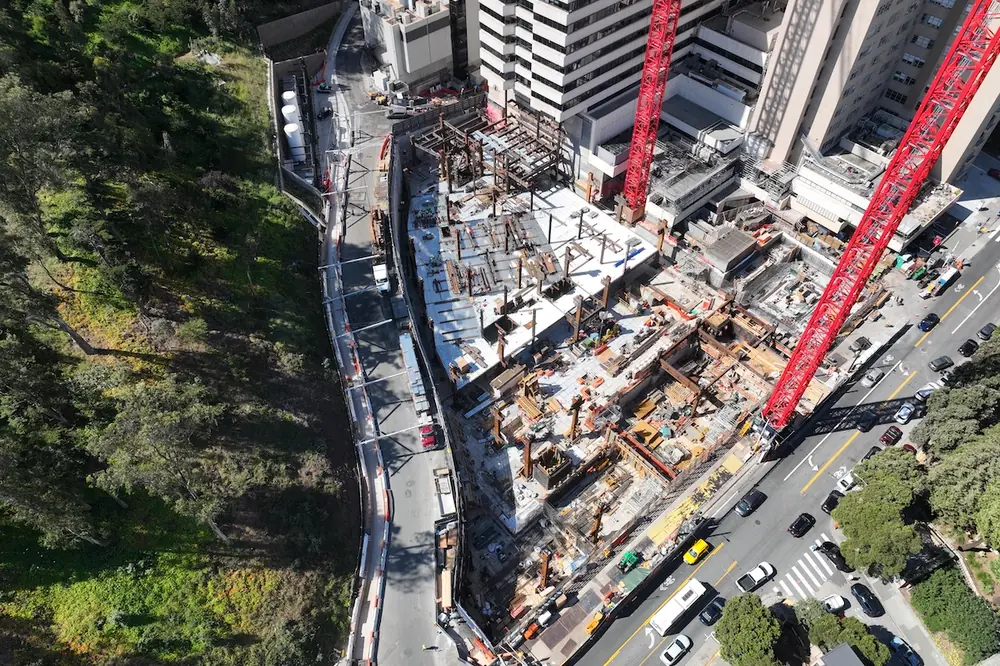
The construction site itself presents the project team with challenges. The entire construction site can be accessed via a single access road. The triangular building plot is situated between the existing hospital, residential neighborhoods, and a forested area.
“There is very little space available for logistics and material handling,” said Drew Szabat, Construction Manager for the UCSF Health Helen Diller Hospital project. “The construction site conditions here are significantly more challenging than on those projects in downtown San Francisco.”
For this reason, the cranes, which were erected in spring 2025, were positioned along the perimeter of the site rather than its center. Due to their 65-meter jib lengths, they can still reach large portions of the construction area. Positioned this way, the cranes can remain in place throughout the entire construction process and continue to be used for interior fit-out work after completion of the building shell — an essential advantage on a construction site with no access opportunities or maneuvering space for mobile construction equipment and mobile cranes.

| Your local Gomaco dealer |
|---|
| Terry Equipment |
A key factor in selecting the WOLFF 1250 B US, in addition to its high lifting capacity, was its combination of a compact tower design and significant freestanding height. Despite a footprint of only 3.3 by 3.3 meters, the cranes were erected freestanding to a height of approximately 85 meters. With the jib raised, they reach an overall height of approximately 152 meters. Due to California’s seismic requirements, the geological conditions on the campus, and neighboring utilities and foundations, conventional crane foundations were not a viable option. Instead, the two WOLFF cranes were erected on specially engineered foundations consisting of pipe piles and steel grillages.
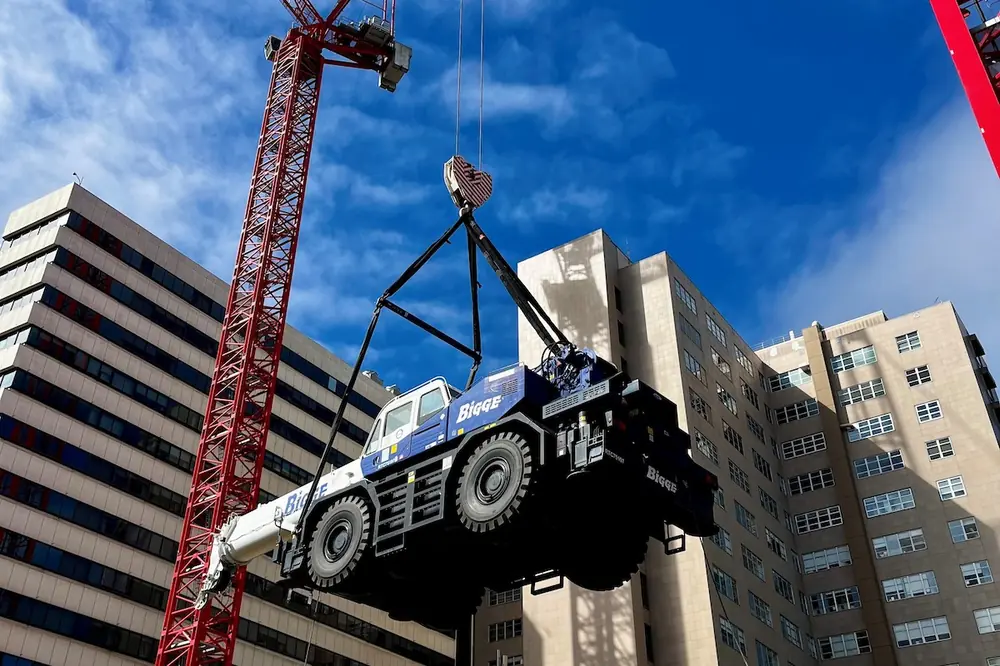
The WOLFF cranes are responsible not only for typical lifting tasks involved in hospital construction — such as handling rebar and structural steel — but also serve as the primary transportation system for the entire construction site. They lift virtually everything that needs to be moved. Among the heaviest components are steel box columns weighing approximately 32 tons each. At times, both cranes work together to raise these columns from a horizontal to a vertical position in a process known as tandem column tripping. Because there was also no room for a ramp leading to the basement level, even a mobile crane weighing around 38 tons had to be lowered into the basement using the tower cranes.
The greatest challenge of the project is that the new building is being constructed directly adjacent to hospital facilities that remain fully operational. As a result, site preparation began as early as 2022. Particularly disruptive construction activities were planned years in advance and closely coordinated with the affected hospital departments. For certain construction phases, clinical operations had to be adjusted or temporarily relocated, while additional protective measures were implemented.
The construction site is located directly adjacent to patient care areas, including operating rooms and the Emergency Department. Accordingly, all work had to be meticulously planned with regard to noise, dust, vibrations, and exhaust emissions. In addition, cranes are only permitted to swing over existing hospital buildings with an empty hook.

| Your local Trimble Construction Division dealer |
|---|
| SITECH West |
| SITECH Southwest |
“The ongoing hospital operations, combined with the geological challenges and the extremely limited logistical possibilities that San Francisco presents, meant that the two WOLFF 1250 B US cranes were the only machines that could meet the requirements of our project,” Szabat said.
According to Szabat, a particularly noteworthy aspect of the project is that one of the WOLFF cranes will eventually dismantle the other. While this is standard practice on many construction sites around the world, dismantling one tower crane with the help of another is extremely rare in California. In fact, the dismantling procedure had to be planned and approved by the state regulatory agency, Cal/OSHA, three years before the first crane was ever erected.
“Once completed, this will be only the second project in San Francisco where one tower crane has been dismantled by another,” Szabat said.
The removal of the second WOLFF 1250 B US will be no less complex. First, the crane will be climbed down to roughly half of its original height. After that, a 600-ton mobile crane will be brought in to complete the dismantling process. Because the adjacent roadway serves as an access route for emergency vehicles and cannot be closed, the dismantling will be carried out in multiple phases and from several different mobile crane positions
| Your local Gomaco dealer |
|---|
| Terry Equipment |
“The preparation for this single operation alone takes about a year. The dismantling, which is scheduled for early 2029, will take several weeks,” Szabat said.
Completion of the approximately $4.3 billion project is scheduled for 2030. With the UCSF Health Helen Diller Hospital, UCSF Health1 is expanding its medical capacity in Parnassus Heights through the construction of a new 15-story hospital building with approximately 900,000 square feet of gross floor area. The new hospital will bring together highly specialized medical services — including neurosurgery, cardiology, transplant medicine, and emergency care — under one roof.