
Construction firms are busier than ever, with strong demand and full pipelines. So why have 90 percent of them passed on a profitable project?
Mobilization Funding’s 2026 Construction Growth and Cash Flow Report found that it’s not the usual suspects of labor shortages and bonding constraints. The real culprit is cash flow.
For most firms, the issue comes down to timing. Winning a new project typically requires significant upfront spending on materials, labor, and equipment well before invoices are paid or progress billing starts. In an industry where payment cycles can stretch for weeks or months, those early costs create real pressure on working capital. That pressure forces trade-offs. Leaders delay hiring, postpone investments, or pass on profitable work because cash leaves long before it comes in.
The report surveyed 250 senior decision-makers at U.S. commercial construction firms, and the results make it clear that what most contractors have normalized as a cost of doing business is actually one of the biggest constraints on their growth.
According to the survey, nine out of 10 construction leaders have looked at work they knew was profitable and walked away from it — and 43 percent say they’ve done so multiple times.

| Your local Liebherr Construction Eq dealer |
|---|
| Nueces Power Equipment |
Every respondent in the survey said cash flow influences whether their company pursues or declines a project. More than half (57 percent) said it always or frequently acts as a deciding factor.
I regularly hear from contractors who are forced to pass on projects with solid scope and fair terms because they couldn’t get in front of them financially. Most contractors have normalized these constraints, but a barrier this large shouldn’t be the norm.
The survey also tells us that winning new work often intensifies financial pressure instead of alleviating it.
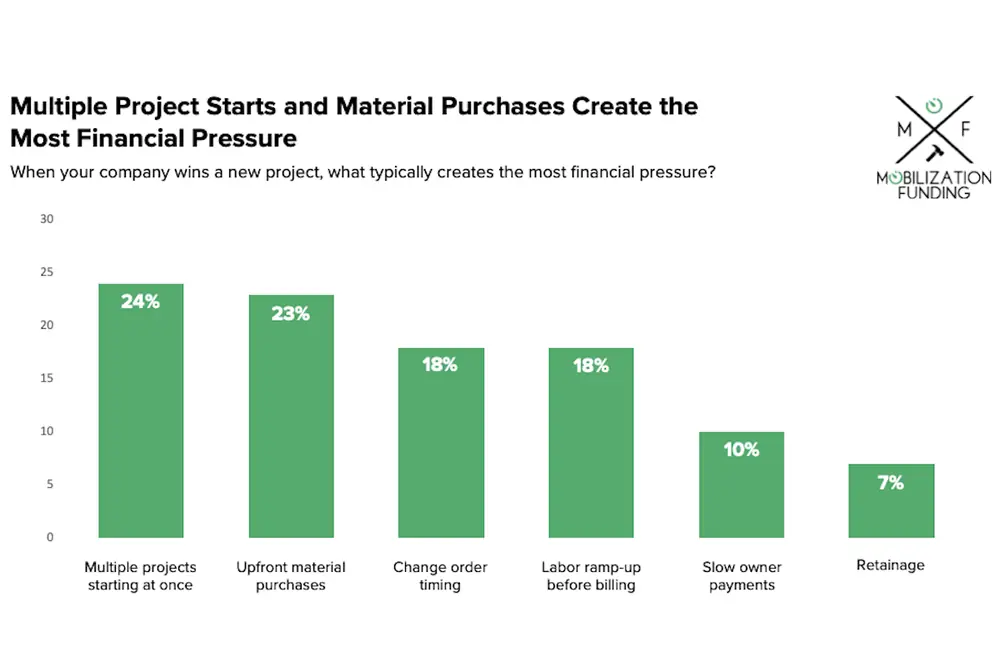
When respondents were asked what creates the most financial strain on a newly awarded project, the answers focused on the front end of the job. Multiple projects starting at once was the top answer at 24 percent. Upfront material purchases followed at 23 percent. Labor ramp-up costs before billing can begin and change order timing each registered at 18 percent.

| Your local JCB North America dealer |
|---|
| Monk JCB |
| BOSS JCB |
| South Star JCB/Meinecke |
When you have to order materials and pay crews before the first invoice goes out or before the first draw comes in, it adds up — especially when several projects start at the same time. Firms that don’t have strong cash visibility or fast internal approval cycles see even more financial strain. That period between project award and first payment can make growth feel more like pressure and less like the realization of your vision.
This isn’t confined to undercapitalized companies. We work with contractors doing more than $50 million in revenue who feel this same pressure. The size of the business only changes the scale of the numbers.
Nearly all respondents (97 percent) said the challenge of funding upfront project costs while trying to grow has kept them up at night. More than half said it does so frequently. That’s a lot of cognitive and operational energy being consumed by a problem that, in many cases, doesn’t have to be this hard.
Project pipelines aren’t empty. The survey found that 78 percent of construction firms describe their companies as currently growing, with 48 percent saying the growth is steady and 29 percent calling it aggressive. Only 5 percent described themselves in a defensive posture.

| Your local Sennebogen LLC dealer |
|---|
| WPI |
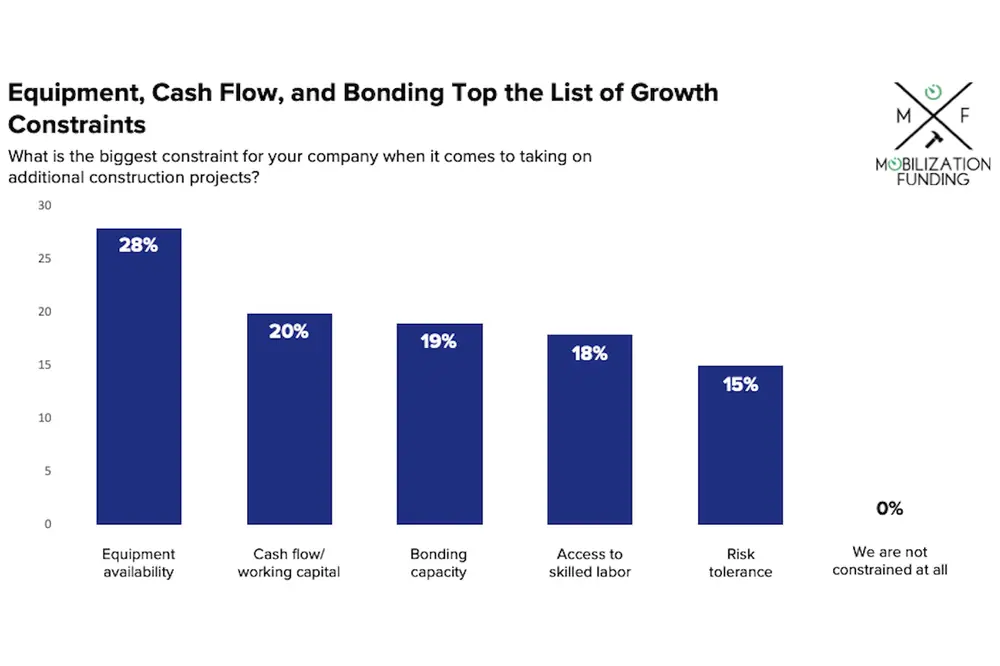
When asked about the biggest constraints to taking on additional projects, respondents pointed to equipment availability first at 28 percent, followed by cash flow and working capital at 20 percent and bonding capacity at 19 percent. Access to skilled labor came in at 18 percent.
Cash and bonding together represent 39 percent of the constraint. Both are working capital problems at their core. A contractor with strong liquidity can mobilize equipment more quickly, support a bonding program more effectively, and carry early project costs without flinching. When a contractor has reliable access to working capital, their decision-making changes. They stop asking, “Can we afford to take this job?” and start asking, “Is this the right job to take?” Being able to execute is the real differentiator for growth.
The survey asked what immediate access to capital would change. The top responses were increased speed of execution at 42 percent, reduced financial stress at 41 percent, and improved vendor relationships at 40 percent. Nearly 40 percent said it would allow them to pursue larger contracts, and 38 percent said it would let them take on more projects overall.
Faced with the timing problem, contractors are piecing together capital strategies from whatever is available. The survey found no single dominant approach. Owner deposits or front-loaded billing was the most common funding method at 22 percent, followed by bank lines of credit at 18 percent, and internal cash reserves at 16 percent. Supplier credit, limiting growth to avoid overextension, and partner financing each came in at 15 percent.

| Your local Hyundai Construction Equipment USA dealer |
|---|
| Nueces Power Equipment |
There’s no clean, purpose-built solution that most firms reach for by default. Many are managing the timing problem the same way they managed it 20 years ago with a combination of negotiated terms, restrained growth, and whatever the balance sheet can carry at a given moment.
The key to achieving aggressive, sustainable growth right now is to stop treating working capital as a constraint that you’re forced to manage and start treating it as a tool you can deploy strategically. Capital partners can serve as a growth tool. The survey found that surety and bonding support ranked as the second most valued growth partner among contractors looking to scale, behind only equity or growth capital. Project-based and ongoing working capital partners together drew 28 percent of responses.
Rising material costs and tariff pressure are tightening margins at a moment when many firms are trying to push into larger projects and new markets. That’s only making the timing problem harder. Firms are facing higher early project costs and more intense pressure during the window between mobilization and first payment.
To grow through that pressure, knowing whether the working capital is there to support the next opportunity is critical. I’ve seen too many capable contractors lack a reliable way to bridge the timing between when costs hit and when payments arrive.

| Your local Astec dealer |
|---|
| Closner Equipment Co Inc |
What determines whether a firm can truly grow is whether the financial infrastructure behind the business can move at the same speed as the opportunity in front of it.
Scott Peper is the Chief Executive Officer and Founder of Mobilization Funding. He also hosts the business and entrepreneurial podcast The Mobilization Mindset and authored The Big Book of Cash Flow.