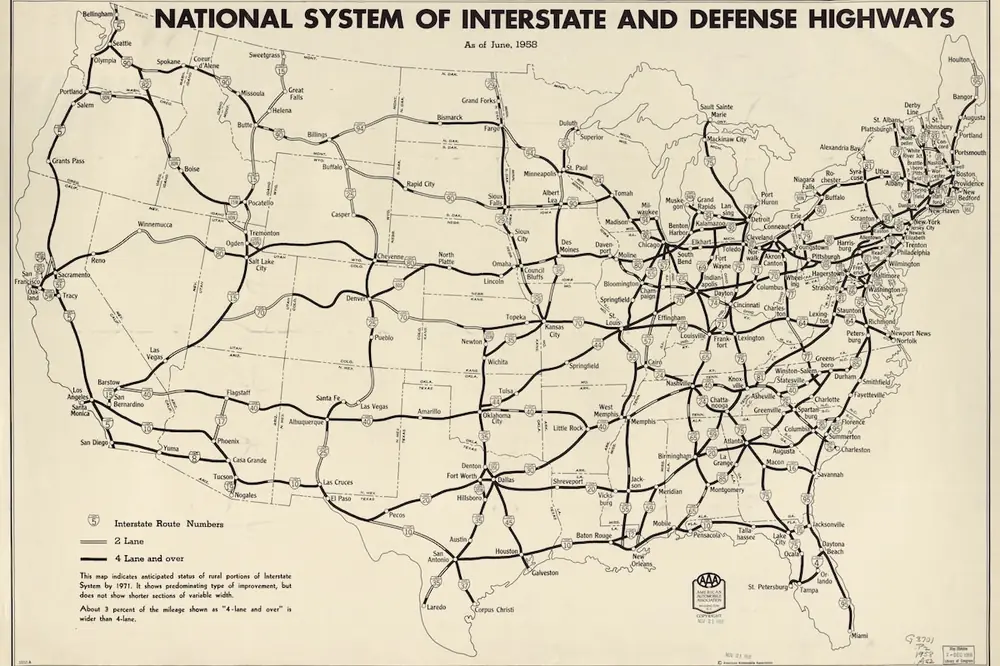

Initiated by the Federal-Aid Highway Act of 1956 under President Dwight D. Eisenhower, the Interstate Highway System is widely considered one of the greatest public works projects in the first 250 years of United States history. For the heavy civil construction industry, it represented an unprecedented era of standardized road building, requiring all routes to be freeways with at least four lanes, controlled access, and no at-grade crossings.
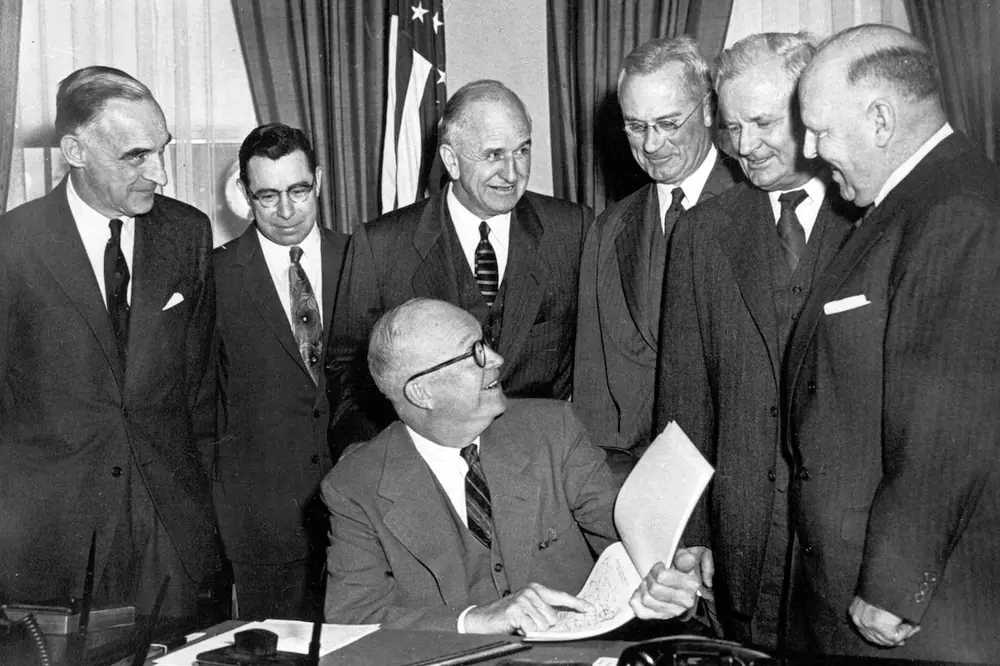
“Our highways badly need modernization and expansion to accommodate today’s vastly increased motor traffic,” Eisenhower said when signing the legislation.
Seventy years later, that statement rings just as true.
Authorized at an initial $25 billion — equivalent to $300 billion today — for the construction of 41,000 miles over a 10-year period, the massive construction undertaking ultimately spanned 35 years and cost approximately $114 billion, or $937 billion in 2026 dollars.
Today, the sprawling network spans 48,890 miles and serves as the main arteries for much of the U.S., generating an estimated economic benefit of $65 billion annually considering fuel savings, road safety improvements, and congestion reduction, according to research by the Washington, D.C.-based nonprofit TRIP.
Celebrating its 70th birthday this year, the Interstate Highway System’s infrastructure is showing severe signs of its advanced age. A critical issue for modern roadbuilders is that most interstate segments still retain their original underlying foundations, meaning repeated pavement resurfacing yields diminishing returns and increasingly shorter periods of pavement smoothness.
“America’s Interstate Highway System was built to meet the transportation needs of another era,” said Kyle Phillips, Past Chairman of Associated General Contractors of Missouri and TRIP Board Member. “Today, maintaining a strong economy means investing in a network that is safer, more resilient, and capable of supporting growing freight volumes and population growth. By modernizing these critical corridors, we can strengthen commerce, improve mobility, and ensure the Interstate System continues to serve businesses and communities for generations to come.”
In the Midwest, intense utilization has heavily strained this aging network:
- Missouri: The state struggles with heavily fatigued surface infrastructure. A striking 52 percent of major locally and state-maintained roads in Missouri are in poor or mediocre condition. Driving on these rough surfaces costs the average Missouri driver $990 annually in additional vehicle operating costs (VOC) — the highest per-driver cost in the four-state region — amounting to $4.3 billion statewide each year. Furthermore, 9 percent of Missouri’s bridges are rated in poor or structurally deficient condition, and 36 percent were built prior to 1970.
- Iowa: Iowa faces the most severe bridge crisis in the region. An alarming 19 percent of Iowa’s bridges are rated in poor or structurally deficient condition, meaning there is significant deterioration of major structural components. Additionally, 26 percent of Iowa’s major roads are in poor or mediocre condition, costing motorists $1 billion annually ($439 per driver) in extra VOC. Thirty-five percent of Iowa’s bridges were built prior to 1970, indicating a massive wave of upcoming bridge rehabilitation and replacement work.
- Nebraska: Currently, 15 percent of Nebraska’s major roads are in poor or mediocre condition, costing the state’s drivers $422 million annually ($290 per driver) in extra VOC. While its pavement quality is relatively stronger, 7 percent of Nebraska’s bridges are rated in poor or structurally deficient condition, and 37 percent were built prior to 1970.
- Kansas: Kansas boasts the strongest pavement conditions, with only 10 percent of its major roads rated in poor or mediocre condition, costing motorists $582 million annually ($288 per driver). However, its bridge network is heavily aged: 5 percent of Kansas’ bridges are currently rated in poor or structurally deficient condition, and a region-leading 46 percent of the state’s bridges were constructed prior to 1970, signaling a critical need for structural overhauls.
For contractors, modernizing the network will require a massive pipeline of upcoming work. Beyond simply replacing aging pavements, roadbuilders will be tasked with completely upgrading outdated interchanges, “right-sizing” lane capacity, and fundamentally overhauling safety features to handle the influx of both passenger and commercial freight. Freight moved by trucks in these states alone equals $1.4 trillion in goods.
“Modernizing the Interstate Highway System will require more than replacing aging infrastructure,” said Scott Hildebrand, Vice President at Hawkins Construction in Omaha, Nebraska, and TRIP Board Member. “It will take strategic investments that expand capacity, improve safety, and prepare key freight corridors for decades of future growth. Contractors are ready to deliver these critical improvements, but long-term success depends on sustained investment and a commitment to building a transportation network that supports America’s economy and growing population.”
“The Interstate Highway System is more than concrete and steel; it is a living symbol of American ambition, ingenuity, and unity,” TRIP Executive Director Dave Kearby said. “Built by a generation that believed in creating something bigger than themselves, these roads connected families, fueled commerce, strengthened national defense, and opened the country to endless opportunities. As we reflect on its 70th anniversary and America’s 250th, rebuilding this system is not just an investment in infrastructure; it is a chance to honor that legacy and ensure future generations inherit an America that still believes in building boldly for tomorrow.”
For more information and access to all TRIP reports, go to www.tripnet.org.