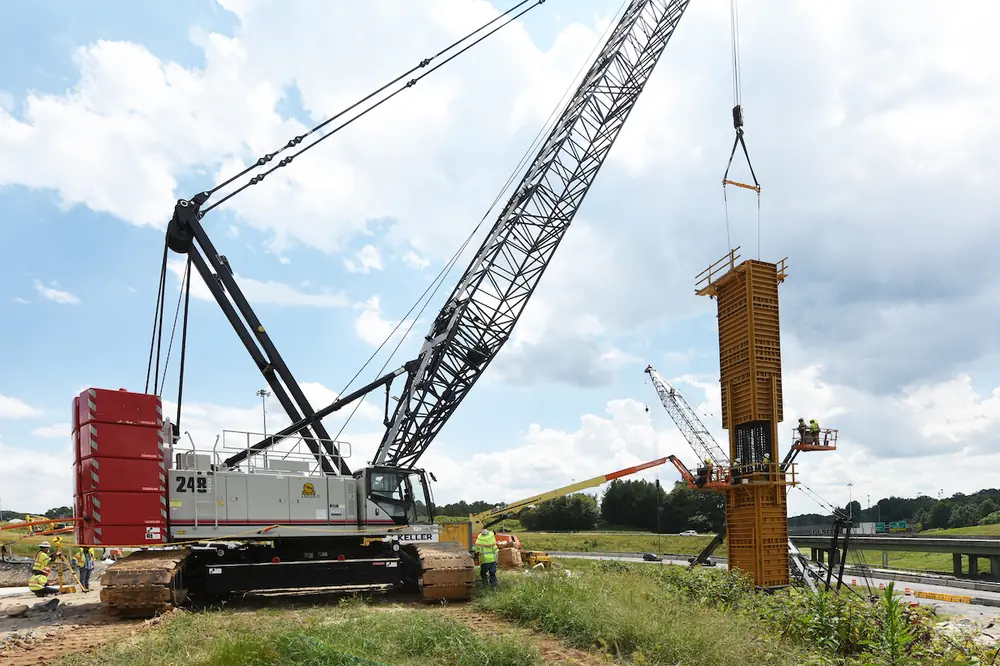

For over 35 years, C.W. Matthews Contracting Co. Inc. has been using Link-Belt cranes on projects across Georgia. The company’s fleet currently consists of only Link-Belt cranes, which are being employed on the I-285/I-20 West Interchange project in Atlanta, Georgia.
“Our bread-and-butter machines are the 218s, 110-ton cranes. We have about 16 of them,” said John Faress, Equipment Manager at C.W. Matthews. “We do have some 238s and the 248, 200-ton crane since we are seeing a need going into the future for the bigger machines. Our current project at the I-285/I-20 interchange points that out with higher, larger pier columns and caps, [as well as] heavier beams. We see that is going to be ongoing, especially with the future work we have in and around the Atlanta area.”
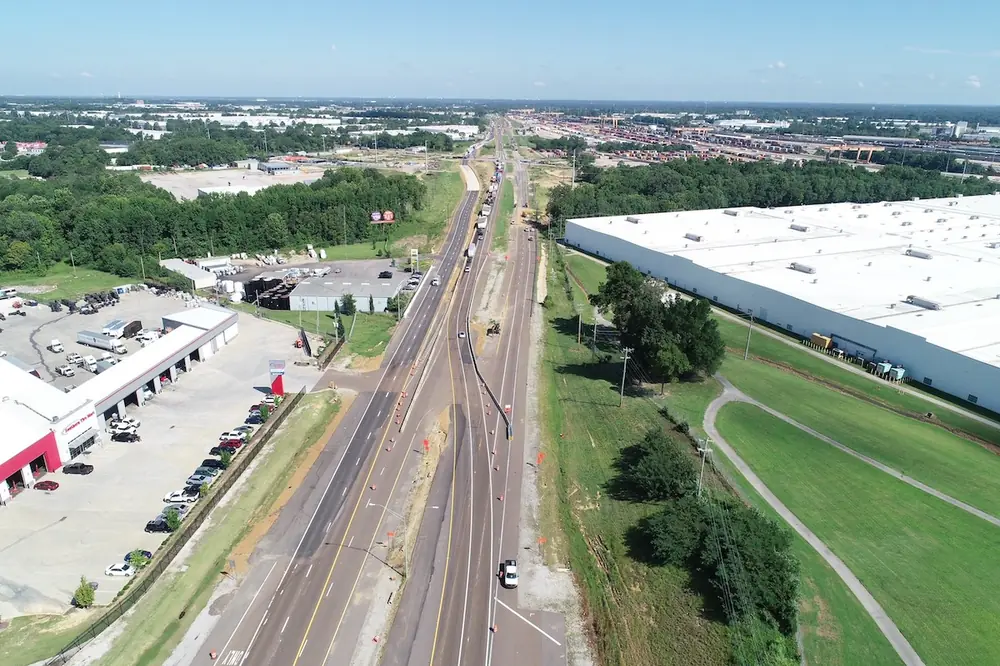
Forty years ago, the I-285/I-20 interchange was built on the west side of Atlanta. Today, an average of 380,000 vehicles traverse that intersection every day. According to the American Transportation Research Institute, this interchange is currently ranked as the sixth most congested and 10th worst truck bottleneck in the nation.
“That interchange is rated as one of the worst intersections in the country,” Faress said. “There are a lot of trucks coming out of Savannah and Brunswick. Savannah is the third busiest port on the East Coast, and all that traffic passes through Atlanta on I-20 going west.”
To alleviate the congestion and complicated road system, the project will revamp, widen, and add lanes to the interstates — providing a more efficient traffic flow. The result will be a more compact interchange design and is expected to show a 20 percent improvement in vehicle throughput, with a 10 percent increase to average travel speeds during rush hour. This project is part of the Georgia Department of Transportation’s (GDOT) Major Mobility Investment Program.

| Your local Leica Geosystems Inc dealer |
|---|
| Laser Specialist inc |
GDOT awarded the $1.3 billion design-build-finance project to Legacy Infrastructure Contractors LLC, established and headed by C.W. Matthews of Marietta, Georgia, which is also the lead construction contractor. Founded in 1946, the local 80-year-old firm has experience building heavy highway construction projects, particularly in Atlanta and across the state.
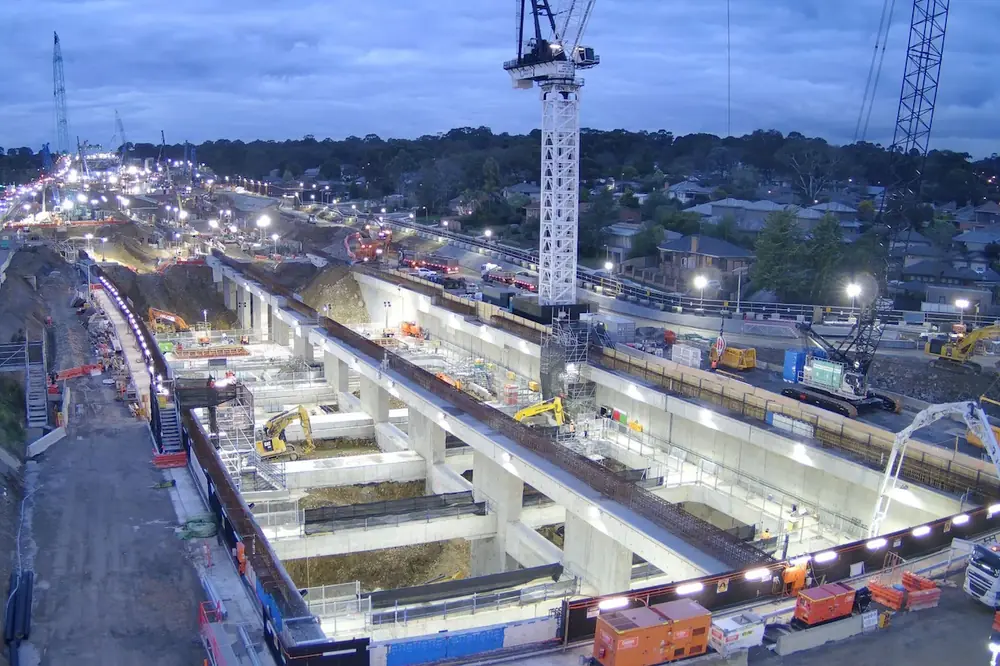
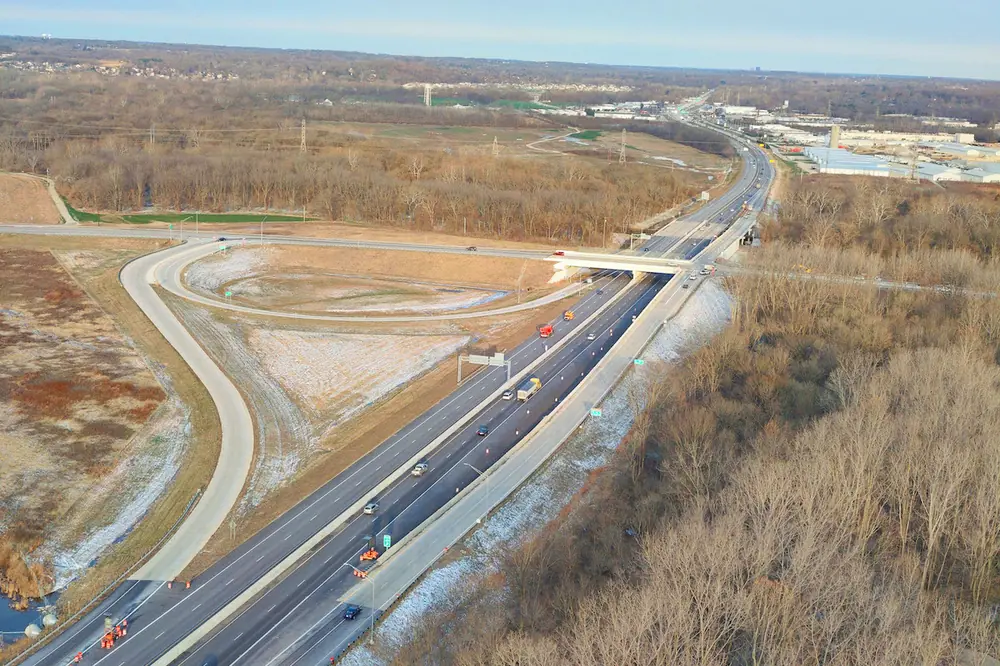
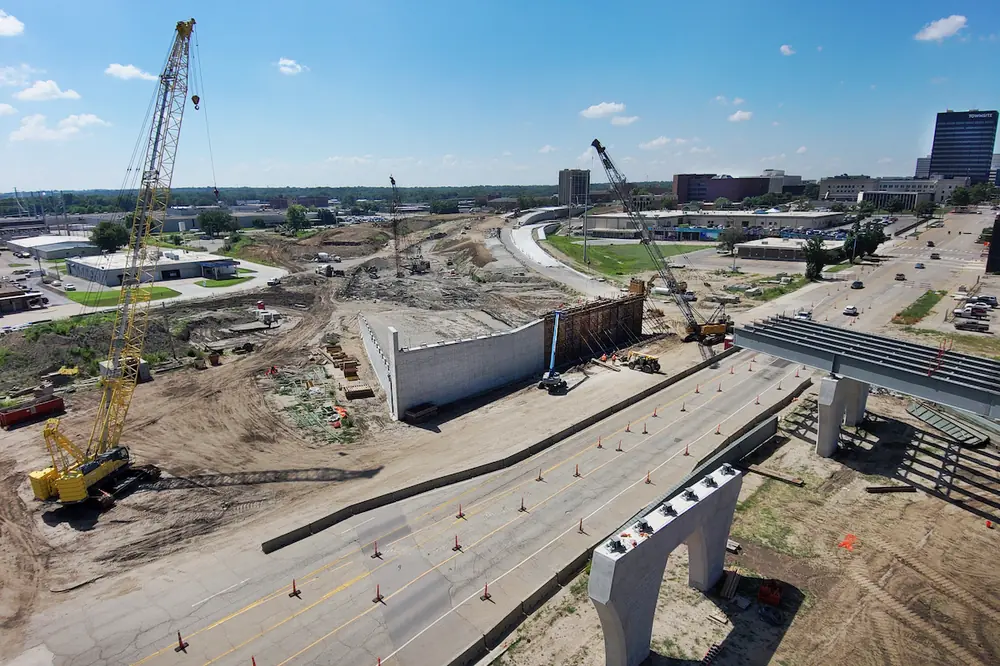
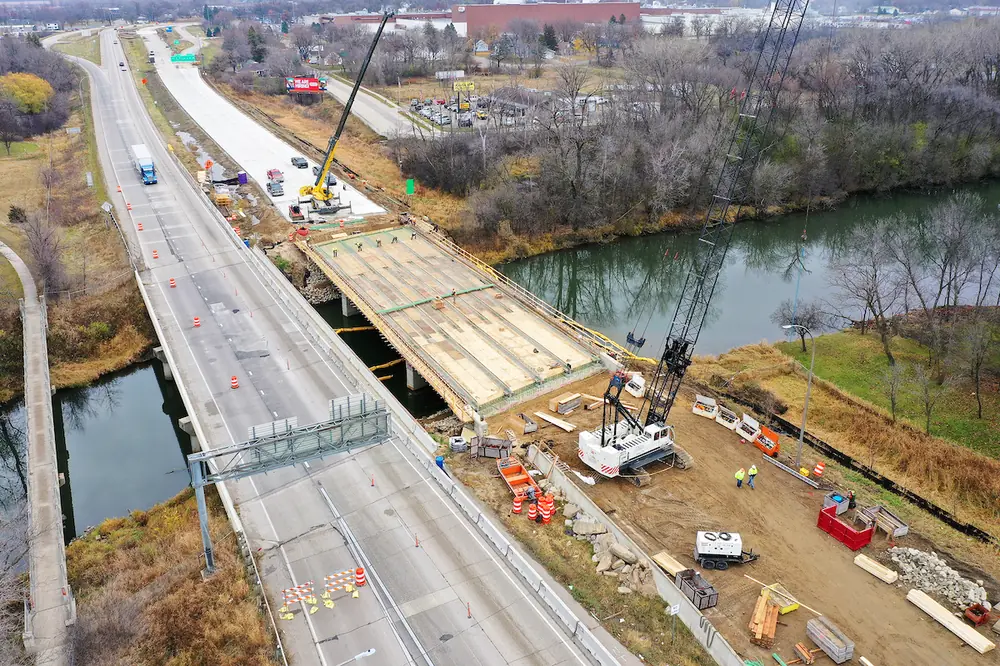
The five-year I-285/I-20 West Interchange project includes removal of left-hand entrance and exit ramps, which will be one of the major improvements to the traffic flow in this corridor. Two-lane ramps, about 50 feet wide, will be implemented within the interchange. Construction of collector-distributor (CD) lanes, or connecting lanes, will be built westbound. CD lanes run parallel to the main travel lanes of an interstate or highway, connecting them to access roads or entrance ramps to improve traffic flow, speed, and safety. In some cases, the interchange will be four levels high. Additional lanes will be constructed on I-285 and I-20 in several locations, ranging from 2 miles to 6 miles long.
About 26 bridges will be replaced or modified in the interchange along I-20. Many bridges are structurally deficient, so replacement is necessary. Most of the bridge design consists of large, precast concrete beams weighing as much as 120,000 to 132,000 pounds placed in tandem lifts. Substructures of deep drill shafts with heavy rebar cages (30 feet to 60 feet long and 8 feet in diameter) are placed into the ground of solid granite rock.
The columns, encased with substantial rebar cages, are generally 30 feet to 40 feet tall and fit into a 6-foot by 7-foot octagonal EFCO column form. The hammerhead pier caps placed over the large diameter columns are 6 feet wide by 8 feet tall and 50 feet long. The single pier column or bent configuration has been accepted as the general substructure design for the bridges.

| Your local Wirtgen America dealer |
|---|
| Brandeis Machinery |
Conceptual design engineers enabled construction to start early with a 2,500-foot-long I-20 westbound to I-285 southbound directional flyover ramp. This is made up of 21 spans, with each span about 150 feet long. It is actively being built in phase one with 50- to 60-foot-tall pier columns over heavy foundations because of its design location. That area had zero water resource permitting, zero utility relocations, and zero traffic shifts — making it feasible for high-capacity cranes to start work rapidly.
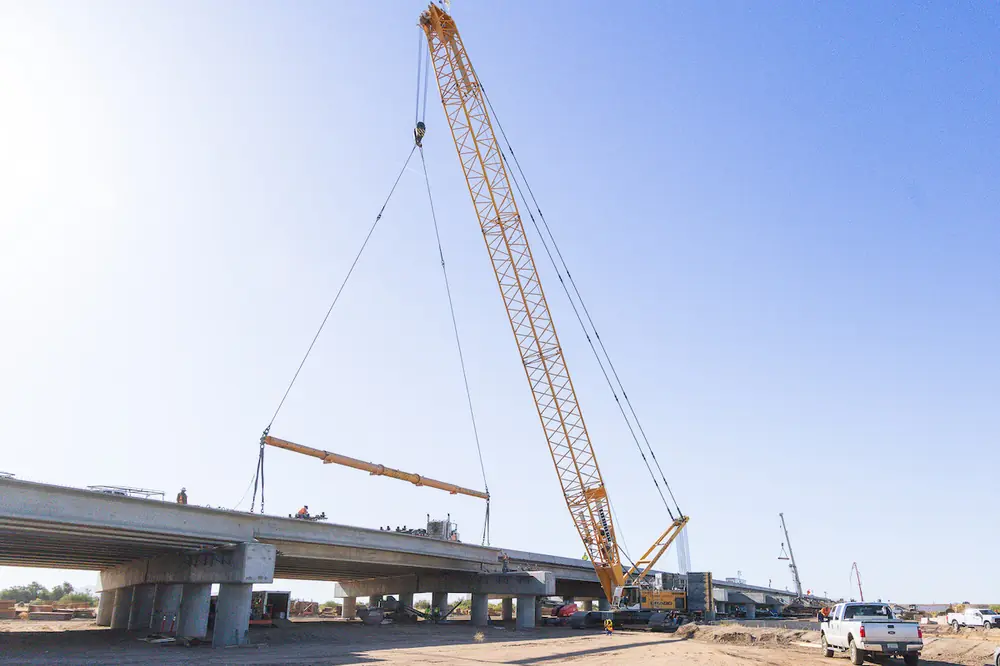
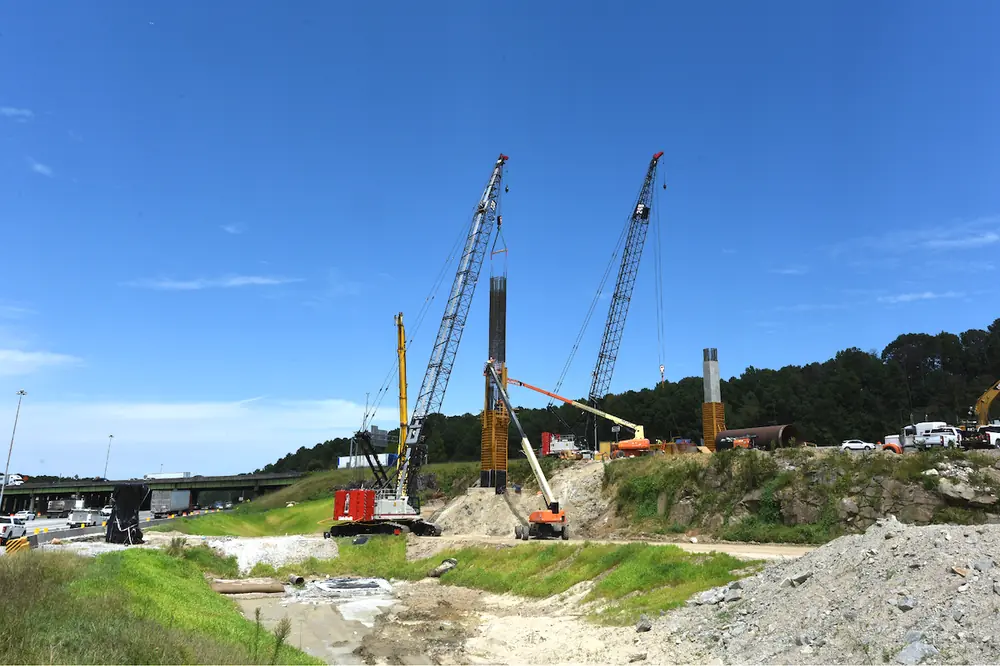
Several Link-Belt crawler cranes are assisting in that effort and have been mobilized within a loop ramp of I-20 eastbound to I-285 northbound. A Link-Belt 200-ton 248 HSL and a 150-ton 238 HSL lattice boom crane are just two of the company’s fleet of Link-Belt machines involved with constructing tall pier columns, some as high as 90 feet. They will also place the 50-foot-long caps, along with the prestressed, precast concrete beams that are up to 163 feet long and 6 feet tall.
“When we bring the beams in, we will be able to close a ramp down in the evening,” said Mark Dolan, Structures Manager for C.W. Matthews. “The one nice thing about using the crawler crane for that work is that we can walk the machine. That allows us to keep a smaller radius by utilizing the pick and carry approach, especially with the beams. We will work from median work zone to median work zone back towards the beginning of the bridge. We are actually starting in the middle because of the site logistics. Once we get a lot of the support and piers built, then we will start setting the beams by early next year.”
The bridge piers in the small work zone are massive. Many of the picks are in the 25,000- to 40,000-pound range, especially the critical lifts of 40-foot-tall, 6-foot by 7-foot rebar cages hoisted more than 45 feet in the air when mating to another in-place rebar cage. The Link-Belt crane may also be lowering a 35-foot-tall form work between several strong back whalers. Later, the crane would put the 35,000-pound pier cap rebar cage on top of the heightened column and then join the two metal cap forms to cover the cage for concrete placement.
| Your local New Holland dealer |
|---|
| Burris Equipment |
“They are really heavy loads in building our substructures, from drilled shafts, our columns, footings, and caps. ... We have a lot of weight on the hook,” Dolan said. “The flyover picks are bigger in size, so the bigger machines are used there. The 200-ton and 150-ton Link-Belt cranes fit our work for the weights, but also for the work zones that we have set the machines on. It’s just an ideal size machine for highway and bridge work in this market.”
With Link-Belt dealer Atlantic & Southern Equipment’s Atlanta branch located so close to the job, C.W. Matthews can work confidently across phases.
“We like the Link-Belts because if we have an issue, a lot of the parts are close by,” Dolan said. “We’re not waiting weeks for a part. The Link-Belts are well made. The service — if we have an issue — we know it will get handled quickly. They make good machines, and they are capable, too. We can rely on them. A lot of people don’t realize, but when our guys are working around those cranes, their lives are at risk with really dangerous lifts, and we really rely on those machines.”
While setting in the interchange median, the cranes for their heavy lifts are equipped with 150 feet of boom. The 238series2, 150-ton rig lifted a more than 30-foot, 6-foot by 7-foot octagonal rebar cage to an existing concrete column enhancing its height. The 23,000-pound cage was lifted at a 56.1-foot radius while at a 69.7-degree boom angle.

| Your local Takeuchi Mfg Ltd dealer |
|---|
| Brandeis Machinery |
The next day, a 248series2, 200-ton Link-Belt crane — situated about 20 feet higher uphill and on the opposite side of the existing column — lifted a 30-foot tall, 24,000-pound octagonal metal column form. It was raised up and over the rebar cage at a 79-foot radius, with about a 57-degree boom angle while also using a four-part line and an 8-foot-long spreader bar.
Both operators, Ronald Carter and Jose de Jesus, were “threading the needle” while mating the existing rebar cage, or surrounding the cage between the whalers, requiring a smooth and slow crane operation.
“At times it’s like threading a needle with some of these heavy loads,” Carter said. “You have to be careful lowering the rebar cages between existing cages with men helping with that procedure. The crane has to be smooth so no one will get hurt, and I need to be slow about it. It’s the same way when lowering the column forms over the rebar cages and between the strong back whalers.”
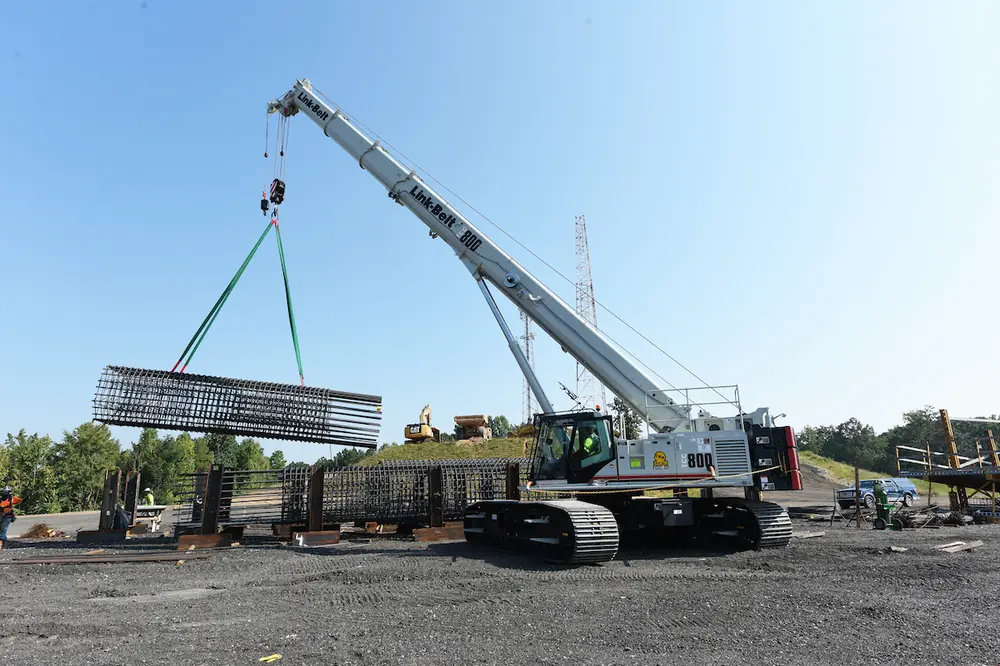
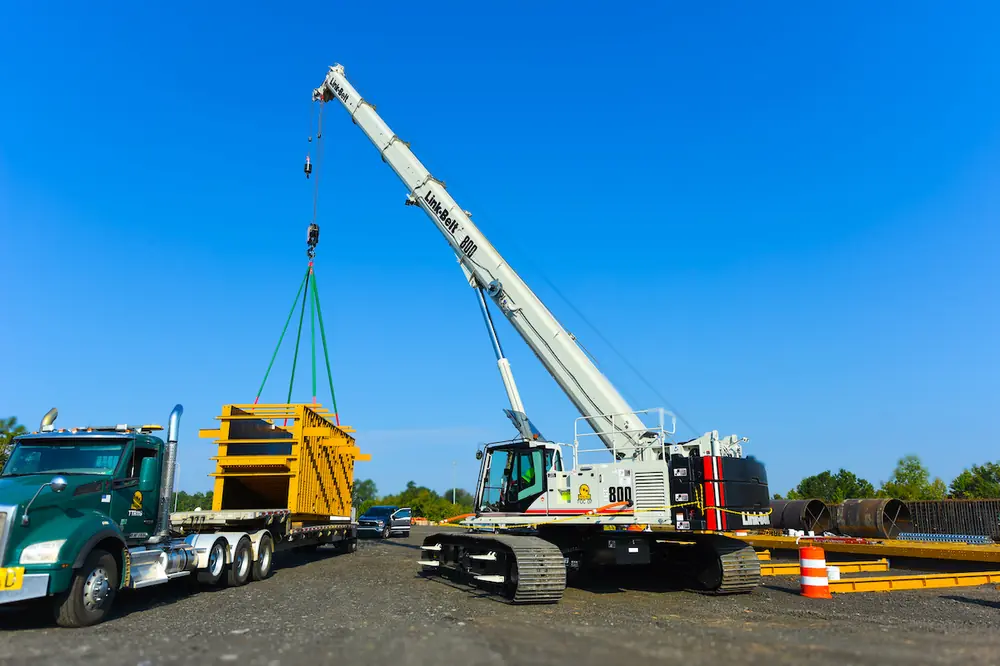
To supply pier sections to the construction site, a Link-Belt TCC-800 Telecrawler loaded the finished, built rebar cages and highway-permissible heavy metal column forms onto lowboys at the company’s laydown yard.

| Your local Komatsu America Corp dealer |
|---|
| Brandeis Machinery |
“Our work yard is kind of a dynamic work zone where we are constantly moving,” Dolan said. “So, building the rebar cages in a central location, or assembling cap forms, without trying to move that operation with basically a dynamic moving work zone (pier site to pier site), was the idea of that concept. We just constantly feed the work zone as it moves with the material from the yard. And just having a central location allows for a lot of efficiencies — being safer and keeping the crews out of traffic. Standard deliveries can also be done during the day when needed, especially when the work zone is small with limited room for storage.”
The TCC-800 loaded a large, finished pier rebar cap form that was over 45 feet long and weighed 35,000 pounds onto the trailer destined to the work site. It was hoisted at a 63-degree boom angle, with 84 feet of boom out, and at a 34-foot radius. A smaller rebar cage was also loaded that only weighed 16,000 pounds.
The metal pier cap forms were loaded onto a lowboy in two sections. Each section weighed about 20,300 pounds and were placed at a 32-foot radius with a 51-degree boom angle and had 65 feet of boom out.
“We use the TCC-800 80-ton machine in the yard as a service machine,” Dolan said. “A later delivery of a TCC-1200 120-ton Link-Belt will be used in the construction zones where more flexibility is needed, whether close to traffic or smaller tight work sites since it has a smaller footprint.”

| Your local Bobcat dealer |
|---|
| O'Leary's Contractors Equipment & Supply |
“You can retract the boom and walk it under a bridge or low overhead lines or obstacles,” Dolan added. “Then extend the boom back out and still have a really good capacity. That is my favorite machine because it has so much capacity and so much flexibility. You don’t have to break them down very much ... really just put some counterweights on a truck, and send it down the road.”
Ronald Carter, operator of the 248series2, 200-ton crane at the loop road site, has been working at C.W. Matthews for 50 years and has operated Link-Belt cranes for 35 of those years. He spoke of his experience while lifting the ready-made rebar cages and form work.
“We don’t have any problems with any of these new cranes we have here,” Carter said. “They are big enough to do the job. Sometimes you get on a job and sometimes the crane is not big enough for what you need. What we have out here, it will handle everything we got to do. ... These Link-Belt cranes are made dependable. They can do just about anything you want them to do on lifting heavy stuff, light stuff — it doesn’t matter.”
“I love the way the levers are set in place because your hands depend on them doing several things at one time,” Carter added. “I also really enjoy how the cab is set up on the inside with the levers. They’re all within your reach and comfortable to run. ... I’ve seen a lot of changes in all these cranes through the years, and I’m sure glad that C.W. Matthews went with Link-Belt. They are easy to operate, they have a comfortable cab, and I just love them.”