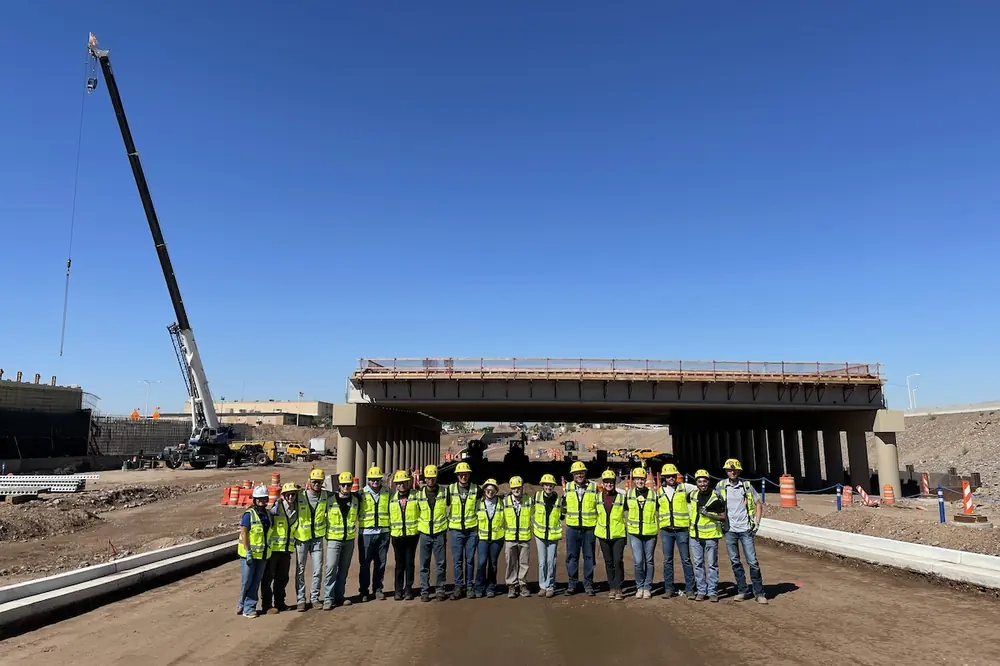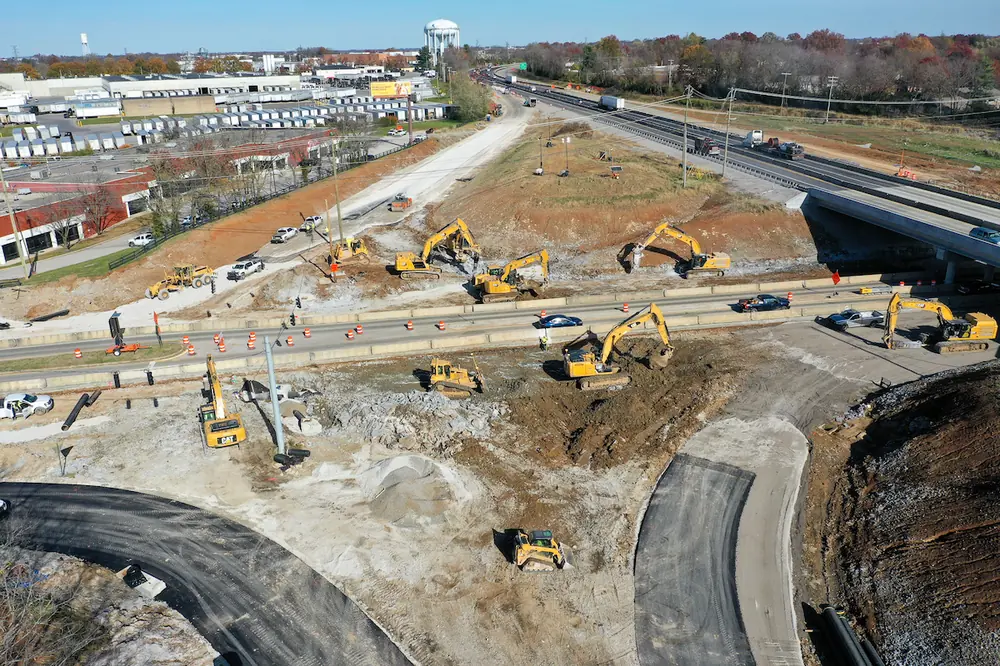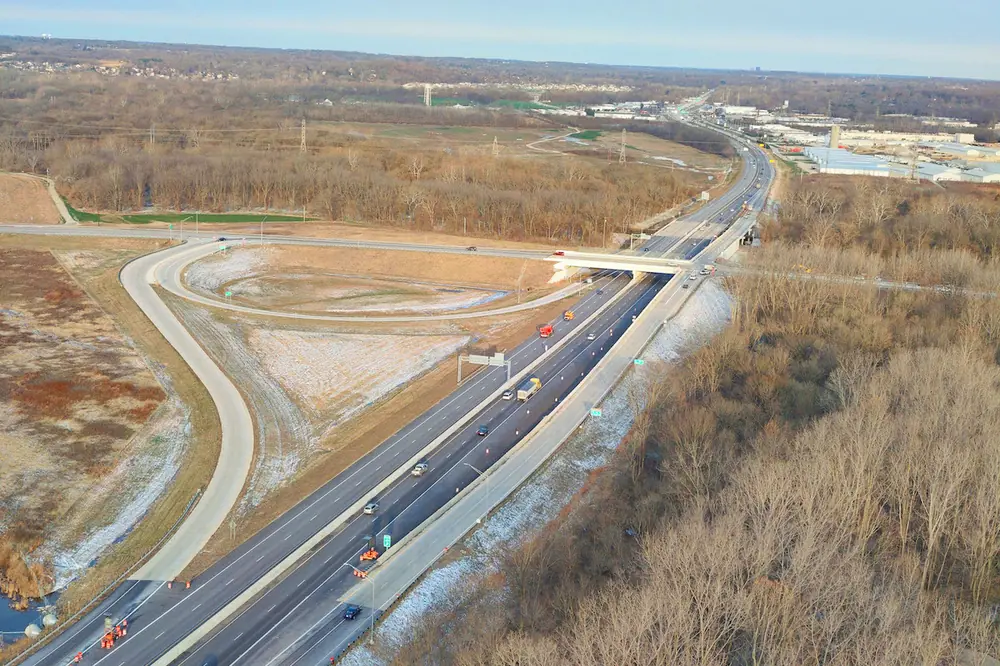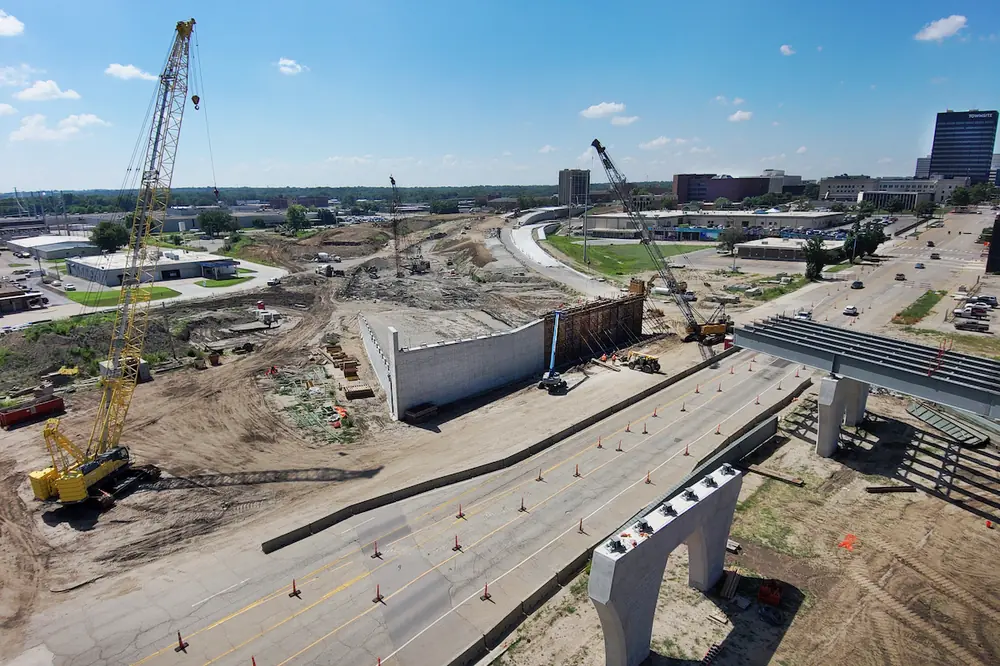
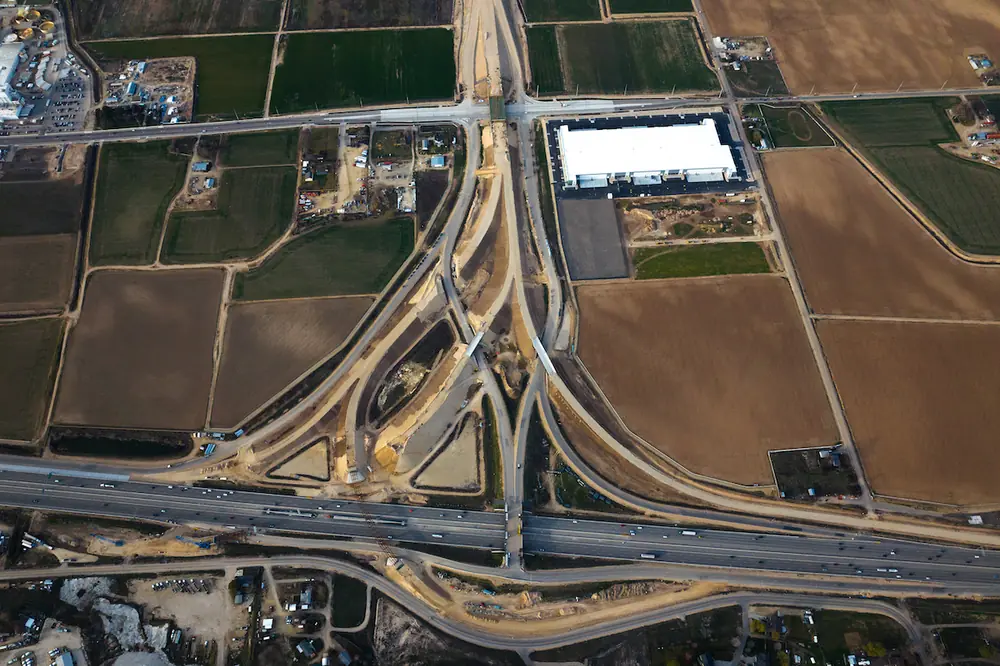
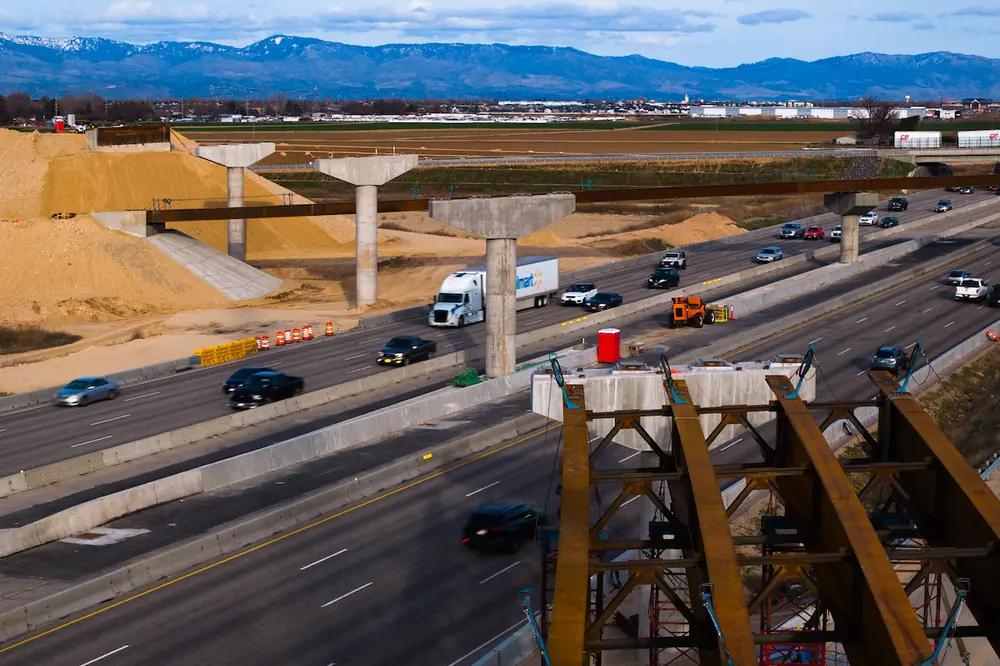
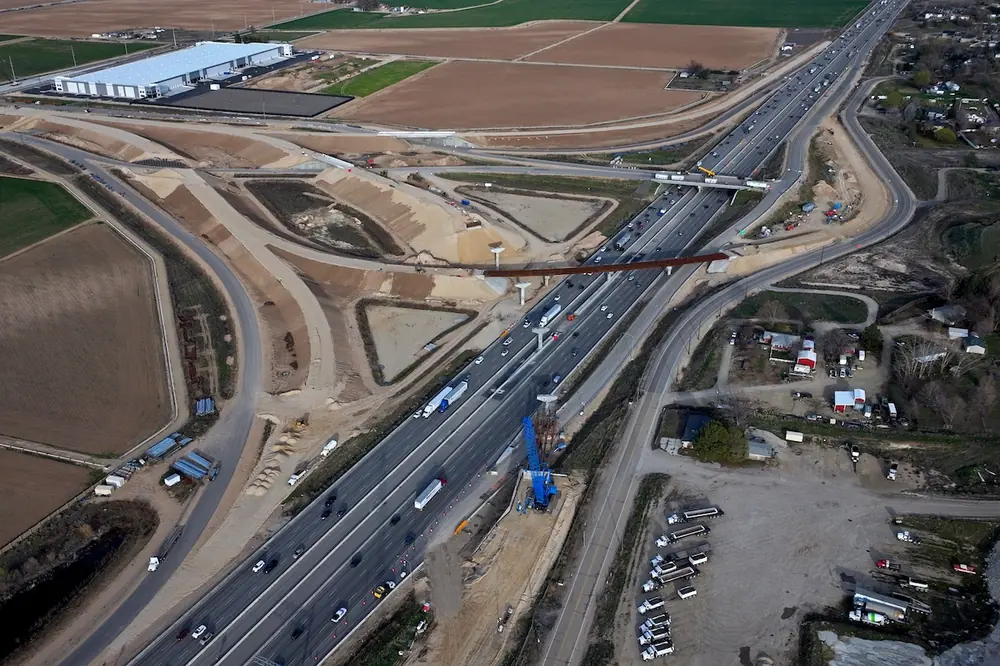
Rapid growth throughout southwestern Idaho’s Treasure Valley has created the need for expanded transportation capacity. To address increasing congestion and improve regional connectivity, the Idaho Transportation Department (ITD) and general contractor Concrete Placing Co. (CPC) are constructing the I-84 system interchange.
The project currently in progress is one of five interchanges that make up the larger I-84/SH-16 System Interchange project, a long-planned effort that began construction in the early 2010s and had been under consideration for years before that.
“There’s no good north-south corridor in Treasure Valley,” said Jeff Ryan, ITD’s District 3 office Resident Engineer. “The central Treasure Valley needs a new controlled-access road to increase mobility in the area.”
ITD anticipates that the project will help ease congestion on local roads and improve access between I-84, U.S. 20/26, and SH-44.
State Highway 16 currently ends at I-84, leaving the system interchange with no direct southbound continuation. The broader project intends to change that.

| Your local Leica Geosystems Inc dealer |
|---|
| Laser Specialist inc |
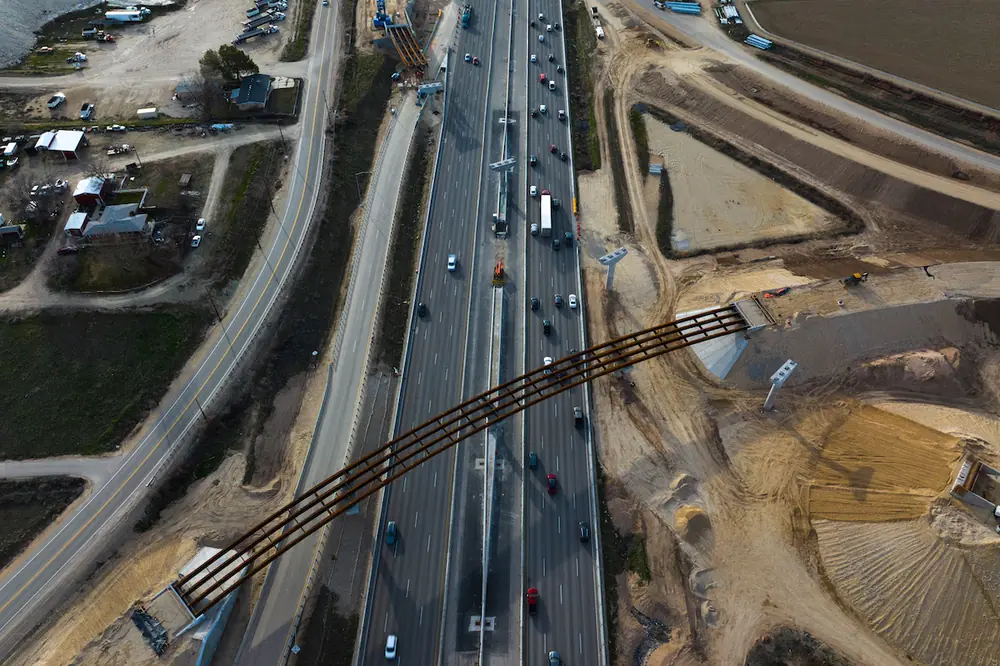
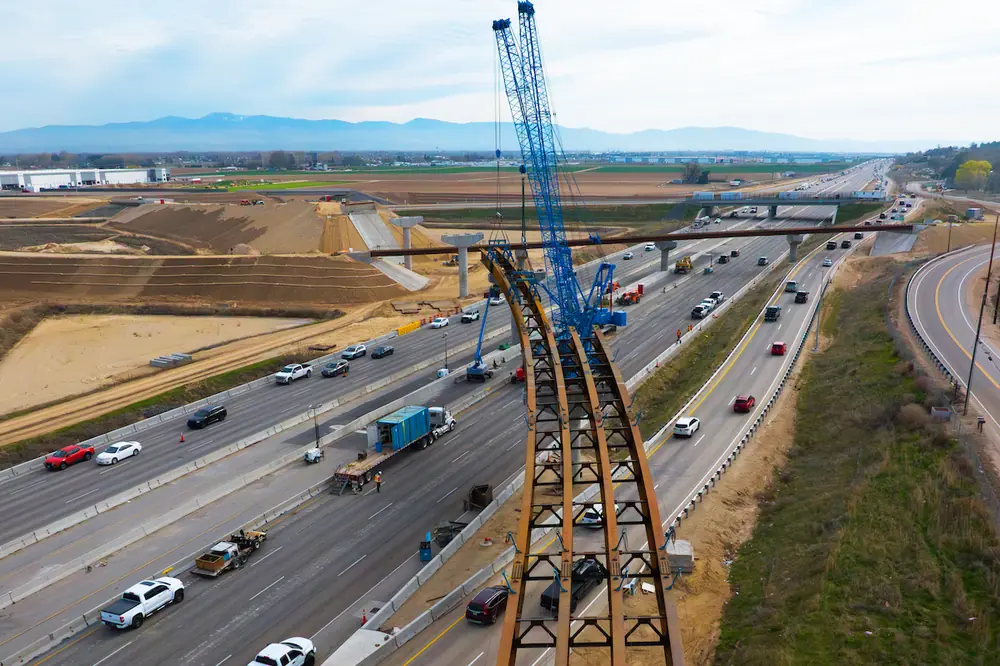
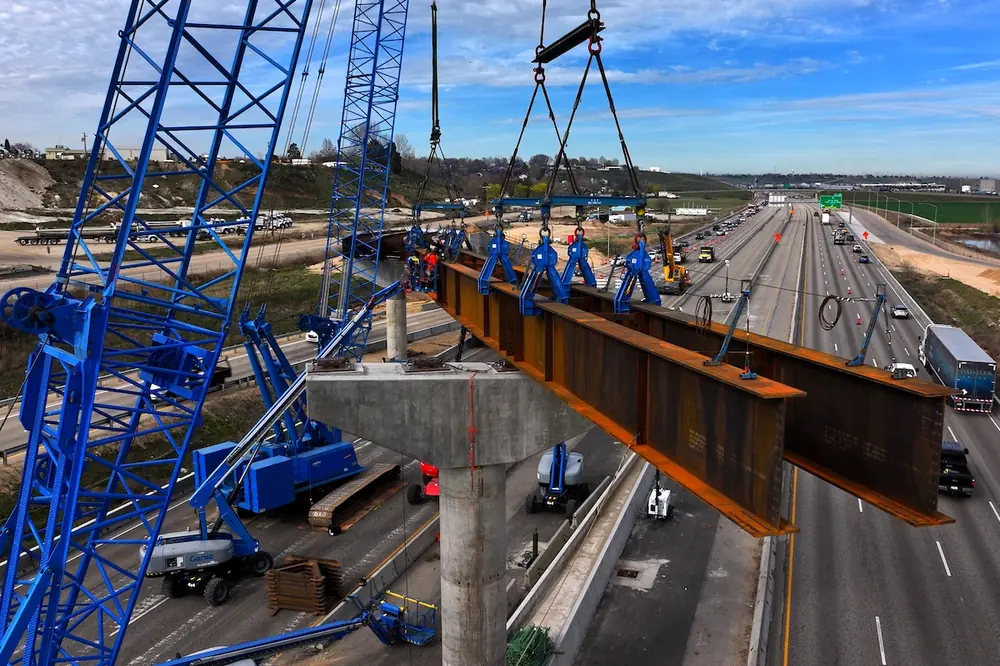
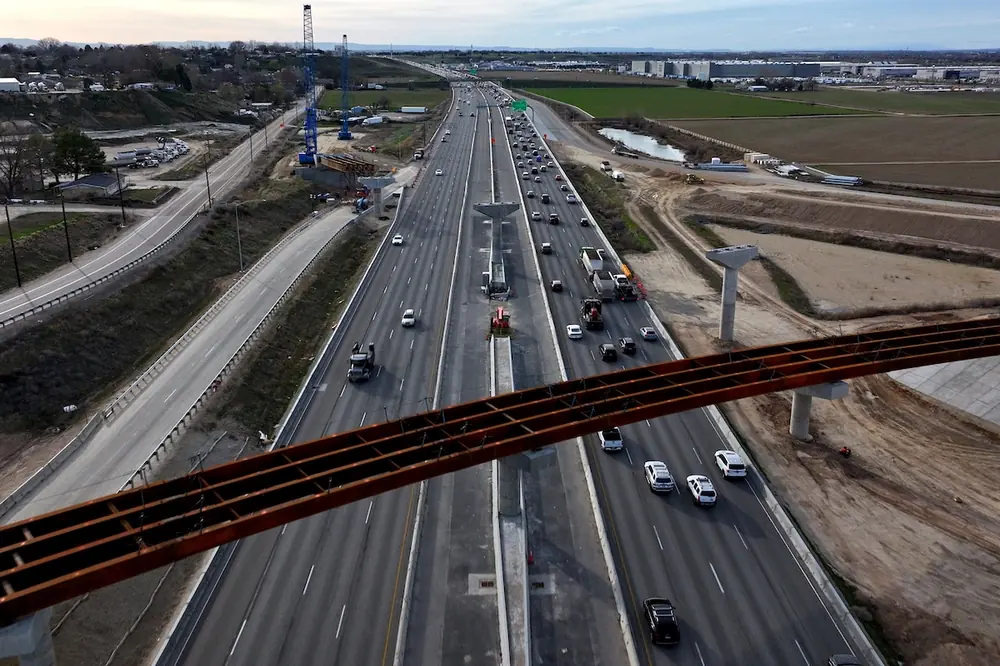
Upon completion, the I-84 system interchange will be a three-level structure with substantial steel girder bridges for the flyovers.
The project also involves the construction of a single-point urban interchange (SPUI) at the intersection of a local road, Franklin. The team chose an SPUI due to increasing traffic volumes.
“An SPUI [is] unlike a standard diamond [interchange], which has dual lights that have their own cycles that need to be programmed together,” Ryan said. “The SPUI is better at dealing with significant traffic volumes and functions much better.”
The system interchange will include a single-lane flyover for southbound-to-eastbound traffic and a second single-lane flyover for eastbound-to-northbound traffic. The other ramps are single-lane as well.

| Your local Wirtgen America dealer |
|---|
| Brandeis Machinery |
The interchange includes six bridges. There are two flyover structures: a steel bridge over Franklin Road and another bridge over the service interchange ramp.
The corridor will function like a divided highway, with two lanes in each direction separated by a concrete barrier running through the entire route.
Because the I-84 system interchange is part of a larger project, crews encountered some complications tied to earlier work.
“As part of phase two, we had to relocate some utilities that were not relocated to the right spot during an earlier phase,” Ryan said.
| Your local New Holland dealer |
|---|
| Burris Equipment |
A high-pressure gas line was 90 feet off from where it was meant to be. If it had remained in the incorrect location, it would have been 2 feet off the pile line for the Franklin Road overpass.
Quickly moving the utilities was essential, as the project has a very aggressive schedule. Any utility delays would have hurt the schedule, making it extremely difficult for the team to meet the completion date.
“We were dealing with one of the more responsive utility companies, and they understood their error,” Ryan said. “We stressed the importance of our schedule to the utility company, and they worked quickly to resolve the issue.”
Another challenge the team dealt with involved the large, deep-drilled shafts required to build the flyover ramps. According to Ryan, the shafts were the largest he has ever constructed in his career and are atypical for Idaho.

| Your local Takeuchi Mfg Ltd dealer |
|---|
| Brandeis Machinery |
“Most of the drilled shafts around here are for overhead sign structures and things of that nature, but this is a completely different ballpark,” he said.
The drilled shafts are 9 feet in diameter and are a minimum of 70 feet deep, with some closer to 85 feet deep. ITD put great effort into finding a team that had the necessary equipment and expertise to drill the shafts in a timely manner. Ultimately, a team from Southern California (Legacy Foundations) was selected.
“They met the schedule and did a phenomenal job building the drilled shafts,” Ryan said.
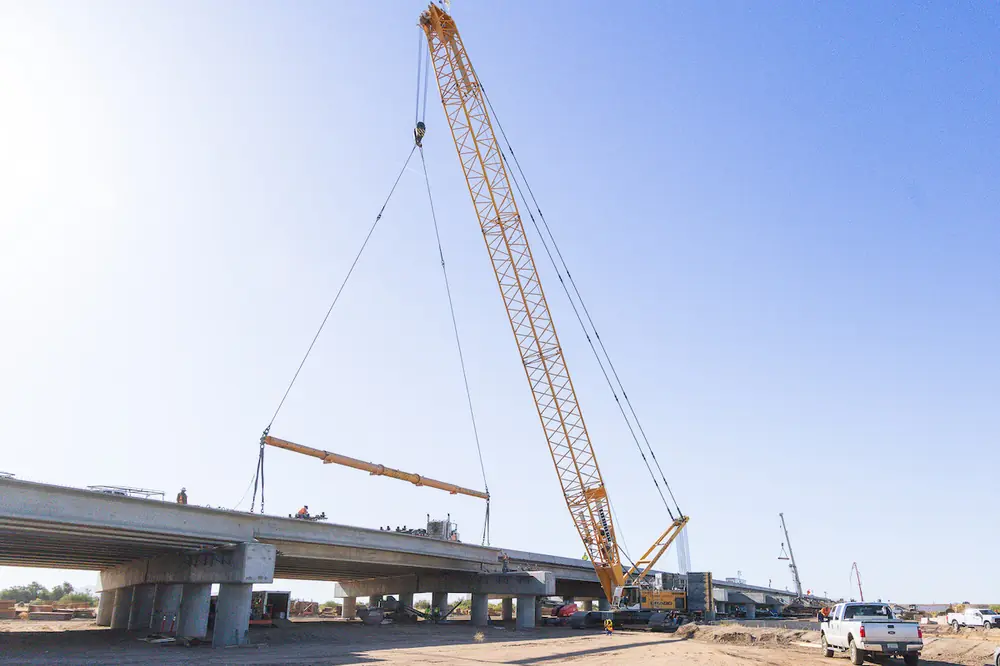
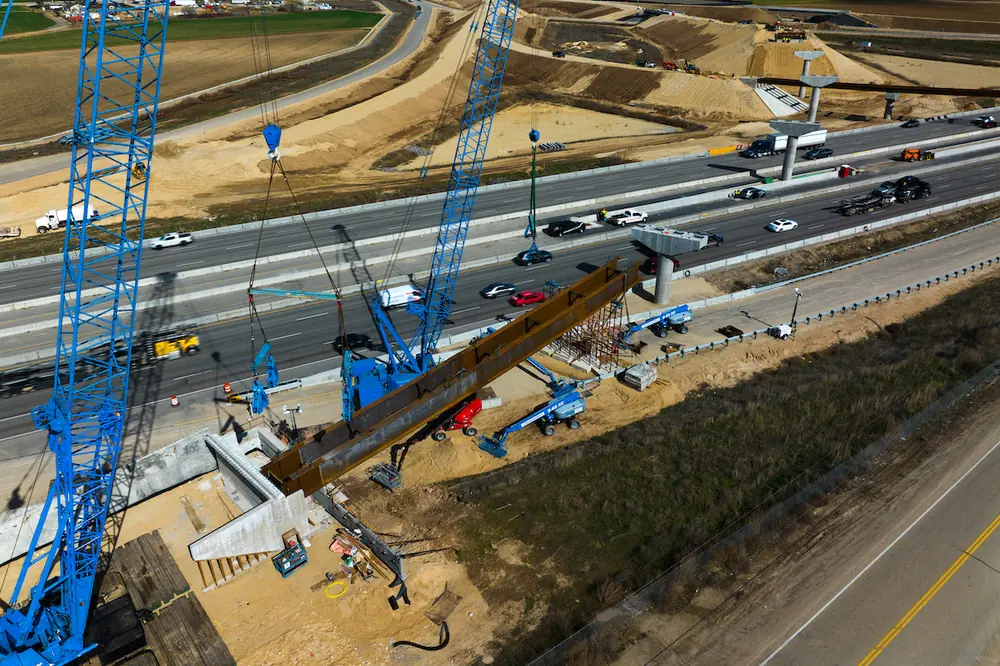
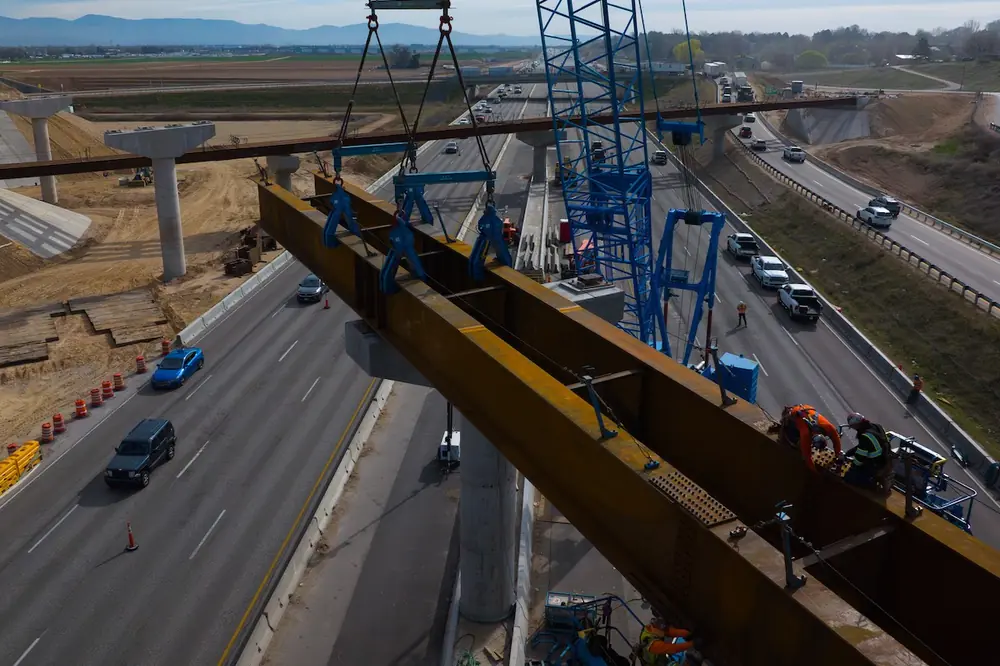
The sheer size and complexity of the steel girders also presented a challenge. Approximately 3.7 million pounds of structural steel girders are being used throughout the interchange.

| Your local Komatsu America Corp dealer |
|---|
| Brandeis Machinery |
“There was a long lead time to get them, as fabrication takes quite a while and has to be pretty precise,” Ryan said.
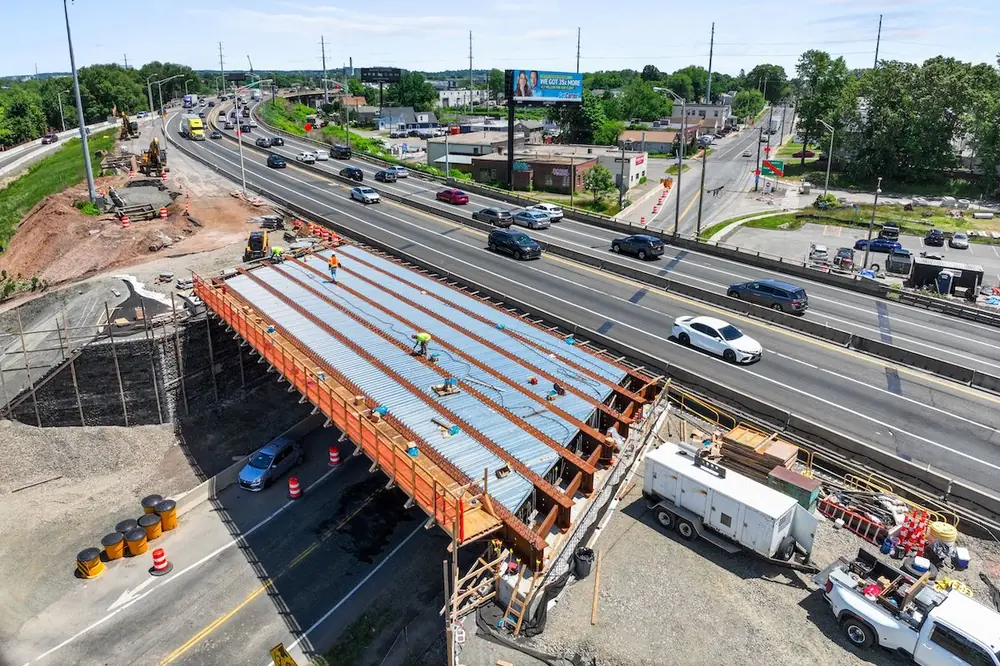
Erecting the girders required full closures to safely lift and set the bridge beams in place. Weekend closures were used to minimize disruptions on I-84, Idaho’s busiest interstate, which had an average daily traffic of 105,000 in 2020.
Because of earlier phases of the project, the team had already built portions of the new interchange, including ramps. That allowed eastbound traffic to be detoured efficiently.
“Instead of sending drivers on a long alternate route, eastbound traffic could exit the interstate and immediately re-enter using the newly constructed ramps,” Ryan said. “This approach kept traffic moving more smoothly and reduced disruption while the work was underway.”

| Your local Bobcat dealer |
|---|
| O'Leary's Contractors Equipment & Supply |
Westbound traffic was detoured onto the local system.
Concrete Placing Co., which has been a fixture in Treasure Valley since 1962, has partnered with ITD on many projects in the past.
“They're one of the larger local contractors, and they’ve won a good majority of our bridge works,” Ryan said.
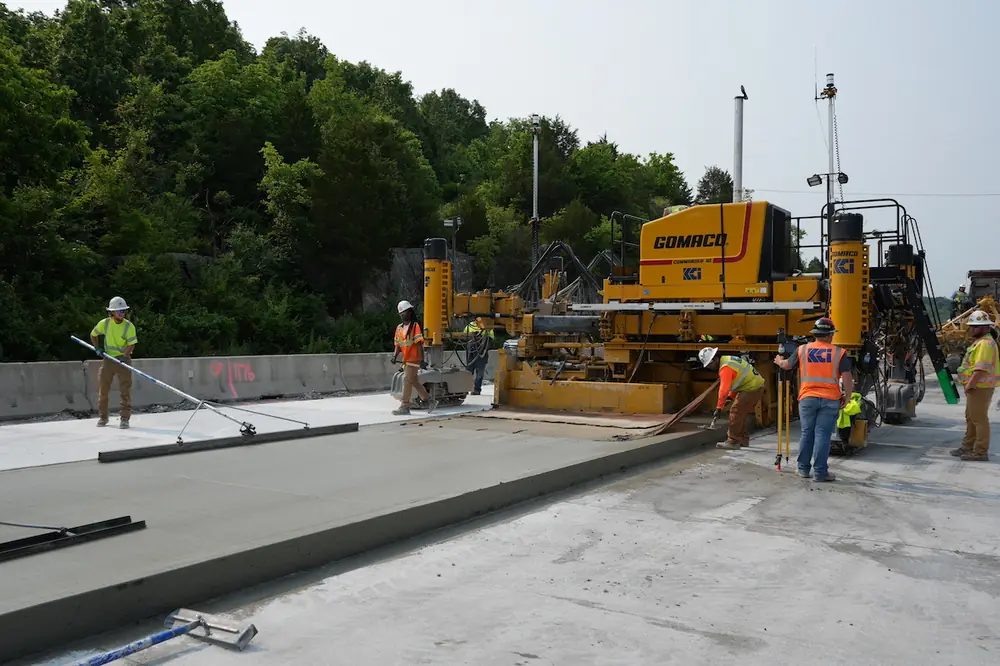
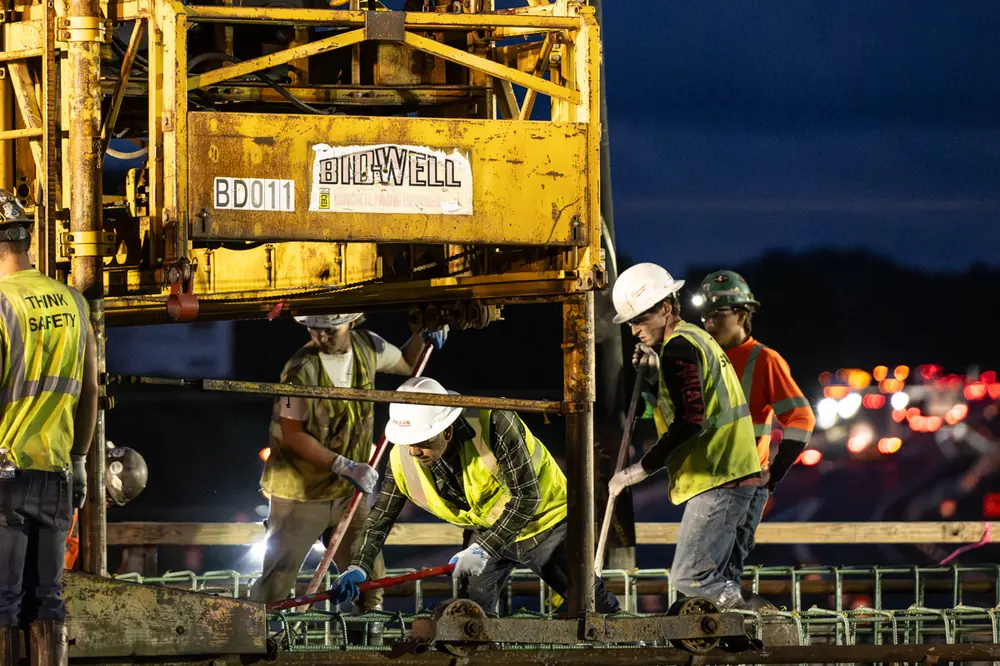
He added that CPC has good bridge-building skills and is highly experienced at concrete paving — an important skill for this job, since the corridor work involves 6 miles of concrete paving.

| Your local Case Construction Equipment Inc dealer |
|---|
| Birkey's Construction Equipment |
“I think they've done a phenomenal job of managing their schedule and keeping their subconsultants and subcontractors on schedule,” Ryan said. “If something comes up, they’re able to make changes and continue along at a good rate.”
The project kicked off in February 2025, and completion is expected in spring 2027. As of this writing, the project is on schedule.
“We were incredibly fortunate, as we didn't have much of a winter here this year,” Ryan said.
The team only lost five days to weather in February 2026. This enabled the team to perform earthwork and other tasks during the winter, in addition to the planned winter work.

| Your local Wirtgen America dealer |
|---|
| Brandeis Machinery |
“The mild winter helped us to make more progress on some things that weren't scheduled until a little bit later, so we got a bit ahead of the schedule,” Ryan said.
The project has a construction budget of nearly $86 million. Currently, the project is on budget. Ryan credits a few things, such as a good bid set, for keeping the project on budget.
“This project comes on the heels of [an] earlier project in the area, so all the right of way was acquired, the irrigation work was done,” Ryan said. “All the pre-work that can sometimes cause delays and cost extra were done on their previous projects.”
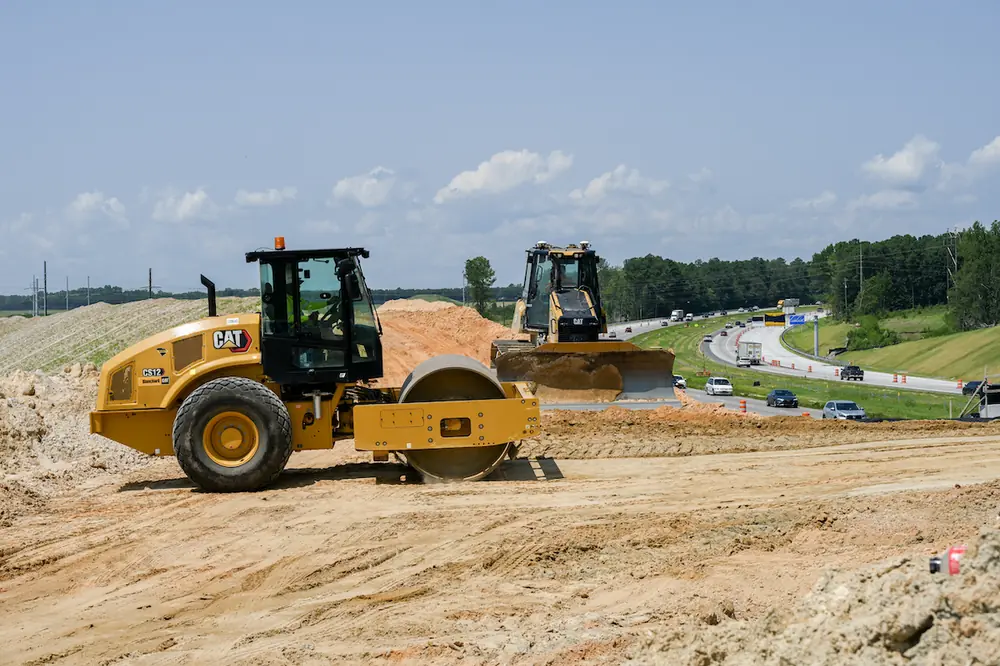
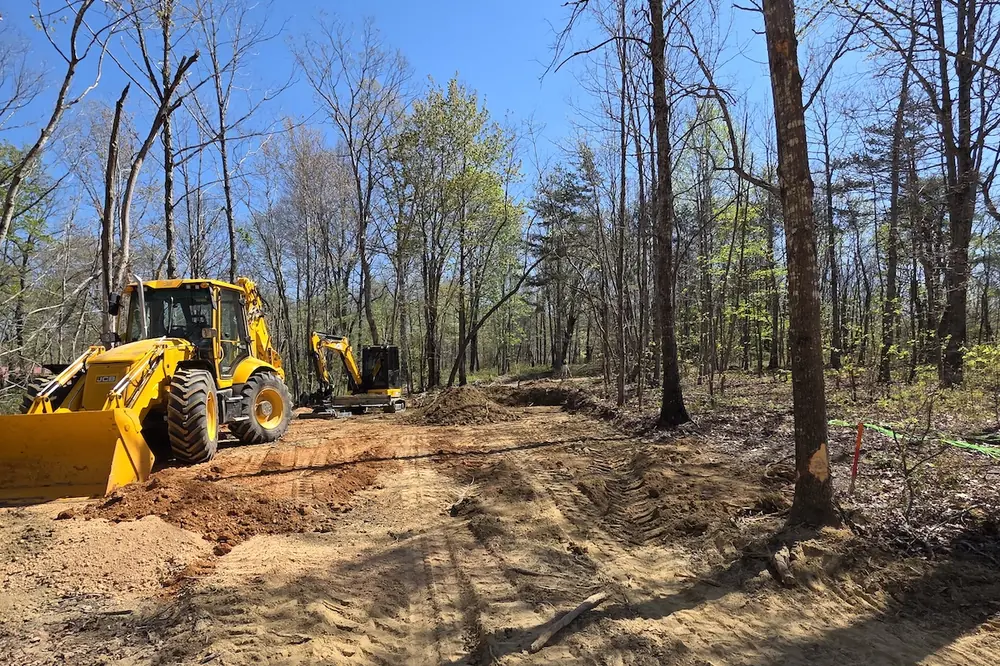
Another advantage for the budget and schedule is that the work is occurring on a new greenfield alignment corridor.

| Your local Wirtgen America dealer |
|---|
| Brandeis Machinery |
“Basically, we have the entire corridor, so we don’t have to deal with traffic, which tends to slow things down a lot,” Ryan said.
When this project is completed and the overall I-84/SH-16 System Interchange is fully operational, it will transform State Highway 16 and create a vital high-capacity north-south corridor connecting I-84 to Emmett, Idaho. This will help alleviate severe traffic congestion in a rapidly growing area of the country.
The corridor is expected to improve regional mobility, enhance safety, and support the expanding housing and business development in the local counties throughout Treasure Valley.
- Owner/Engineer: Idaho Transportation Department
- General Contractor: Concrete Placing Co., Boise, Idaho
- Designer: Parametrix, Seattle, Washington
- Other Contractors: Suncore, Spanish Fork, Utah; Legacy Foundations, Corona, California; Adams & Smith, Lindon, Utah; Power Plus, Boise, Idaho