
ALBANY, NY — Roads and bridges that are deteriorated, congested, or lack some desirable safety features cost New York motorists a total of $40.3 billion statewide annually due to higher vehicle operating costs, traffic crashes, and congestion-related delays. A lack of adequate investment in transportation and increasing inflation in construction costs could hamper New York’s ability to make needed improvements to its transportation network, according to a new report released by TRIP, a Washington, D.C.-based national transportation research nonprofit.
The TRIP report, “New York Transportation by the Numbers: Providing a Modern, Sustainable Transportation System in the Empire State,” includes statewide and regional pavement and bridge conditions, congestion data, highway safety data, and cost breakdowns for the Albany-Schenectady-Troy, Binghamton, Buffalo-Niagara Falls, New York-Newark-Jersey City, Poughkeepsie-Newburgh-Middletown, Rochester, Syracuse, and Utica urban areas.
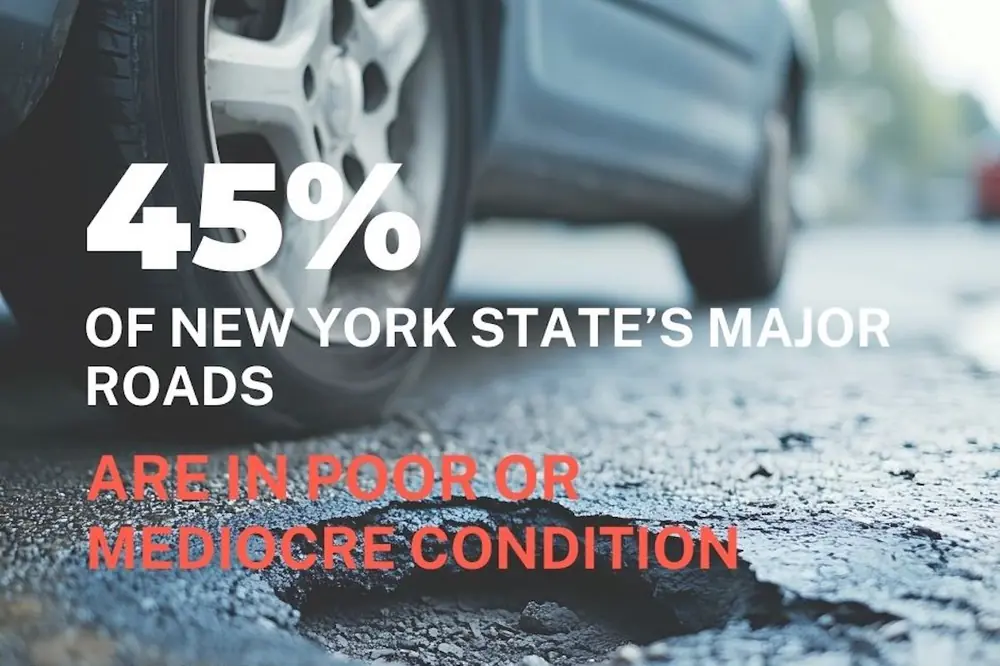
Due to a lack of funding, 45 percent of major locally and state-owned roads in New York are in poor or mediocre condition. Driving on rough roads costs the average New York driver $718 annually in extra vehicle operating costs — a total of $8.8 million statewide. Extra vehicle operating costs include accelerated vehicle depreciation, additional repair costs, and increased fuel consumption and tire wear.
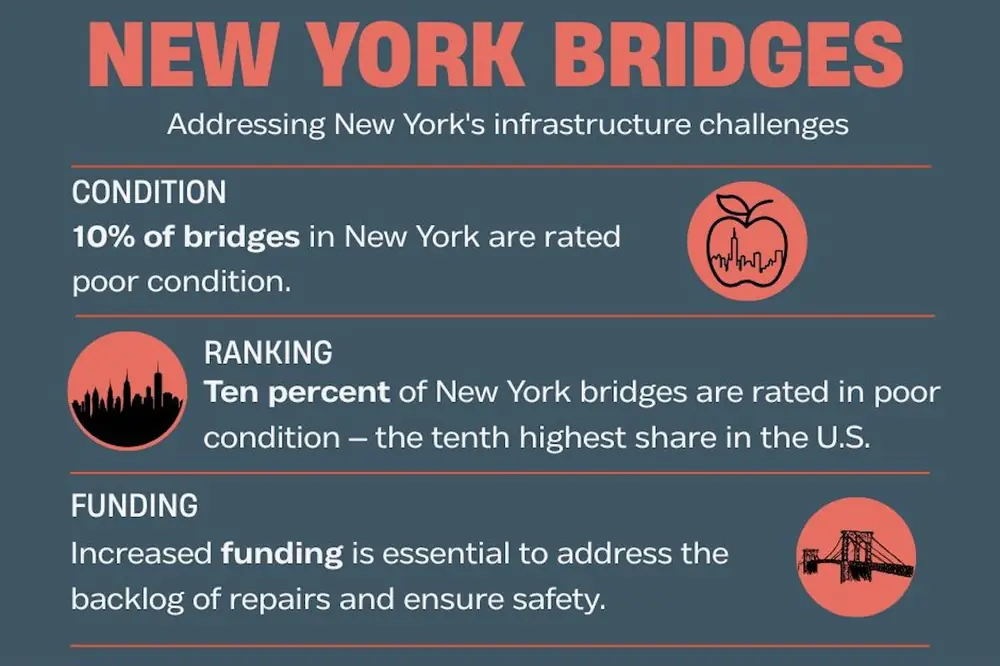
Ten percent (1,741 of 17,666) of New York’s bridges are rated in poor/structurally deficient condition, the 10th highest share in the nation. Bridges that are rated poor/structurally deficient have significant deterioration of the bridge deck, supports, or other major components. Fifty-eight percent of the state’s bridges are rated in fair condition, and the remaining 32 percent are in good condition.
Congested roads cost the state’s drivers $20 billion annually in lost time, and wasted fuel costs the average driver up to 99 annual hours of delay in some areas. Due to the COVID-19 pandemic, vehicle travel in New York dropped by as much as 45 percent in April 2020 (as compared to vehicle travel during the same month the previous year). By 2024, vehicle miles of travel in New York had rebounded to 2 percent below 2019’s pre-pandemic levels. The New York State Department of Transportation (NYSDOT) estimates that vehicle travel in New York will increase by 23 percent by 2040.

| Your local Trimble Construction Division dealer |
|---|
| SITECH Allegheny |
| SITECH Northeast |
Traffic crashes in New York claimed the lives of 6,529 people between 2019 and 2024. The financial impact of traffic crashes in which the lack of adequate roadway safety features, while not the primary factor, were likely a contributing factor, was a total of $11.5 billion statewide. New York traffic fatalities began to increase dramatically in 2020 even as vehicle travel rates plummeted due to the COVID-19 pandemic. The number of fatalities continued to increase in 2021 and 2022 before falling in 2023 and 2024. While the state’s traffic fatality rate decreased 15 percent from 2021 to 2024, New York’s traffic fatality rate in 2024 was still 15 percent higher than a decade ago.
Rising vehicle fuel efficiency, increasing adoption of electric and hybrid vehicles, and inflation in highway construction costs will make it difficult for revenue from state and federal motor fuel taxes and other transportation funding sources to keep pace with New York’s future transportation needs.
From 2023 to 2024, NYSDOT’s capital investment in pavement and bridge conditions, mobility, and safety dropped by nearly $262 million, declining from $3.36 billion to $3.1 billion — a decrease of 8 percent. Capital spending declined in six of NYSDOT’s 11 regions, with reductions of up to 70 percent in some regions. Meanwhile, the need for repairs is growing: 270 miles of state-maintained roadway required reconstruction in 2023, up from 142 miles in 2022. Overall, 73 percent of state-maintained pavements need some level of treatment, at an estimated cost of $7.76 billion. Needed improvements to locally and county-owned bridges — just over half of the state’s bridge inventory — total nearly $29 billion.
Increasing inflation has hampered New York’s ability to complete needed projects and improvements, as the available funding now covers significantly less work. Based on the Consumer Price Index, it is estimated that inflation has eroded $3.8 billion of New York’s core construction funding over the last five years. The Federal Highway Administration’s national highway construction cost index, which measures labor and materials cost, increased by 47 percent from the beginning of 2022 through the first half of 2025.