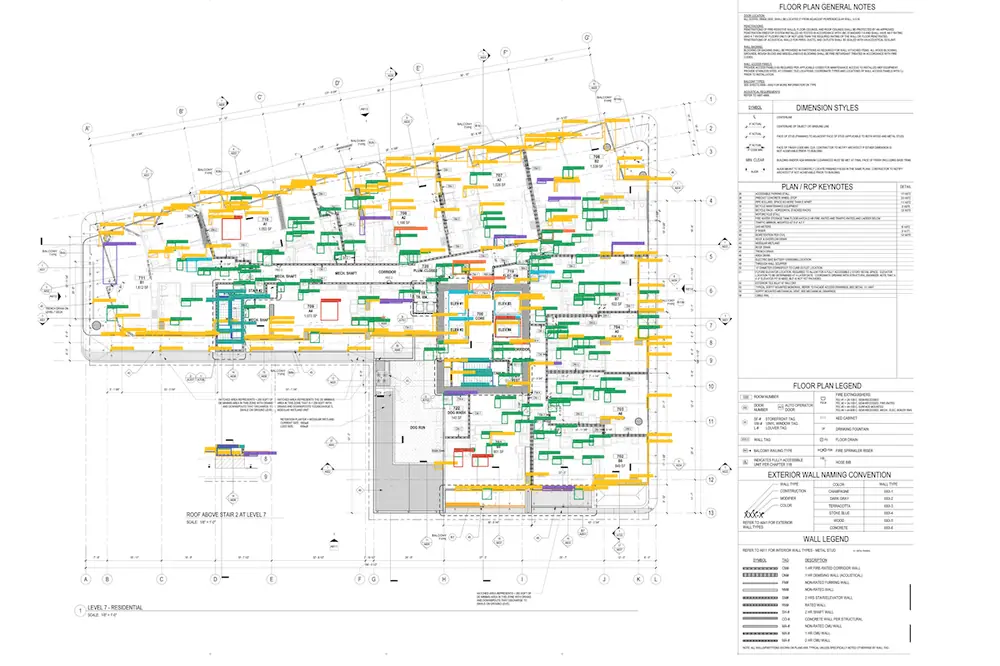


There was a time when a project could barrel through design and construction on sheer momentum — fewer trades, simpler systems, less documentation. That era is gone.
Today's projects involve dozens of consultants; hundreds of sheets; and mechanical, electrical, plumbing, and fire protection systems that are deeply interdependent. The documents that describe these systems are where coordination either holds together or quietly falls apart.
When it falls apart, the numbers are staggering. According to HKA's 2024 CRUX Insight report, construction overages driven largely by design errors totaled an estimated $500 billion annually worldwide. Meanwhile, research shows that 20 percent to 30 percent of a typical project's budget goes to nonphysical, indirect soft costs — preconstruction, design management, coordination, RFIs, rework — representing a massive surface area for automation and process improvement.
The takeaway: The biggest coordination failures don't come from one obviously wrong sheet. They come from small inconsistencies spread across dozens of sheets that nobody catches until steel is going up or concrete is being poured.
Not all drawing errors are created equal. Some are dimensional nuisances. Others can shut down a project.

| Your local Metso Minerals Industries Inc dealer |
|---|
| PacWest Machinery |
| Westate Machinery Co |
Critical System Failures
The most expensive inconsistencies are the ones that affect life safety and core building systems. Missing electrical feeds to fire pumps. Fire-rated door assemblies specified at 30 minutes on the architectural drawings but requiring 90 minutes per the fire protection plan. Storm and sanitary invert elevations on the civil drawings that don't match the plumbing engineer's connection points. Missing scope — an entire system or assembly that one discipline assumed another was covering, but nobody actually detailed.
These aren't hypothetical. They're the issues that generate six-figure change orders and multi-week delays.
Specification-to-Drawing Conflicts
The specifications call for one concrete mix design but the structural notes call for another. The spec requires a specific reinforcement grade that contradicts the bar bending schedule. These conflicts often hide until procurement or placement.
Dimension and Geometry Conflicts
A footing dimension on the structural plan doesn't match the detail sheet. A column grid line drifts between the architectural and structural drawings. This is common when design teams work in parallel and coordinate imperfectly before issuing documents.

| Your local Gomaco dealer |
|---|
| Gomaco -Contact For a Dealer Near You |
Broken References and Callouts
A plan view references "See Detail 3/S-5," but Detail 3 on Sheet S-5 has been renumbered, doesn't exist, or shows something unrelated. Broken references are among the most frequent inconsistencies and force field crews to stop work and improvise.
Catching these issues is valuable. But the real question is how an organization builds a repeatable process — a design review standard operating procedure (SOP) — so that catching them becomes standard practice rather than heroic individual effort.
A major U.S. developer we work with found that roughly a third of their change orders originated from design errors and omissions, which led them to mandate independent third-party design reviews on all projects above a certain threshold. The results spoke for themselves in reduced rework and fewer field surprises.
Here's a framework any contractor or owner can adapt:

| Your local Trimble Construction Division dealer |
|---|
| SITECH Northwest |
Track Sources of Unexpected Cost
Before you can fix the problem, you need to see it clearly. Use your project management platform — Procore, Autodesk, whatever your team runs on — to categorize the root cause of every change order, RFI, and rework event. Was it an owner-driven change? A design error? Unforeseen site conditions? Missing scope? Break it down by asset type, region, project size, and trade.
Analyze Where Your Organization Hurts the Most
The data will tell you. Maybe MEP coordination is your consistent weak spot. Maybe it's civil-to-structural interfaces on highway work. Maybe smaller projects slip through without adequate review because they don't feel complex enough to justify the effort. Identify the patterns.
Develop Targeted SOPs
One-size-fits-all review checklists rarely work. Develop standard operating procedures that are specific — by project type, by region, by the scopes that consistently generate problems. A heavy civil contractor's SOP will look different from one for a multifamily developer.
Choose the Right Approach — and the Right Tools
The SOP might call for an in-house review task force, external third-party reviewers, structured checklists, or AI-powered plan review tools that can scan hundreds of sheets for cross-discipline conflicts in minutes rather than weeks. Increasingly, firms use a combination. The manual expertise sets the standard; the technology scales it.

| Your local Superior dealer |
|---|
| Westate Machinery Co |
Train, Monitor, and Iterate
Roll out the SOP, track whether RFI counts and change order rates actually decrease, and then refine. The firms that treat design review as a living process — rather than a one-time initiative — are the ones that sustain the gains.
Every RFI that results from a drawing inconsistency carries a cost beyond the direct rework. Industry data consistently shows average RFI turnaround times of one to two weeks. During that window, dependent work may be on hold, crews get redirected, and out-of-sequence construction introduces its own risks.
For contractors running net margins in the low single digits, the math is unforgiving. If a $50 million project generates 100 RFIs and even a fraction stem from cross-sheet inconsistencies, the accumulated administrative cost, delay exposure, and rework quickly erode the margin that was already thin. The Construction Industry Institute's body of research on front-end planning has consistently shown that investing in document quality before construction yields returns on the order of 10 to 1 compared to fixing problems in the field.
The drawings will never be perfect. But organizations that build systematic review processes — supported by the right expertise and the right technology — shift from reactive problem-solving to proactive risk management.
| Your local Metso Minerals Industries Inc dealer |
|---|
| PacWest Machinery |
| Westate Machinery Co |
The inconsistencies are in the documents. The question is whether your organization finds them before the first piece of equipment rolls onto the site — or after.
Alexander Michalatos is the Co-founder and CEO of Buildcheck. He previously worked at Stantec, Honeywell, and EllisDon.