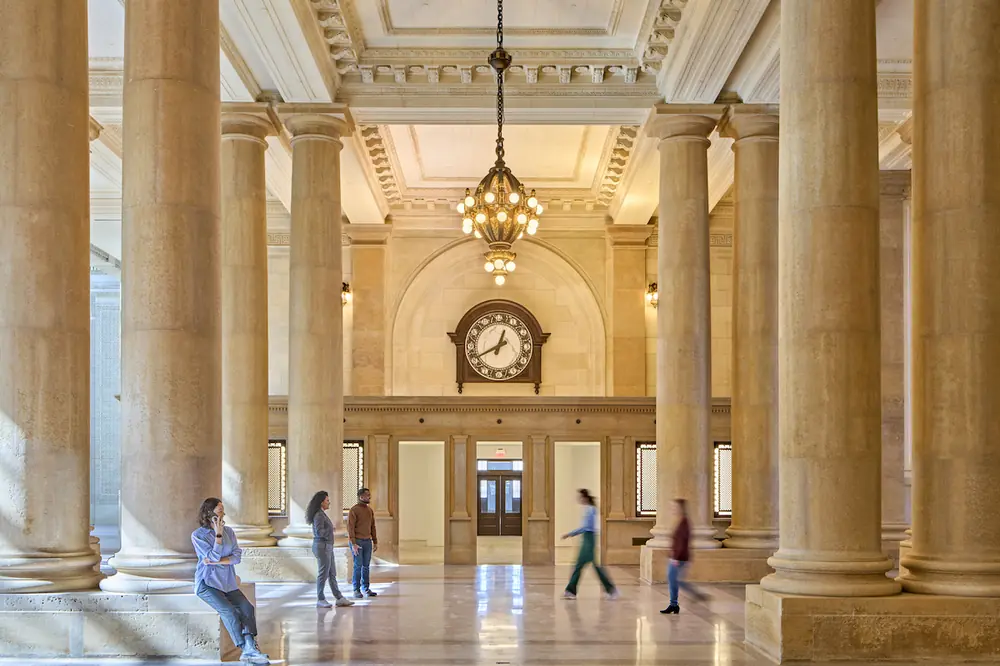
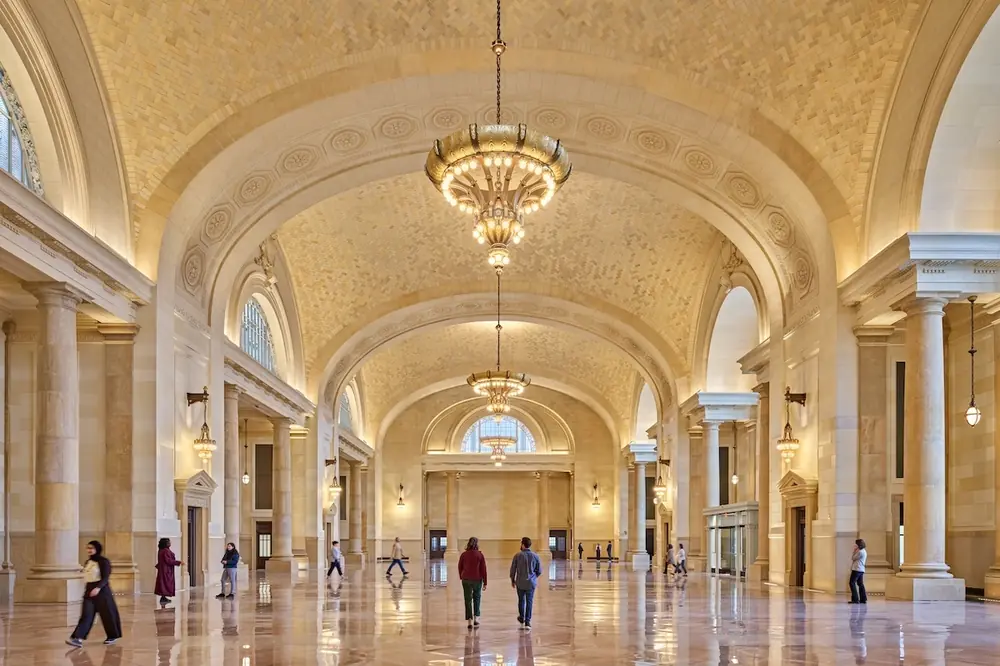
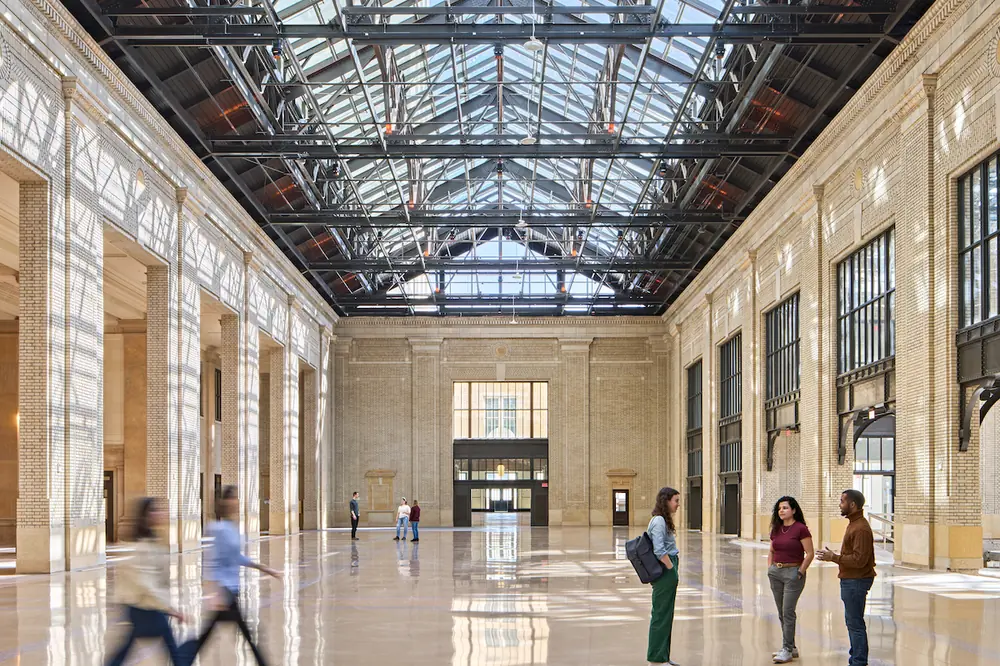
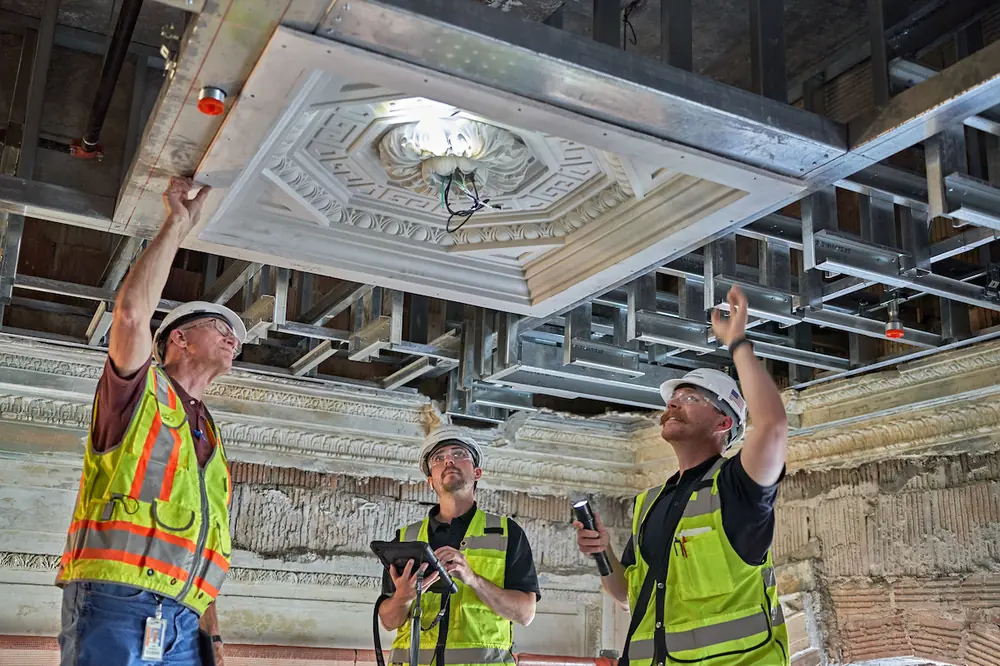


What does it take to revive an iconic landmark built more than a century ago, then abandoned for three decades?
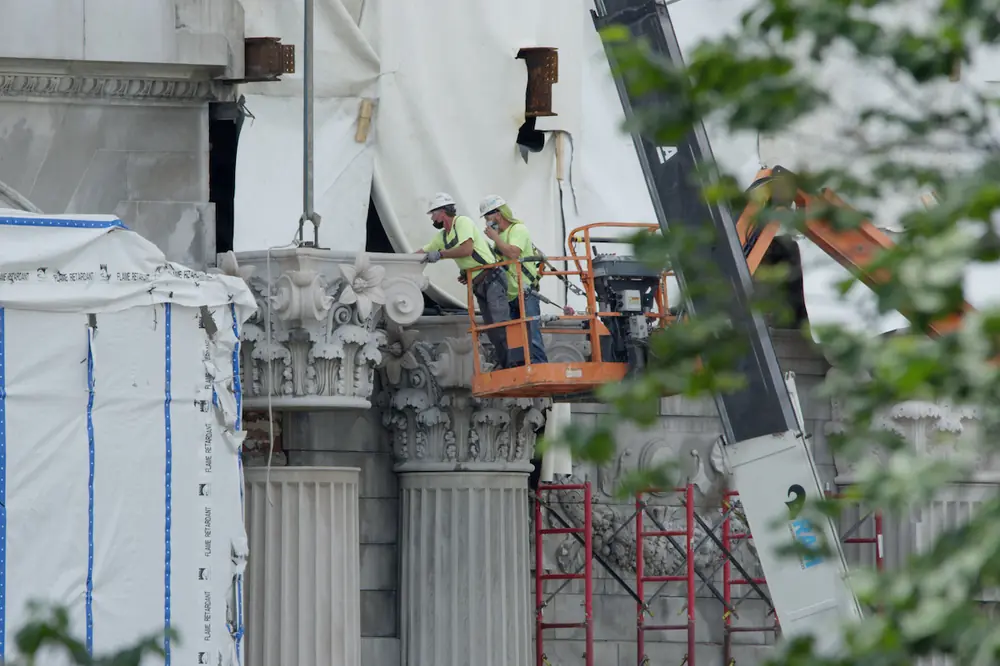
At the historic Michigan Central Station in Detroit, the Christman/Brinker Corktown Transformation Joint Venture employed a combination of established preservation methods and advanced technologies to safeguard existing elements, restore missing features, and incorporate modern systems.
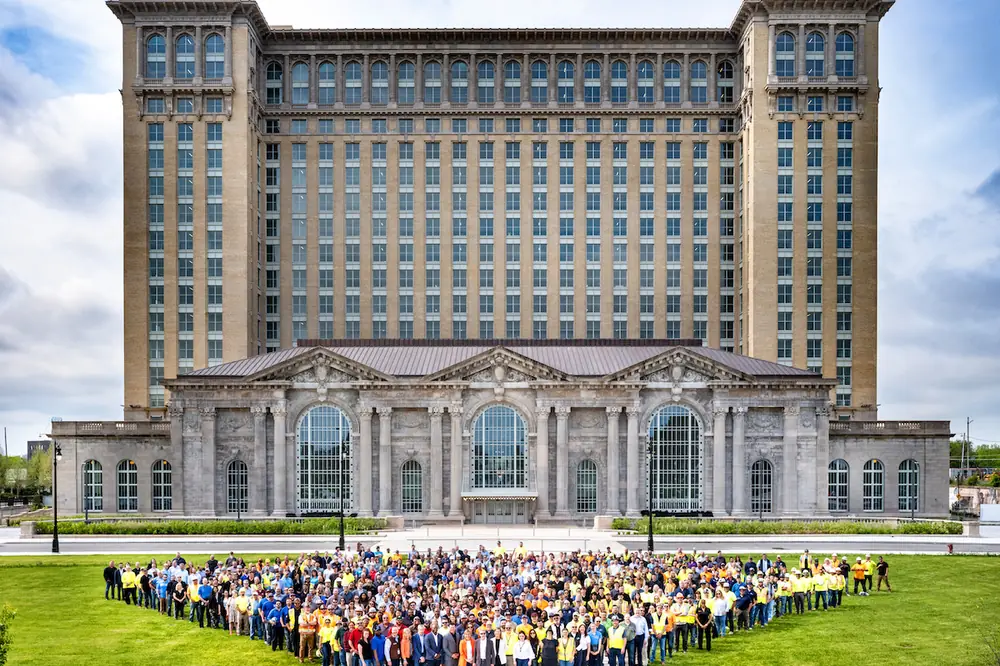
Composed of The Christman Company, based in Lansing, Michigan, and L.S. Brinker, a Brinker company based in Detroit, Michigan, the joint venture team led over 76 months of complex construction planning and execution to stabilize and bring the building up to modern code while preserving its grand waiting room, historic concourse, and 18-story tower.
“This project challenged our team in every way, and I couldn’t be more proud of how our people and partners rose to meet that challenge while honoring a historic landmark that means so much to Detroit,” said Steve Roznowski, President and CEO of The Christman Company.
The team’s work earned national recognition (see “Winning Highest Honors” section) and turned the abandoned structure into a revitalized landmark that now houses a mix of office, retail, and public spaces, serving as the flagship for Ford Motor Company’s Corktown innovation district for research and development in the rapidly evolving field of mobility.

| Your local Bobcat dealer |
|---|
| Ditch Witch West |
Among the few surviving grand railroad stations from the early 20th century, the original station and office tower opened in 1913. At its peak, the facility served 4,000 patrons traveling via 200 trains each day.
In 1988, when Detroit’s economy slowed, the landmark closed and sat empty for 30 years before Ford acquired it in 2018.
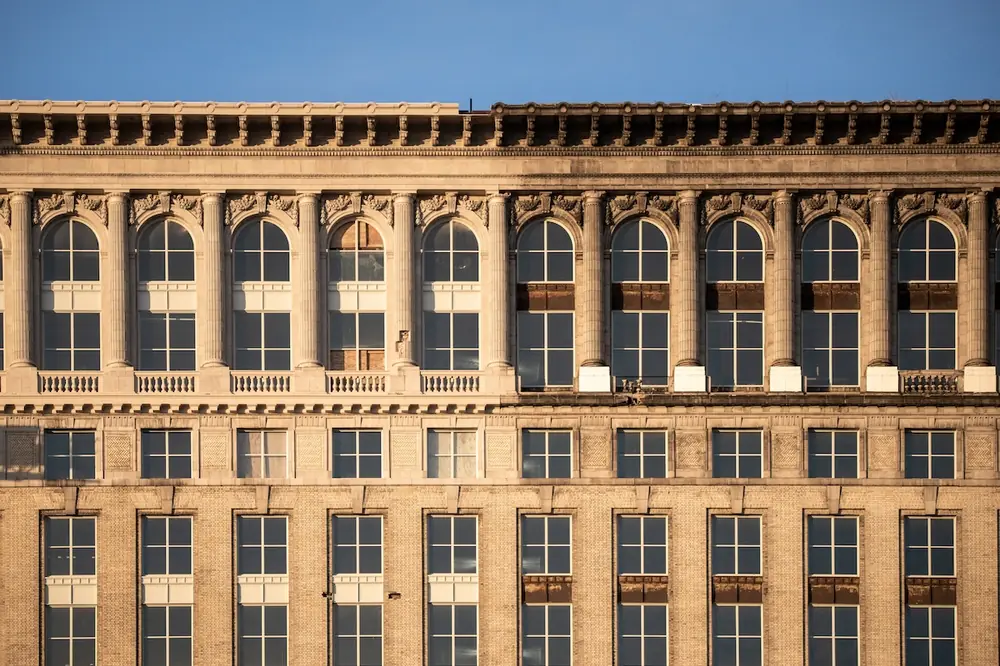
By that time, the 640,000-square-foot Beaux-Arts station had suffered severe structural damage, water infiltration, and extensive deterioration — including an abundance of graffiti, broken windows, and corroded steel.
At the start of the restoration project, crews worked amid debris, ice, and darkness, which required unique safety measures and constant innovation to uncover architectural treasures and complete the work. They restored the intricate, 29,000-tile Guastavino domed ceilings and 8 acres of masonry surfaces. They even reopened the original quarry to source 600 tons of replacement limestone.

| Your local Trimble Construction Division dealer |
|---|
| SITECH Rocky Mountain |
| SITECH Southwest |
| SITECH Northwest |
“A mindset of discovery, flexibility, and problem solving was essential to transforming a severely compromised historic structure into a functional, modern hub for innovation,” said Austin Giesey, Senior Project Manager and Christman’s Historic Preservation Leader in Michigan.
The project required creative thinking through every stage.
“Given the extreme level of deterioration, one of the most innovative ideas was rethinking how design and construction were sequenced amid significant uncertainty,” Giesey said. “The team adopted a phased design and construction approach supported by smaller, highly targeted bid packages rather than a few large scopes of work. This enabled construction to begin while investigative work was still underway, significantly reducing schedule risk and allowing the team to adapt as new conditions were uncovered.”
Before restoration began in earnest, though, the building needed some extra care.

| Your local Gomaco dealer |
|---|
| Gomaco -Contact For a Dealer Near You |
“After being abandoned for more than 30 years, the building had lost many of its natural layers of protection due to exposure, scrapping, and urban exploration,” Giesey said. “The team’s first priority was thoroughly evaluating the building’s existing condition and safely stabilizing it.”
That included installing temporary roofing systems — and, in some cases, intentionally leaving areas open to the elements while carefully controlling rainwater. The team also used OSHA-compliant hole covers and temporary power and lighting as part of the safety, protection, and strategic building dry-out plan.
“A restoration project of this scale and condition required an extraordinary level of planning and precision to stabilize and protect the structure while allowing it to gradually acclimate as restoration and renovation progressed,” Giesey said.
Throughout the project, specialized teams worked concurrently across different areas of the building, including exterior restoration, the historic ground floor and mezzanine restoration, the tower, and the basement (housing major mechanical, electrical, and plumbing systems).
| Your local Bobcat dealer |
|---|
| Ditch Witch West |
“This allowed progress to continue even as conditions changed,” Giesey said.
Cutting-edge techniques supported the work at every stage.
“The project incorporated a wide range of advanced technologies throughout the restoration, beginning with extensive non‑destructive testing to understand the building’s condition,” Giesey said. “These methods included ground-penetrating radar, ultrasonic pulse velocity testing, impact echo, half-cell potential, linear polarization, electrical resistivity, load testing, and vibration monitoring.”
The team also relied heavily on building information modeling and Ford’s proprietary 3D printing technologies, Giesey said.
| Your local Bobcat dealer |
|---|
| Ditch Witch West |
“However, one of the most unique and impactful technological applications was the comprehensive process used to recreate damaged and missing historic ornamentation,” he said. “Without this approach, it would have been nearly impossible to accurately reproduce architectural elements from a 640,000‑square‑foot historic structure that had been abandoned for more than 30 years within the owner’s desired timeline and budget.”
In one particular process, Giesey said the “remaining historic fabric was laser scanned, digitally cleaned, and refined through digital sculpting, and then 3D printed to precise dimensions. From those prints, silicone molds were created, allowing the final ornamentation to be cast in plaster and seamlessly reintegrated into the building.”
Giesey noted a particularly significant technology application.
“Collaboration with Ford’s automotive technology team enabled missing historic window elements to be digitally scanned and recreated using 3D printing,” he said. “This process blended advanced manufacturing technology with traditional preservation craftsmanship, allowing the team to faithfully restore architectural details that would otherwise have been lost to history.”
| Your local Bobcat dealer |
|---|
| Ditch Witch West |
To accomplish the restoration, the joint venture organized over 120 trade partners. In addition, through the Ford Fast Track program, they facilitated multiple cohorts of Detroit residents with paid, hands‑on construction experience, helping create a pipeline into the skilled trades.
“While we bring technology and innovation to every project, it is still the craftsmanship and wisdom that comes with that, that allows us to restore buildings like Michigan Central Station,” said Larry Brinker Jr., Chief Executive Officer at Brinker. “The most exciting part is training that next level of people who can continue to learn the trade and fill those shoes of those who have come before them.”
A total of 3,100 men and women worked to restore Michigan Central Station.
“I am in awe of the skills and artistry demonstrated by our skilled trades to accomplish this renovation, and thanks to them, this iconic building now stands as a symbol for the future of Detroit,” said Mary Culler, Chair of Ford’s Michigan Central Station project.
| Your local Bobcat dealer |
|---|
| Ditch Witch West |
The Michigan Central Station rehabilitation earned the 2026 Grand Award, the top honor in the Associated General Contractors of America’s (AGC) Baldwin Group Build America Awards program. The Christman/Brinker joint venture also won a Build America award for the best construction management renovation project valued over $126 million.
“Completing projects of this scale and complexity requires remarkable expertise, teamwork, and determination,” said Todd Roberts, AGC National President and President of ERS Inc. “This award honors the construction professionals whose dedication and skill made this project a success.”
For 44 years, the Build America Awards have recognized excellence in the construction industry. A panel of judges representing all areas of construction evaluated submitted projects based on factors including innovation, complexity, safety, and contribution to the community.
- Owner: Ford Motor Company
- Construction Manager: Christman/Brinker Corktown Transformation Joint Venture, composed of The Christman Company, Lansing, Michigan, and L.S. Brinker, Detroit, Michigan
- Design Team: Quinn Evans (architect), TYLin | Silman Structural Solutions (engineers - structural), Buro Happold (MEP), Gary Steffy Lighting Design (lighting design), GHD (fire protection and life safety), Giffels Webster Engineering Materials (civil), Jablonski Building Conservation (conservation), Horizon Engineering Associates (commissioning), Gemellaro Systems Integration (security), Jaffe Holden (acoustics), Midwestern Engineers (laser scanning)
- Major Trade Contractors: Acoustic Ceiling & Partition Co., Allen Architectural Metals, Amalio Corp., Atsalis Bros. Painting, BDN Industrial, Ben Washington & Sons, Benkari, Blaze Contracting, Brinker Team Construction, Capital Stoneworks, Cashero Raycraft, CEI Group, Center Line Electric, Christman Constructors Inc., Commercial Contracting Corp., Conti, Curtis Glass, Custom Architectural Sheet Metal (CASS), D21/Next Gen, Denn-Co. Construction, Edwards Glass Co., Electric Time, Empire Tile, Eugenio Painting, Evergreene Architectural Arts, Future Fence, Gemellaro Systems Integration Inc., Homrich, Ideal Contracting, IF Metal Works, Industrial Fence, Industrial Services Inc., John E. Green Co., KONE, Leidal & Hart, Limbach, Madison Electric, Michielutti Bros., Midwest Steel, Mobile Air & Power Rentals, Motor City Electric, Pontiac Ceiling & Partitions, Pullman SST, RAM Construction Services, Schreiber Roofing, Seaway Painting, Shambaugh & Son, Site Development, Solid Platforms, Super Sky, The Sheer Shop, W.J. O'Neil