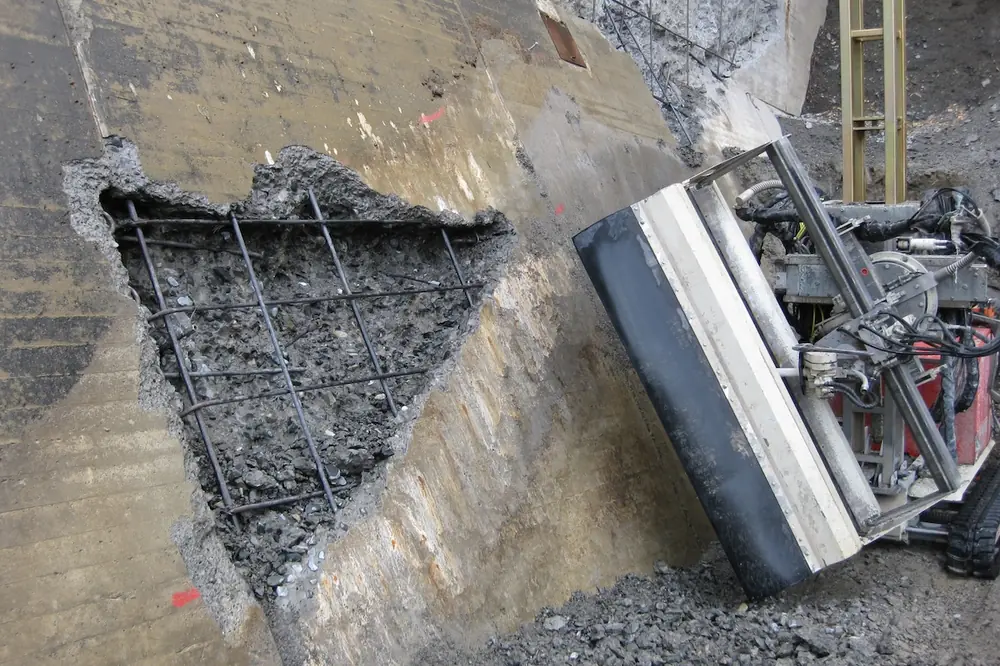

Historically, the conventional method to repair concrete structures was to remove the material with jackhammers. This created a problem, however. Core samples on those projects revealed microcracks in the original portions of the structures. What started as tiny cracks turned into big consequences. Those cracks compromised the quality of the repair, which reduced how long it lasted and ultimately shortened the life of the structure.
Per the European Water Jetting Institute, this caused the Swedish National Road Administration (SNRA) to seek a science-based solution in the early 1980s. The SNRA’s project spawned a new, nondestructive concrete removal method: hydrodemolition.
Hydrodemolition uses a high-pressure water jet to remove layers of concrete, eliminating the impact that causes microfractures. The SNRA’s main goal was to eliminate microcracks — but industry leaders noticed more benefits over time. Mechanically controlling the water jet made for a faster and more precise process. These findings stimulated a new industry that has now preserved concrete structures for more than 35 years.
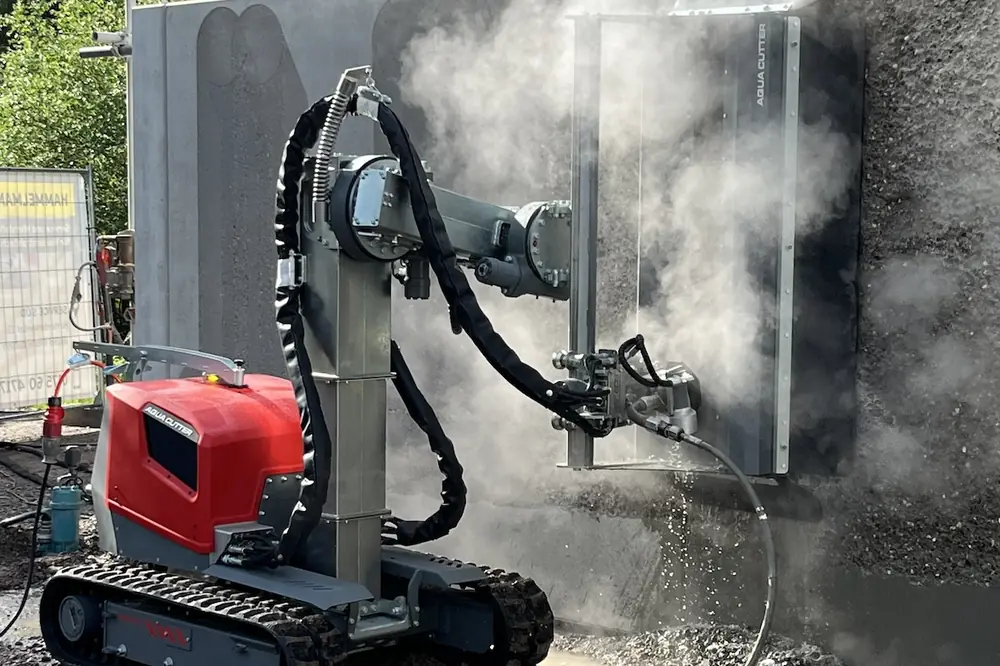
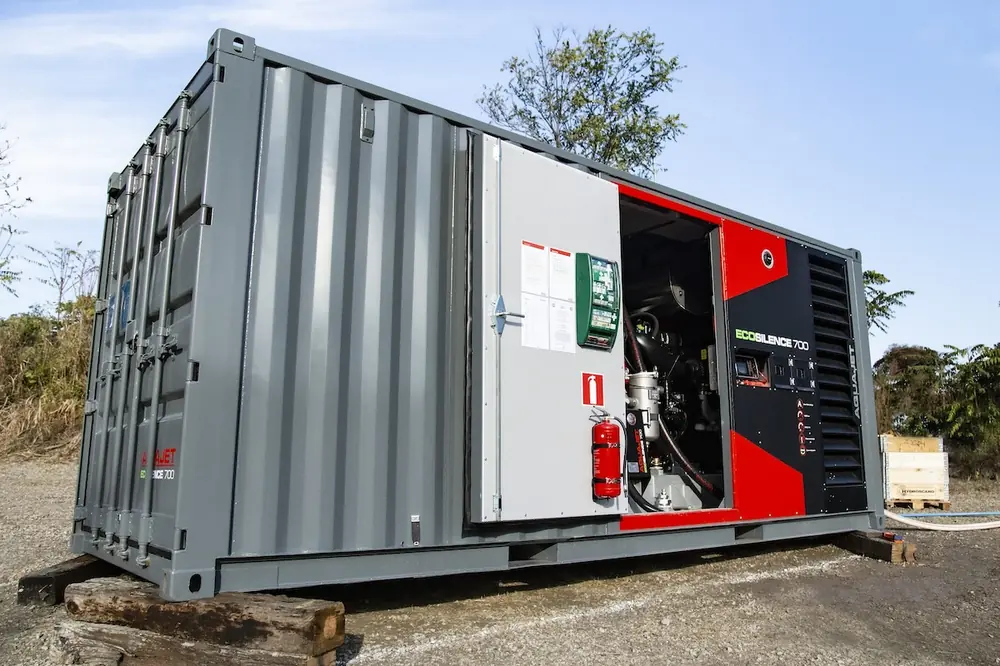
Today, a full hydrodemolition system includes a robot, a high-pressure pump, and a fully automated water treatment plant. The first systems included a semiautomatic robot to control a newly developed water jet and a high-pressure pump, which already existed for other types of water jetting tools.
Pumps have evolved to be more reliable and to offer higher and higher water pressure outputs. When hydrodemolition was in its infancy, for example, 14,000-psi pumps were used. In today’s high-pressure world, 14,000 psi is now the low range for pumps that go as high as 40,000 psi.

| Your local Komatsu America Corp dealer |
|---|
| Continental Equipment Corp (CEC) |
The greater range of pressure allows increased flexibility and precision. Water pressure, along with flow, are primary factors that affect the depth and speed of the removal.
If an asset owner or engineer wants to only remove deteriorated concrete and leave the sound concrete intact, they might choose to operate at 15,000 to 20,000 psi to achieve that selective removal. If the operator is charged with concrete surface preparation, they can make the choice to use 30,000 to 40,000 psi to achieve that goal. Having the choice to use the right pump for the project — whether higher or lower pressure — makes hydrodemolition an even more attractive option for concrete removal and surface preparation.
To make these pressure gains, however, equipment manufacturers had to improve pump design and component durability, which also increased reliability. Today’s most sophisticated pumps are long-running units that enclose the pump system, protecting workers if a hose bursts. The enclosed pumps also protect workers from excessive noise. It’s possible to stand by an enclosed, silent high-pressure pump running at its highest RPM and carry on a conversation in a normal tone of voice.
When hydrodemolition robots were first manufactured, the basic idea was to control the high-pressure water jet to apply consistent energy to the entire concrete surface and control the depth of removal.

| Your local Deere & Co dealer |
|---|
| AIS Construction Equipment |
With increased demand to bring hydrodemolition to more types of projects, manufacturers engineer today’s machines to specialize in a wide range of concrete removal and repair jobs that go beyond the flatwork applications they were initially designed for. Now they are engineered with the capabilities to efficiently perform hydrodemolition overhead, on walls, or below grade on roads, bridges, tunnels, dams, pillars, underwater structures, building interiors, and more.
In hydrodemolition’s early days, most robots were controlled by manual hydraulic valves and basic relays. Machines had a limited number of electronics — they didn’t have computers to perform automated functions. When a problem occurred, the operation needed someone with good mechanical knowledge to troubleshoot the machine.
Over time, manufacturers have gathered customer feedback and conducted research to take hydrodemolition robots from rudimentary machines to incredibly advanced pieces of equipment. Robots are now built with programming logic controllers, sensors, and an operator interface. Their systems feature settings that cut different shapes like circles, triangles, and rhomboids. They can even be programmed to seamlessly cut to different depths in one pass without stopping. The high-pressure lances themselves have been improved with better nozzles and better flow dynamic.
Historically, lances moved in either an oscillating or rotating motion, but in recent years, some manufacturers discovered that combining the two movements to create a figure-eight pattern provides optimal production without making pipe holes. The figure-eight pattern creates a constant speed over the concrete surface that results in greater production and a rough but even finished product, leaving an ideal bonding surface for new concrete. This allows for longer-lasting repairs than what could have been achieved with manual impact tools.

| Your local Trimble Construction Division dealer |
|---|
| SITECH Michigan |
Despite technological advancements, hydrodemolition robots have become much simpler to use, with many more automated functions. Some even let users know when an error occurs to make troubleshooting more streamlined. Hydrodemolition robots are now designed to work reliably for long hours at a time.
Hydrodemolition work can’t be completed without considering water management and how to treat water respectfully while following local regulations. Because hydrodemolition, by its nature, uses water, the industry has engineered solutions to help contractors take a proactive approach to properly handling, treating, and even reusing wastewater.
Early on, before a manufactured solution existed, contractors often went to great lengths to cobble together a system that captured and treated the wastewater. It was time consuming and labor intensive, often requiring chemicals to treat the water, with continuous manual testing. Some hired a third party to collect and treat the water, which increased project costs.
Today’s water treatment systems are compact and fully automated to streamline the process. These systems treat hydrodemolition wastewater for pH and remove suspended solids so contractors can release it into sanitary or storm sewers, or recirculate the treated water through the equipment.
| Your local Komatsu America Corp dealer |
|---|
| Continental Equipment Corp (CEC) |
Recycling the water in this manner greatly reduces the amount of water needed, which is good environmental stewardship and reduces costs. Automatic, continuous monitoring makes it much easier to comply with local regulations and provide documentation that requirements are met.
The hydrodemolition industry has achieved considerable milestones over the past three-plus decades. Through resources like those provided by the International Concrete Repair Institute, overall knowledge has increased. Manufacturers continue enhancing equipment to reduce environmental impact while increasing productivity, safety, and operability. Contractors using hydrodemolition continue to build their expertise.
One elusive milestone remains, however. The goal for stakeholders is to give concrete structures the longest possible lives. After nearly 40 years, hydrodemolition remains the only impact-free mechanical method to remove concrete, which should make it the standard method. That hasn’t happened yet, but optimism remains.
What will that moment look like? Hydrodemolition will become the gold standard when it is routinely specified by engineers and when contractors use it whenever prolonging repair is the ultimate goal.
| Your local Komatsu America Corp dealer |
|---|
| Continental Equipment Corp (CEC) |
Keith Armishaw is the Business Development Manager for Aquajet’s North American subsidiary. He has more than 25 years of industry and leadership experience.