

Nobody’s perfect — and contracts aren't perfect either. One of the problems that we commonly encounter in construction contracts is ambiguity.
We've made the point before that the contracts are really an opportunity to clarify expectations. Done well, they define not just what is required, but how performance will be measured. This can lead to complex contracts, incorporating various standards and referencing technical requirements. Complexity, in many cases, is simply the price we pay for clarity.
Precision is Clarity — Until it Isn’t
Imagine a contract for roadwork. A simple contract might specify “3,000-pound concrete.” Experienced industry professionals understand this shorthand. They know it refers to concrete with a compressive strength of 3,000 psi.
But that phrase alone still leaves room for dispute. A more precise requirement would specify that the concrete would have a compressive strength of at least 3,000 psi as measured by the 28-day cylinder break performed in accordance with ASTM testing standards. Further precision could then be achieved by calling out additional requirements, like slump tests. Those technical references and specifications do more than prescribe an end result; they define the method of verification. That is real clarity.

| Your local Hitachi dealer |
|---|
| ASCO Equipment |
When Specifications Collide
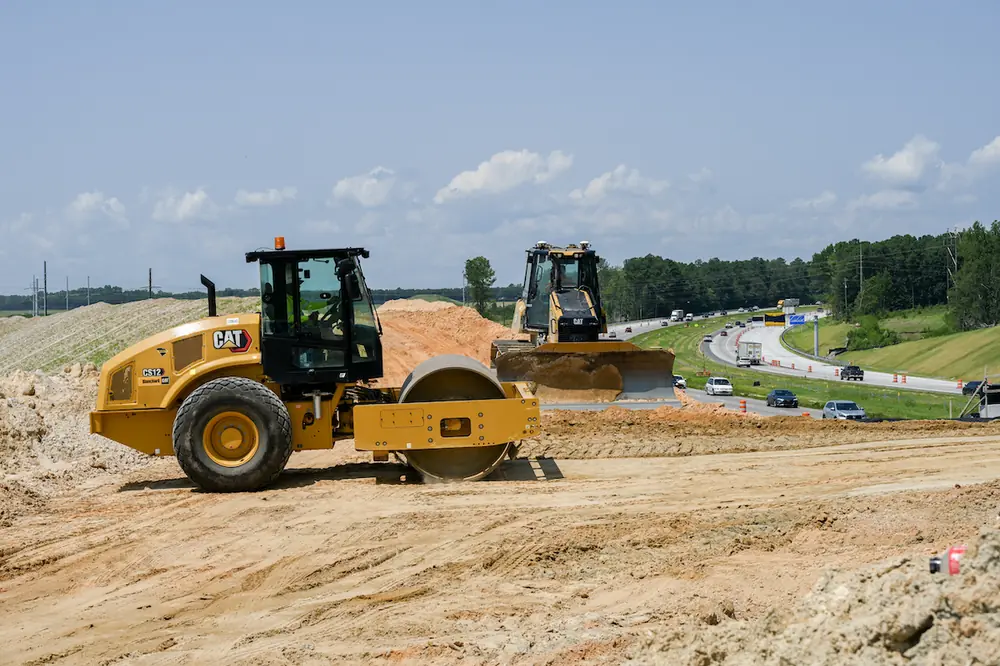
But layering references and technical requirements to contracts can also create problems. Consider the following example. There is a landfill contract that requires compaction of the soil immediately below the HDPE liner. But the various documents incorporated into the contract offer conflicting compaction standards. One says 95 percent standard compaction, another 90 percent standard compaction, another 90 percent modified compaction.
Not only were the specifications internally inconsistent, but none of them directly addressed the true objective — limiting permeability. From an engineering perspective, permeability would have been a more appropriate performance metric than compaction percentage.
It doesn’t take much imagination to see how such inconsistencies could spiral into disputes between the owner, contractor, and engineer of record — and eventually into protracted litigation.

| Your local Wirtgen America dealer |
|---|
| Nueces Power Equipment |
| Kirby-Smith Machinery |
Ambiguity is not Limited to Technical Specs
Ambiguities could also arise in seemingly straightforward scope descriptions. Consider, for instance, a lawsuit that arose on a Montana project over the extent of the utility subcontractor’s scope of work. The general contractor argued that the subcontractor was to ensure its work was “in every respect complete and ready for immediate and continued use.” The trial court agreed with the general contractor, but the Montana Supreme Court reversed, pointing to two notes on drawings. One said that the utility work terminated at a point 5 feet outside the building line, where it would be capped or plugged. The other said that the plumber would run its lines under the building and 5 feet outside the building line to connect to the utility lines.
The 5-foot convention is familiar to anyone experienced in utility construction. But how many trial court judges have ever been in the trenches (figuratively and literally)? That judge is instead trained, after countless years behind a law firm desk and then at the bench, to read black and white contract language. Imagine having your contract performance questioned and having to go to the state supreme court, after years of litigation, to justify adherence to a common industry practice. This is why we stress clarity and contract requirements.
Boilerplate Versus Bidding Assumptions

| Your local Yanmar dealer |
|---|
| CLM Equipment Co |
| WPI |
A similar result occurred in the Dallas-Fort Worth area several years ago. The technical terms of the sitework contract specified that there was suitable fill available in a certain area for use in bringing another area of the site up to the proper elevation. And if the contractor ran out of fill from that area, it would find suitable fill in a second designated area.
You can't blame the site contractor for thinking that they should bid the job as a balanced project. But later, when the two designated soil areas did not provide sufficient capable fill, the contractor’s claim for the costs of importing suitable fill were denied, based on boilerplate language in the general conditions stating that the contractor had inspected the site and had accepted it as being suitable for completion of the work or its designated purpose.
The case went to federal court, and the final word came from the United States Court of Appeals for the 5th Circuit, which rejected the site contractor’s claim based on the boilerplate site acceptance language.
What the Law Calls ‘Ambiguity’

| Your local Bobcat dealer |
|---|
| Central Texas Equipment |
| Nueces Power Equipment |
The law refers to contract terms like these as “ambiguous.” Law students learn various guidelines for resolving such ambiguities. But the first rule for all of us to follow doesn’t require a law degree — seek to avoid ambiguity altogether.
The prescription is simple, if not easy. Contractors and subcontractors need to understand not only the technical specifications that govern the work but the boilerplate in the construction contract, general conditions, and special conditions. Ambiguities caught before bidding can be addressed in pre-bid meetings and/or addenda, thereby avoiding expensive lessons in resolving contractual ambiguities.
Contracts Have Multiple Audiences
These cases also illustrate the point that contracts can have different audiences.

| Your local Gradall Industries dealer |
|---|
| Kirby-Smith Machinery |
| WPI |
Contractors or subcontractors use them for pricing and then managing expectations. Lawyers may know the original intent of the language but are trained to advocate aggressively for their clients by leveraging the words on the page. Judges and juries, meanwhile, might find themselves puzzling over seemingly massive documents using unfamiliar language in an unfamiliar industry.
Interpreting Ambiguous Contracts
If a contractor is forced to argue about ambiguous terms, it can employ some of the lessons learned by lawyers in law school. The first rule of contract interpretation is typically attempting to determine the intent of the parties. This would have been a useful discussion in the landfill case above, although the owner was not interested in discussion in that case.
Courts often say that the contract is interpreted as a whole. Judges declined to resolve a case based on one cherry-picked provision. When and if courts find terms that appear to conflict, they will try to reconcile those terms, attempting to harmonize them rather than choose one and reject the other. The Montana Supreme Court in the utility subcontract dispute said that it was reading the contract terms “together.”

| Your local Magni dealer |
|---|
| Kirby-Smith Machinery |
You may have heard other “rules” of interpreting ambiguous contracts. Here are some of the guidelines that might be employed in court or arbitration:
• Words are given their plain meaning
• Terms that are special industry terms may be given the meaning that they have in the industry
• If the parties have shown one understanding as to contract meaning throughout their work on the project, that “course of performance” may be introduced to suggest that the parties interpreted the contact in a certain way
• If the parties have worked together with that language on past projects, then their “course of dealing” might be introduced to show that their past conduct suggests a certain shared meaning
• If the ambiguity cannot be harmonized, it might be construed against the drafter, with the theory that the drafter had the best opportunity to avoid the confusion
We don’t dwell on these “rules” because they’re really not rules but just guidelines. And lawyers often select and advance the guidelines that suit the specific demands of their current case.
We weren’t in trial with the site contractor in the Dallas-Fort Worth case, but we imagine that they argued that specific language governed over general language. In other words, language promising the quality and quantity of available select fill was specific enough to govern over a boilerplate site acceptance. Or that the contract could be harmonized with the site being acceptable, provided that the plans were correct about the provenance of the available select fill. But those rules of interpretation didn’t prevail.

| Your local NPK Construction Equipment Inc dealer |
|---|
| WPI |
Planning for What Goes Awry
So contracts aren’t perfect, but neither are our expectations. More than two centuries ago, Robert Burns observed that “the best-laid plans of mice and men often go awry.” Construction professionals encounter that truth daily — sometimes because a site is not actually balanced, sometimes because a contract wasn’t either.
The lesson is clear: protect yourself against things going awry by scrutinizing all contract language — technical specifications and boilerplate alike — before work begins. Improving imperfect terms on the front end is almost always cheaper than litigating them on the back end.