
For construction business owners considering a sale, earnouts are becoming an increasingly popular pricing structure that ties a portion of the purchase price to the company’s performance after closing. This can help bridge valuation gaps and reward future performance but can also create post-closing disputes.
Understanding how an earnout is structured, measured, and protected can help sellers evaluate whether it makes sense for their deal and protect both the purchase price and the business they built.
Before the COVID-19 pandemic, earnouts were more the exception than the norm. That began to change when the pandemic made historical financials less reliable as a predictor of future performance. Earnouts appeared in 24 percent of private-target acquisitions in 2025, up from 22 percent in 2024 and above the 2014-2022 historical average of roughly 17 percent, according to two 2026 SRS Acquiom studies.
Buyers reviewing 2020 and 2021 results had to decide whether weaker performance was a temporary disruption or the start of a longer-term trend. Sellers, meanwhile, could argue those years should not define the company’s value.
Construction companies faced even greater uncertainty as supply chain disruptions drove up the cost of lumber, equipment, and other materials, making future profitability harder to predict.

| Your local Topcon Positioning Systems Inc dealer |
|---|
| Linder Industrial Machinery |
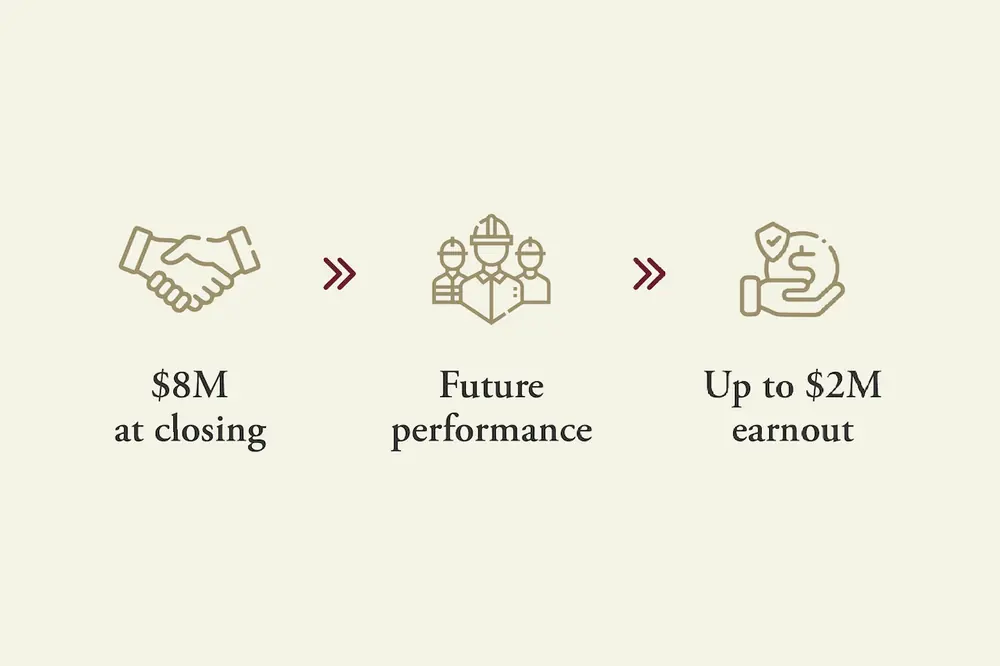
Earnouts offered a way to bridge that gap. A seller may value a company at $10 million while a buyer is only comfortable paying $8 million at closing. The remaining $2 million can be tied to future financial targets, sometimes with additional upside if the company exceeds them.
Although pandemic-era disruptions have eased, construction costs remain above pre-pandemic levels, helping earnouts remain a useful tool for managing acquisition risk.
An earnout is not automatically a good or bad deal. Much depends on what the seller wants from the transaction and how confident they are in what happens next.
An earnout may make sense when:
- The market does not support the seller's valuation: If potential buyers consistently value the company below what the owner believes it is worth, an earnout gives the seller an opportunity to prove that value through future results.
- The seller expects the company to continue performing strongly: Instead of accepting a lower price, an owner confident in the company's trajectory may be willing to put part of the purchase price at risk.
- Both parties want the deal: A buyer unwilling to assume all the performance risk upfront can still make a competitive offer while giving the seller a path toward the desired price.

| Your local Bomag Americas dealer |
|---|
| Linder Industrial Machinery |
An earnout may be less attractive when:
- The owner wants a clean exit: A seller who plans to retire or completely step away after closing may have little visibility into the decisions affecting future performance, making a contingent payout harder to control.
- Certainty matters more than potential upside: Some owners may prefer accepting less money at closing rather than relying on payments tied to results several years into the future.
However, even a well-intentioned earnout can create problems if sellers overlook several key risks.
How a deal is structured and carried out influences it value. Be sure to address these risks:
Failing to Clearly Define the Financial Target
Earnouts are often tied to earnings before interest, taxes, depreciation, and amortization (EBITDA). But a target alone is not enough.

| Your local Iowa Mold Tooling Co Inc dealer |
|---|
| Nichols Fleet Equipment |
The agreement should establish how EBITDA will be calculated and keep that methodology consistent with how the company historically measured its performance. Otherwise, a buyer could allocate additional overhead, defer revenue, adjust expenses, change salaries, or make other decisions that affect EBITDA.
Even a shift in accounting practices can skew the comparison. For example, if a smaller seller historically did not prepare its financials according to generally accepted accounting principles (GAAP) but the larger buyer does, applying the buyer's methodology to the earnout could change how performance is measured.
Giving the Buyer Too Much Influence Over the Outcome
If the acquired construction company is absorbed into a larger organization, sellers should make sure the business remains distinct enough to track the performance tied to the earnout. Otherwise, expenses, resources, and other financial activity can become difficult to separate from the buyer’s broader operations.
The agreement can also establish an annual budget for the acquired business unit and give sellers whose compensation depends on the earnout a role in that process. It should also address how the buyer may operate the business during the earnout period so post-closing decisions do not undermine the seller’s ability to achieve the agreed-upon payout.

| Your local Trimble Construction Division dealer |
|---|
| SITECH Mid-South |
| SITECH Tri-Rivers |
Underestimating Accounting Complexities
Construction companies have an added challenge because revenue and expenses can be recognized and allocated differently across long-term projects. Milestone payments and retainage can further complicate the picture.
That creates room for legitimate disagreements over whether a target was met. The purchase agreement should require the buyer to provide the earnout calculation and establish a dispute mechanism if the parties disagree.
An independent accountant or expert can resolve those disputes, but industry knowledge matters. Someone unfamiliar with construction accounting may not understand the nuances behind project payments, retainage, revenue recognition, and expense allocation.
Assuming the Buyer Will Own the Business Throughout the Earnout
A three-year earnout does little good if the buyer sells the company after the first year and the agreement never addressed what happens next. Sellers can negotiate acceleration provisions that make some or all of the remaining earnout due if the business changes hands before the period ends.

| Your local Wirtgen America dealer |
|---|
| Beard Equipment Co - AL |
| Tractor & Equipment |
There is also the risk that the buyer encounters financial trouble. Future payments inherently carry uncertainty, making the balance between money at closing and potential money later an important part of the negotiation.
Construction owners considering an earnout should negotiate beyond the number with an experienced legal and financial team.
The goal of the negotiations is to establish reasonable guardrails around the business, its financials, and the buyer's decisions so the opportunity to earn the remaining purchase price survives the sale itself.
Anthony Casarona is a Partner and Corporate Attorney at Rusing Lopez Lizardi & Saffer, PLLC.