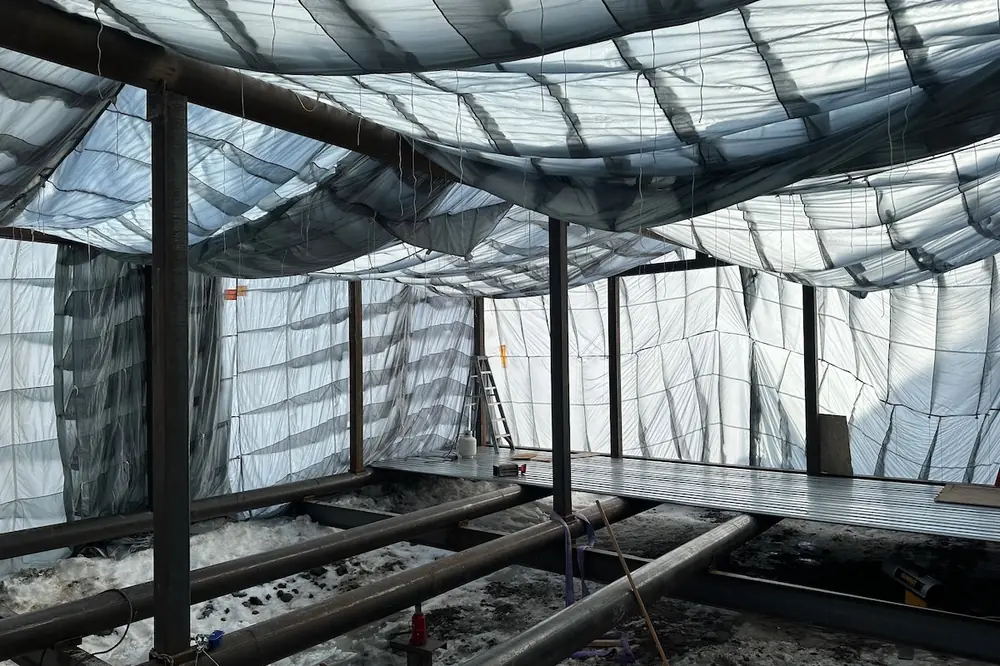
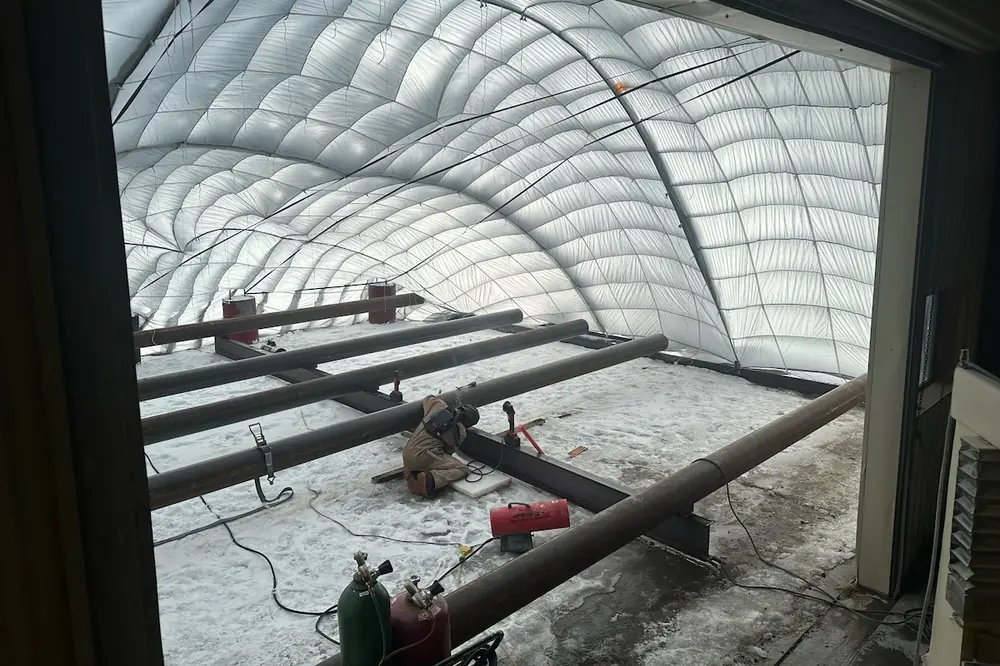
On a remote job site in Wyoming, welders faced a brutal problem.
Temperatures had dropped to nearly 20 degrees below zero, and the crew could no longer keep their tools — or their hands — warm enough to continue welding outdoors. Traditional temporary shelters would have taken time they didn’t have, and the strong winds made standard tarps nearly useless.
Instead of shutting down the project, the crew turned to something unexpected.
They gathered several retired military cargo parachutes, stitched them together, reinforced the seams with heavy webbing, and anchored the structure to concrete-filled drums. When portable heaters were placed inside, the warm air caused the massive canopy to lift and expand like a hot air balloon.
Within hours, the temperature inside the improvised dome rose from subzero conditions to nearly 50 degrees. What had once been surplus parachutes — equipment that had already served its original purpose — became the solution that allowed the crew to continue welding and fabrication work in the middle of a Wyoming winter.

| Your local Metso Minerals Industries Inc dealer |
|---|
| PacWest Machinery |
| Westate Machinery Co |
Stories like this are becoming increasingly common across the construction industry.
In another case, a semi-truckload of 2-inch-thick, Level 8 ballistic glass panels arrived with nowhere to go. The massive 42-inch by 10-foot sheets had originally been manufactured for installation at the California State Capitol complex in Sacramento. After production, however, the panels were discovered to have been built to the wrong specification and were rejected before they could ever be installed.
Material that specialized and expensive would typically face a bleak fate — storage, disposal, or eventually the landfill. Instead, the panels found a second life.
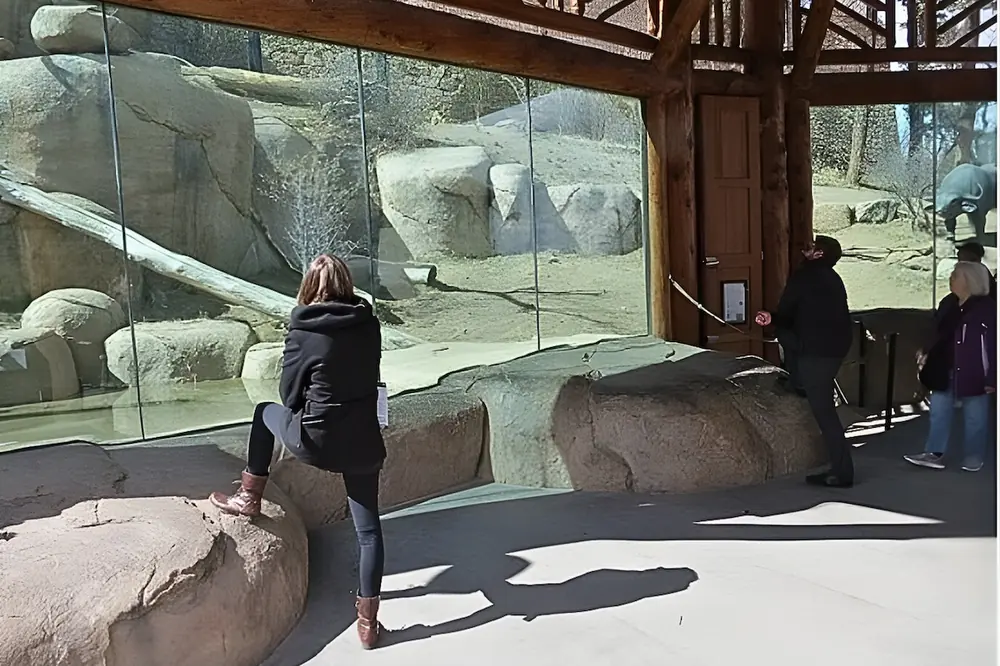
Twenty-four of the giant, bullet-resistant glass panels were rehomed with a zoo in Texas that is beginning construction on a new lion exhibit scheduled to open in 2026. While the 2-inch-thick glass is technically over-engineered for the enclosure, it provided the zoo with an exceptionally durable viewing barrier at a far more affordable cost. Visitors will safely observe the lions through glass originally designed to protect government buildings, and thousands of pounds of advanced material will stay out of the landfill in the process.

| Your local Gomaco dealer |
|---|
| Gomaco -Contact For a Dealer Near You |
These stories highlight a growing shift happening quietly across the construction industry. Some of the most effective solutions on modern job sites aren’t brand-new materials at all. Instead, they are materials that once served a completely different purpose.
Contractors are finding practical ways to repurpose surplus and retired industrial materials, giving them a second life in applications ranging from erosion control to access roads to temporary structures. In many cases, these solutions are not only more affordable than buying new materials, but also more durable and environmentally responsible.
For crews accustomed to solving problems on the fly, repurposed materials are proving to be a natural fit.
When sustainability is discussed in construction, recycling often receives the most attention. Recycling certainly plays an important role, but it typically requires energy-intensive processing. Materials must often be shredded, melted, or chemically treated before they can be turned into something usable again.

| Your local Trimble Construction Division dealer |
|---|
| SITECH Northwest |
Repurposing takes a different approach.
Rather than breaking materials down into raw components, repurposing involves using an existing product in a completely new application, often with little to no processing required. A material originally designed for one industry may perform exceptionally well in another simply because of how it was engineered.
This approach keeps usable materials out of landfills while also providing contractors access to heavy-duty materials at a fraction of the cost of new alternatives.
In recent years, a small but growing network of companies has begun specializing in this type of material recovery. Businesses like repurposedMATERIALS work with manufacturers, contractors, and industrial facilities to intercept surplus, obsolete, or mismanufactured materials before they are discarded, helping redirect those materials into new construction and infrastructure uses.

| Your local Superior dealer |
|---|
| Westate Machinery Co |
In many cases, contractors benefit not only from the durability of industrial-grade materials, but also from significantly reduced pricing compared to purchasing new products — an advantage that can help ease the pressure of tight project budgets.
One material that has found a surprising number of uses on construction sites is industrial conveyor belting originally used in mining and aggregate operations. Conveyor belting is engineered to withstand extreme abrasion, heavy loads, and constant friction — conditions that translate remarkably well to construction environments.
Contractors have used repurposed belting as temporary ground protection for equipment traveling across soft soil, as traction control in muddy conditions, and as erosion control along slopes or drainage areas. Others install it as protective liners inside dump trucks or material chutes where constant wear can damage standard materials.
Because conveyor belting is thick and reinforced with layers of fabric or steel cord, it can handle repeated traffic from heavy equipment far better than many products designed specifically for temporary ground protection. It can be easily cut to size and repositioned as site conditions change.
| Your local Metso Minerals Industries Inc dealer |
|---|
| PacWest Machinery |
| Westate Machinery Co |
In areas where mud, rain, or unstable soil threaten productivity, a roll of repurposed belting can quickly turn a problem area into a workable surface.
Another material appearing more frequently on job sites is industrial steel grating. Originally manufactured for platforms, walkways, and drainage systems in industrial facilities, steel grating is designed to support significant weight while allowing water and debris to pass through its openings. That combination makes it particularly useful in construction environments where drainage and stability are constant concerns.
Contractors often place grating over muddy areas to create temporary walkways or use it to bridge trenches so crews and materials can move safely across the site. In other cases, it serves as ground protection that allows rainwater to drain naturally rather than pooling on the surface.
Because the material is typically galvanized or corrosion resistant, it performs well outdoors and can be reused across multiple projects.
| Your local Metso Minerals Industries Inc dealer |
|---|
| PacWest Machinery |
| Westate Machinery Co |
Repurposed materials are appearing in a wide range of construction applications beyond those typically expected. Materials originally manufactured for different uses are proving remarkably adaptable once contractors begin viewing them through a different lens.
Steel highway guardrail, for example, has found new life as temporary barriers, site fencing, and protective structures along staging areas and haul roads. Large-diameter PVC or HDPE pipe originally produced for industrial use is frequently reused for culverts, drainage channels, or temporary water diversion during site development.
Even structural steel beams, steel pipe, and retired steel cable are being incorporated into projects as temporary supports, bracing systems, and heavy-duty tie-downs during different phases of construction.
While these applications may initially seem unconventional, many contractors recognize the advantages. Industrial materials are often engineered to meet extremely demanding specifications, which means they frequently outperform lighter-duty products designed specifically for construction.
| Your local Metso Minerals Industries Inc dealer |
|---|
| PacWest Machinery |
| Westate Machinery Co |
For contractors managing tight budgets and fluctuating material prices, repurposed materials can offer meaningful financial advantages.
Because these materials are typically surplus, obsolete, or retired from their original industries, they often are available at a fraction of the cost of newly manufactured products. In many cases, contractors report savings of 50 to 80 percent compared to buying new materials.
On large projects where ground protection, erosion control, or temporary infrastructure may require significant quantities of material, those savings can quickly add up.
Construction has always been an industry defined by practicality and problem solving. Crews routinely adapt materials, tools, and techniques to keep projects moving forward despite unpredictable challenges.
| Your local Metso Minerals Industries Inc dealer |
|---|
| PacWest Machinery |
| Westate Machinery Co |
Repurposing industrial materials is simply an extension of that mindset.
By giving surplus materials a second life, contractors are reducing waste, lowering project costs, and finding creative ways to solve job site challenges. In an industry where ingenuity often determines success, the next great job site solution may not need to be manufactured at all.
It may already exist — simply waiting for someone to see its potential.
Shawna Riechers is Marketing Supervisor at repurposedMATERIALS.